Five bullish factors—El Niño, B50, a wide BOPO spread, Brent and trend—keep the upside in charge, but front-loaded MPOB inventory fears and weak soyoil temper the near-term tape.
Palm Oil Steadies Near $1,153 as Bullish Supply Risks Joust with August Stock Build — continued
Where the price sits
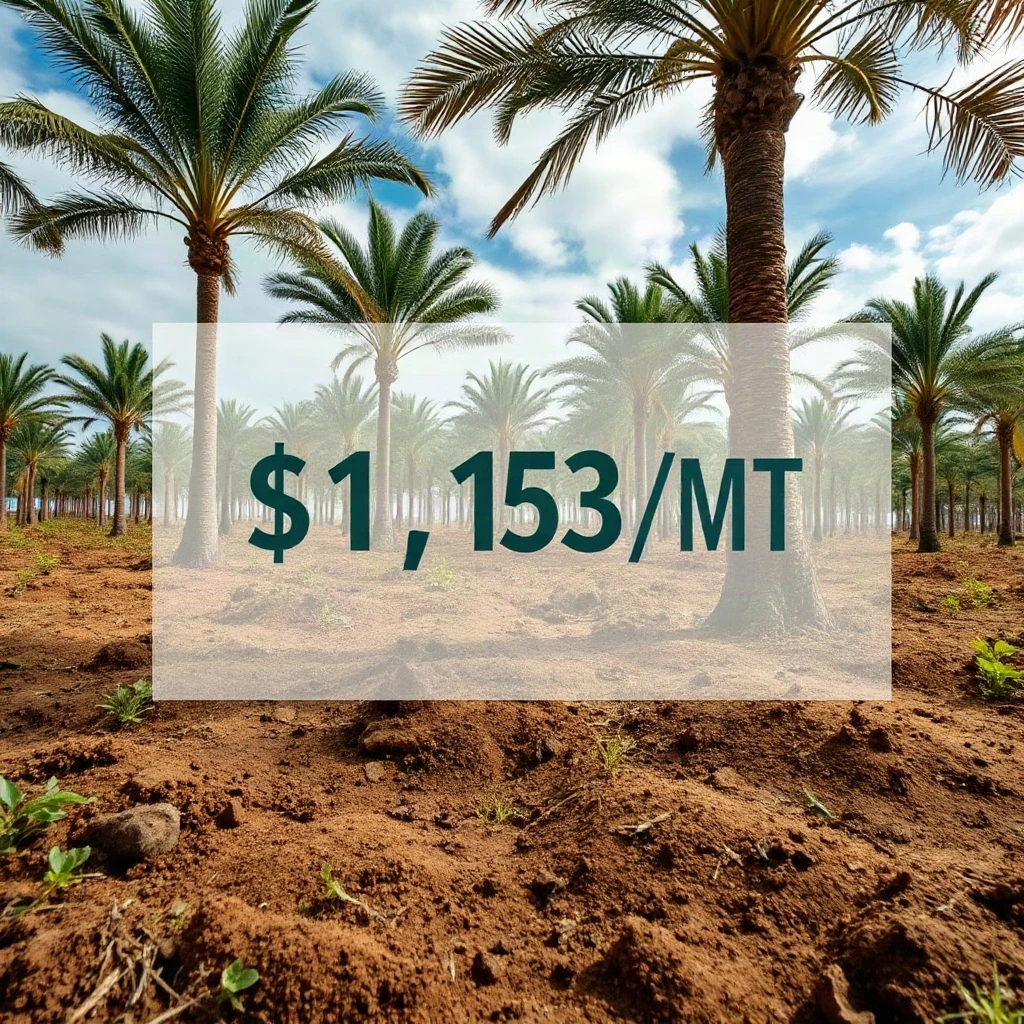
Malaysian CPO benchmark is trading around $1,153/MT, up 0.1% from the previous session (RM 4,663/MT at USD/MYR 4.04). The World Bank benchmark is about $1,117/MT and Indonesia's Kemendag reference is about $1,008/MT. Brent crude is around $96/bbl, near flat on the day but up 7.3% over seven days. The market is holding near the $1,153 level while positioning ahead of the next Malaysian Palm Oil Board report.
The bullish case
The most immediate demand support is the BOPO spread: soybean oil at $1,527/MT versus CPO at $1,153/MT puts the spread at $374/MT, near recent highs. That makes palm oil unusually cheap relative to soybean oil, encouraging food and biodiesel buyers to switch into palm and pull on Malaysian and Indonesian supplies.
On supply, the strong El Niño is the dominant medium-term story. The ONI is +1.8°C for JJA 2026, well into strong El Niño territory, and Sarawak and Kalimantan are already dry. Palm yields react with a six-to-twelve-month lag, so the market is pricing the risk of lower 2027 production now rather than waiting for the damage to appear in the data.
Indonesia's B50 mandate adds another supply-side pull. Full B50 implementation is targeted for 1 October 2026, with distribution already at 80% and covering 90% of Pertamina stations. Each additional tonne consumed in domestic biodiesel is a tonne less available for export, tightening regional supply and supporting Malaysian CPO.
Brent at $96/bbl also helps. The POGO spread is -$328/MT, meaning palm oil is cheaper than gasoil on an energy basis; discretionary biodiesel blending is economic, which supports demand for palm as a feedstock. Technically, the chart remains in an uptrend: a golden cross is in place, MACD is positive, RSI is 66, and price is above the 5-, 20- and 50-day simple moving averages.
The bearish case
The clearest near-term pressure is the upcoming MPOB August report. Headlines on 3–4 September pointed to August inventories hitting a seven-month high, and the July stocks-to-use ratio was already an ample 12.5%. July CPO production was 1,792,979 t (+9.4% month-on-month) and closing stocks were 1,429,316 t (+7.2% month-on-month). The release is about seven days away; if it confirms a large stock build, it would signal that Malaysian supply is running ahead of demand and weigh on spot CPO.
September seasonality adds to that pressure. Historically September averages -0.9% month-over-month, and production is in its seasonal peak from July through October; the seasonal stock path implies a further +6.7% increase next month. That is a mechanical drag on price as more oil comes to market.
Speculative positioning is another vulnerability. CFTC soybean oil managed money net longs are +109,912 contracts, in the 85th percentile. A crowded long is exposed to liquidation if soybean oil breaks lower, and that is exactly the risk highlighted by the 2026-09-03 decline in CBOT soy oil. Weakness in soy oil spills over into palm even when the BOPO spread remains wide, because the two oils trade as a complex.
The balance and what could flip it
On our model's factor balance, the bullish drivers currently outnumber the bearish ones by five to four, so the upside has the upper hand. That does not guarantee an immediate rally: our model outlook is mixed-to-soft in the very near term as the market braces for the MPOB stock build, with a base case of modest negative drift before a post-report relief bounce. The bullish factors are more medium-term in nature, while the bearish factors are front-loaded into the next week or so. Our published path is +0.5% over 7 sessions, consistent with a contained drift and a subsequent bounce.
To flip the balance to bearish, the market would need the MPOB August stocks to come in well above the seven-month high, a cascade of soyoil long liquidation, or a delay or dilution of Indonesia's B50 rollout. To extend the bullish case, the market would need a smaller-than-expected stock build, fresh cargo-surveyor data showing strong exports, or further El Niño intensification. The Indonesian export policy is the swing factor: the Kemendag reference price rose 1.1% to $1,008/MT but the September export duty was held at $148/MT, and GAPKI has warned against raising export levies. A levy change in either direction could shift export supply quickly, but there is no immediate change priced in today.
Benchmark Malaysian palm oil edges up 0.1% to $1,153/MT, but mixed signals from August MPOB stock expectations, Indonesia’s B50 rollout and El Niño keep the near-term bias soft.
Market snapshot
Malaysian CPO benchmark was little changed at about $1,153/MT, up 0.1% from the previous session and equivalent to around RM4,663/MT. The World Bank global benchmark sat lower near $1,117/MT, while Indonesia’s September reference price was roughly $1,008/MT. Brent crude held near $96/bbl, keeping biodiesel blend economics supported. The ringgit was around 4.04 per dollar.
Supply and demand
The latest MPOB July data show production rose 9.4% month-on-month to 1,792,979 tonnes, while closing stocks climbed 7.2% to 1,429,316 tonnes and exports jumped 14.5% to 1,392,178 tonnes. The stocks-to-use ratio reached 12.5%, and the July FFB reference price rose 1.2% to RM49.50 per tonne. Ahead of the August report, the market is bracing for a seven-month high inventory build, with weak soybean oil adding pressure.
Weather and policy
Weather remains a live supply risk. The ONI is at +1.8, indicating El Niño, and key growing areas in Sarawak and Kalimantan are dry. GAPKI has warned that Indonesia’s 2027 palm oil output could drop 2.9%, and the industry is urging faster replanting. Those dryness concerns are one reason traders are not aggressively selling despite the stock build.
Policy news is mixed. Indonesia’s full B50 biodiesel mandate is targeted for 1 October 2026, with national distribution already reaching 80% and covering 90% of Pertamina stations. The September CPO export levy remains at US$148/MT. GAPKI is also cautioning against raising CPO export levies, saying it could pressure farmer FFB prices. New export governance rules under PP 24/2026 and calls from Indonesia’s DPR for a single-door export system add to the regulatory watchlist.
Model outlook
Our model outlook sees near-term bias as mixed-to-soft. The base case is for a modest negative drift before a post-report relief bounce, with a published path of +0.5% over seven sessions. Supporting downside is the expected August stock build, September seasonality and weak soybean oil; supporting prices are wide BOPO spread, El Niño risk, full B50 implementation on 1 October and firm Brent.
For buyers
For buyers, the near-term risks are two-sided: watch the August MPOB release for confirmation of the stock build, and track Indonesian export policy and B50 logistics. Dry weather in Sarawak and Kalimantan could tighten forward supply, but for now weak soybean oil and high visible stocks warrant close monitoring.
CPO holds near $1,153/MT; Malaysia stocks seen at seven-month high, but Gapki's 2027 output warning, B50 and crude support floor.
Malaysian crude palm oil futures settled little changed at about $1,153/MT (RM 4,663), up 0.1% on the session, as the market balanced pre-report caution against supportive energy and weather fundamentals. The global World Bank benchmark stood near $1,117/MT, while Indonesia's September reference price was set at about $1,008/MT, keeping export levies unchanged at $148/MT.
Supply: Stocks rising, output outlook tightening
The market is bracing for the Malaysian Palm Oil Board's August report, widely expected to show inventories at a seven-month high. July data already pointed to a build: closing stocks rose 7.2% month-on-month to 1,429,316 t, while production increased 9.4% to 1,792,979 t. Exports were firmer, up 14.5% to 1,392,178 t, though imports fell sharply by 51.9% to 49,566 t.
Seasonally, September typically brings further output gains, which could weigh on prices in the near term. Yet the supply outlook beyond this year is less comforting. El Niño conditions remain firmly in place (ONI +1.8), with dry weather reported in Sarawak and Kalimantan. Industry association Gapki has now forecast that Indonesia's 2027 palm oil output could drop by 2.9%, citing El Niño risks and urging accelerated replanting of aging trees. This adds weight to the existing narrative of tighter supply ahead, supporting the price floor. Our model outlook sees near-term bias as mixed-to-soft, with a base case of modest negative drift before a possible post-report relief bounce.
Demand: Biodiesel and energy underpin
Energy markets are providing a solid floor. Brent crude held near $96/bbl, flat on the session, which improves the economics of palm-based biodiesel. Indonesia is pushing ahead with full B50 implementation targeted for October 1, with national distribution reportedly above 80% and coverage at 90% of Pertamina stations. Beyond that, preparations for a B60 mandate in 2027 are already being discussed, although industry groups caution that feedstock supply flexibility will be a key challenge.
Soybean oil has been a drag, with weakness in that market pressuring palm values recently. However, a fresh rally in US soybean oil and rising crude have lent support. The wide BOPO spread and firm crude keep palm's energy-linked demand attractive.
Policy and trade flows
Indonesia's new export governance rules (PP 24/2026) are drawing attention, with producers urging that export levies not be raised to avoid pressuring fresh fruit bunch prices. Lawmakers have also pushed for a single-gate export system that prioritizes domestic industry needs over foreign-exchange earnings. Separately, Malaysia's MPOB has launched its PALMS 2030 agenda, focusing on digitalization and expanding global market reach.
The ringgit slipped to about 4.04 per dollar, providing some local-currency support for exporters, while the rupiah traded near 17,636 per dollar.
Takeaway for buyers
Watch the August MPOB report for confirmation of the stock build, but weigh it against the tightening 2027 supply narrative driven by El Niño, slower replanting, and now Gapki's explicit 2.9% output cut forecast. The October 1 B50 start and crude oil direction will likely set the near-term price tone more than the monthly inventory print.
Recent coverage shows national B50 distribution at 80% and 90% of Pertamina stations, while GAPKI flags feedstock supply challenges.
Indonesia’s move to B50 biodiesel has moved from announcement to active rollout. Recent reports indicate the blend is now officially applied, with national distribution reaching 80 percent and coverage extending to around 90 percent of Pertamina fuel stations. A full implementation target is set for the beginning of October 2026. These milestones matter because biodiesel blending in Indonesia is almost entirely palm-based, so each percentage point of blend directly affects how much palm oil stays in the domestic energy system rather than entering export markets.
Supply implications
Palm oil is the primary feedstock for Indonesia’s biodiesel mandate. A rising blend rate increases the volume of crude palm oil absorbed by the energy sector. GAPKI, the national palm oil producers’ association, has called for flexibility around the B50 mandatory program, pointing to palm oil supply as a challenge for the 2027 horizon. That warning suggests the domestic market may face tighter feedstock availability as the blend scales up. For buyers in food, oleochemical and specialty fat segments, more palm oil being reserved for biodiesel can reduce the exportable surplus and make feedstock procurement more competitive.
Demand and market balance
The expansion to B50 shifts demand from the export market to domestic energy use. When distribution reaches a wide share of retail fuel outlets, the effective consumption of palm-based biodiesel becomes more predictable and harder to reverse quickly. This creates a structural demand floor for palm oil within Indonesia. Compliance-minded buyers may see less spot availability of certain grades, longer lead times, or firmer domestic prices as the blending requirement absorbs more supply. The reports of 80 percent distribution and 90 percent Pertamina station coverage suggest the rollout is well underway, which can reduce uncertainty about whether the mandate will be enforced, but it also locks in significant feedstock demand.
What to watch
For companies buying palm oil or palm derivatives, several policy signals are worth monitoring. The targeted full implementation date of 1 October 2026 will show whether the government maintains the schedule or adjusts for supply constraints. GAPKI’s call for flexibility for a 2027 mandate may indicate ongoing discussions about blend rates, export levies, or feedstock availability. Buyers should also track whether distribution gains continue beyond 80 percent and whether any adjustments are made to domestic market obligations or export policies. A key question is whether non-energy palm users will face increased competition for certified or traceable supply, as the biodiesel sector typically draws on large volumes of crude palm oil.
Overall, Indonesia’s B50 policy is reshaping the palm oil demand picture. The policy desk notes that the blend is no longer a distant proposal; it is being distributed across the fuel network. With supply flexibility flagged by producers and full implementation approaching, the main watch items are feedstock availability, exportable surplus, and any policy fine-tuning.
Full B50 implementation targets Oct 1; GAPKI flags feedstock flexibility needs ahead of B60 work
Indonesian biodiesel policy is entering a critical phase as the full B50 mandate is slated to take effect on Oct. 1, with national distribution already reported at 80 percent. Industry association GAPKI has stressed the need for flexibility in the 2027 B50 mandate, pointing to palm oil supply as a key constraint as the country simultaneously steps up preparations for a B60 blend in 2027.
Supply-demand tension
The push toward higher blend rates comes at a time when feedstock availability is under scrutiny. GAPKI's call for flexibility suggests that even the current B50 path may strain domestic supply chains, particularly if production growth lags the pace of fuel demand. A B60 mandate would raise the bar further, requiring either a significant increase in crude palm oil output or a reallocation of exports toward domestic consumption.
For compliance-minded buyers, the implication is straightforward: more Indonesian palm oil diverted into biodiesel means less available for the export market. This dynamic is already visible in the reference price gap, with Indonesia's official palm oil reference at about $1008 per metric ton versus a global benchmark near $1117 and the Malaysian CPO contract around $1153.
Market context
These policy signals land against a mixed fundamental backdrop. Malaysian July data showed production up 9.4 percent month on month at 1.79 million tons, with stocks climbing 7.2 percent to 1.43 million tons. Exports rose a stronger 14.5 percent to 1.39 million tons, but imports fell sharply. The market is now bracing for an August MPOB report expected to show a seven-month high in stock builds.
Our model outlook sees near-term bias as mixed-to-soft, with September seasonality and weak soybean oil adding pressure. Yet the wide BOPO spread, persistent El Niño concerns, and rising Brent crude at about $96 per barrel all offer support to the downside. Technicals remain bullish, though crowded soyoil longs and the absence of fresh cargo-surveyor data widen the uncertainty band.
What to watch
Confirmation that B50 is fully operational from Oct. 1 across all distribution channels
Any formal adjustment to the 2027 mandate timeline or blend rate in response to GAPKI's supply concerns
Monthly Indonesian palm oil export data for signs of tightening availability
Weather developments in Kalimantan and Sarawak, where dry conditions could pressure production
For buyers, the policy trajectory points to a structurally tighter Indonesian export balance over the medium term. The base case in our model sees modest negative drift before a possible post-report relief bounce, with medium confidence, but policy-driven supply diversion is a factor that could shift that path.
Indonesian domestic consumption is becoming a more powerful price-setting force with each blend-rate increase. The transition from B35 to B50 and the early groundwork for B60 signal that this is not a temporary measure but a structural shift in how the world's largest palm oil producer allocates its output.
As Malaysia's stocks climb, the global stocks-to-use ratio nears a pivot; history says levels above 15% soften prices.
The global palm oil market is fixated on inventory benchmarks this week, with Malaysia's July data showing a 7.2% month-on-month rise in closing stocks to 1,429,316 tonnes. That build, alongside a 9.4% jump in production to 1,792,979 tonnes, has refocused attention on the stocks-to-use ratio as the clearest single gauge of supply-demand tightness.
What the ratio measures
Stocks-to-use divides ending inventories by total consumption for a given marketing year. It is a forward-looking pressure valve: high ratios signal ample supply relative to demand, typically capping price rallies; low ratios imply scarcity, leaving the market vulnerable to weather or policy shocks. For palm oil, the ratio is usually calculated on global combined stocks of crude and refined product, with consumption proxied by disappearance.
Historically, readings above roughly 15% have coincided with bearish price phases, while sustained levels near 10% or below have marked bull markets. The current global ratio sits in a middle band—estimates cluster around 12-13% on the order of recent years—but the direction of travel matters more than the static level.
Where it stands now
Malaysia's July stocks-to-use trajectory is climbing: exports rose 14.5% month-on-month to 1,392,178 tonnes, yet production outpaced offtake, and imports fell sharply to 49,566 tonnes. The market braces for the August MPOB report, expected by our model outlook to show a seven-month high stock build, which would push the ratio further upward.
Weather adds a counterweight. El Niño conditions (ONI +1.8) have left Sarawak and Kalimantan dry, threatening future production in Indonesia and Malaysia alike. That dryness is not yet visible in current stocks but raises the risk of a downward revision to 2026/27 output forecasts, which would tighten the ratio later.
At $1,153/MT for Malaysian CPO, prices have held firm despite the stock build, supported by a wide BOPO spread, full B50 biodiesel implementation from 1 October, and Brent crude near $96/bbl. The ratio's signal is mixed-to-soft near term, but the structural support from energy policy and weather keeps a floor under valuations.
What would shift the picture
For the ratio to signal sustained bearishness, August and September production would need to keep growing despite dry weather, and biodiesel uptake would have to disappoint. Conversely, a meaningful El Niño-driven output shortfall in early 2027, or a surge in export demand ahead of B50, would pull the ratio back toward scarcity territory.
Buyers should watch three things: the August MPOB report for confirmation of stock builds, cargo-surveyor data for export momentum, and rainfall forecasts for Kalimantan and Sarawak. A break below 11% global stocks-to-use would likely precede a renewed price push; a move above 15% would open the door to a sustained correction. Until then, expect sideways-to-soft trading with a post-report relief bounce possible.
FROM THE DESK
Sourcing palm oil or derivatives?
Our market desk connects serious buyers with vetted origin suppliers across Southeast Asia. Indicative pricing, specifications and shipment guidance — free of charge.
Benchmark Malaysian palm oil edges up 0.1% to $1,153/MT, but mixed signals from August MPOB stock expectations, Indonesia’s B50 rollout and El Niño keep the near-term bias soft.
Five bullish factors—El Niño, B50, a wide BOPO spread, Brent and trend—keep the upside in charge, but front-loaded MPOB inventory fears and weak soyoil temper the near-term tape.
Where the price sits
Malaysian CPO benchmark is trading around $1,153/MT, up 0.1% from the previous session (RM 4,663/MT at USD/MYR 4.04). The World Bank benchmark is about $1,117/MT and Indonesia's Kemendag reference is about $1,008/MT. Brent crude is around $96/bbl, near flat on the day but up 7.3% over seven days. The market is holding near the $1,153 level while positioning ahead of the next Malaysian Palm Oil Board report.
The bullish case
The most immediate demand support is the BOPO spread: soybean oil at $1,527/MT versus CPO at $1,153/MT puts the spread at $374/MT, near recent highs. That makes palm oil unusually cheap relative to soybean oil, encouraging food and biodiesel buyers to switch into palm and pull on Malaysian and Indonesian supplies.
On supply, the strong El Niño is the dominant medium-term story. The ONI is +1.8°C for JJA 2026, well into strong El Niño territory, and Sarawak and Kalimantan are already dry. Palm yields react with a six-to-twelve-month lag, so the market is pricing the risk of lower 2027 production now rather than waiting for the damage to appear in the data.
Indonesia's B50 mandate adds another supply-side pull. Full B50 implementation is targeted for 1 October 2026, with distribution already at 80% and covering 90% of Pertamina stations. Each additional tonne consumed in domestic biodiesel is a tonne less available for export, tightening regional supply and supporting Malaysian CPO.
Brent at $96/bbl also helps. The POGO spread is -$328/MT, meaning palm oil is cheaper than gasoil on an energy basis; discretionary biodiesel blending is economic, which supports demand for palm as a feedstock. Technically, the chart remains in an uptrend: a golden cross is in place, MACD is positive, RSI is 66, and price is above the 5-, 20- and 50-day simple moving averages.
The bearish case
The clearest near-term pressure is the upcoming MPOB August report. Headlines on 3–4 September pointed to August inventories hitting a seven-month high, and the July stocks-to-use ratio was already an ample 12.5%. July CPO production was 1,792,979 t (+9.4% month-on-month) and closing stocks were 1,429,316 t (+7.2% month-on-month). The release is about seven days away; if it confirms a large stock build, it would signal that Malaysian supply is running ahead of demand and weigh on spot CPO.
September seasonality adds to that pressure. Historically September averages -0.9% month-over-month, and production is in its seasonal peak from July through October; the seasonal stock path implies a further +6.7% increase next month. That is a mechanical drag on price as more oil comes to market.
Speculative positioning is another vulnerability. CFTC soybean oil managed money net longs are +109,912 contracts, in the 85th percentile. A crowded long is exposed to liquidation if soybean oil breaks lower, and that is exactly the risk highlighted by the 2026-09-03 decline in CBOT soy oil. Weakness in soy oil spills over into palm even when the BOPO spread remains wide, because the two oils trade as a complex.
The balance and what could flip it
On our model's factor balance, the bullish drivers currently outnumber the bearish ones by five to four, so the upside has the upper hand. That does not guarantee an immediate rally: our model outlook is mixed-to-soft in the very near term as the market braces for the MPOB stock build, with a base case of modest negative drift before a post-report relief bounce. The bullish factors are more medium-term in nature, while the bearish factors are front-loaded into the next week or so. Our published path is +0.5% over 7 sessions, consistent with a contained drift and a subsequent bounce.
To flip the balance to bearish, the market would need the MPOB August stocks to come in well above the seven-month high, a cascade of soyoil long liquidation, or a delay or dilution of Indonesia's B50 rollout. To extend the bullish case, the market would need a smaller-than-expected stock build, fresh cargo-surveyor data showing strong exports, or further El Niño intensification. The Indonesian export policy is the swing factor: the Kemendag reference price rose 1.1% to $1,008/MT but the September export duty was held at $148/MT, and GAPKI has warned against raising export levies. A levy change in either direction could shift export supply quickly, but there is no immediate change priced in today.