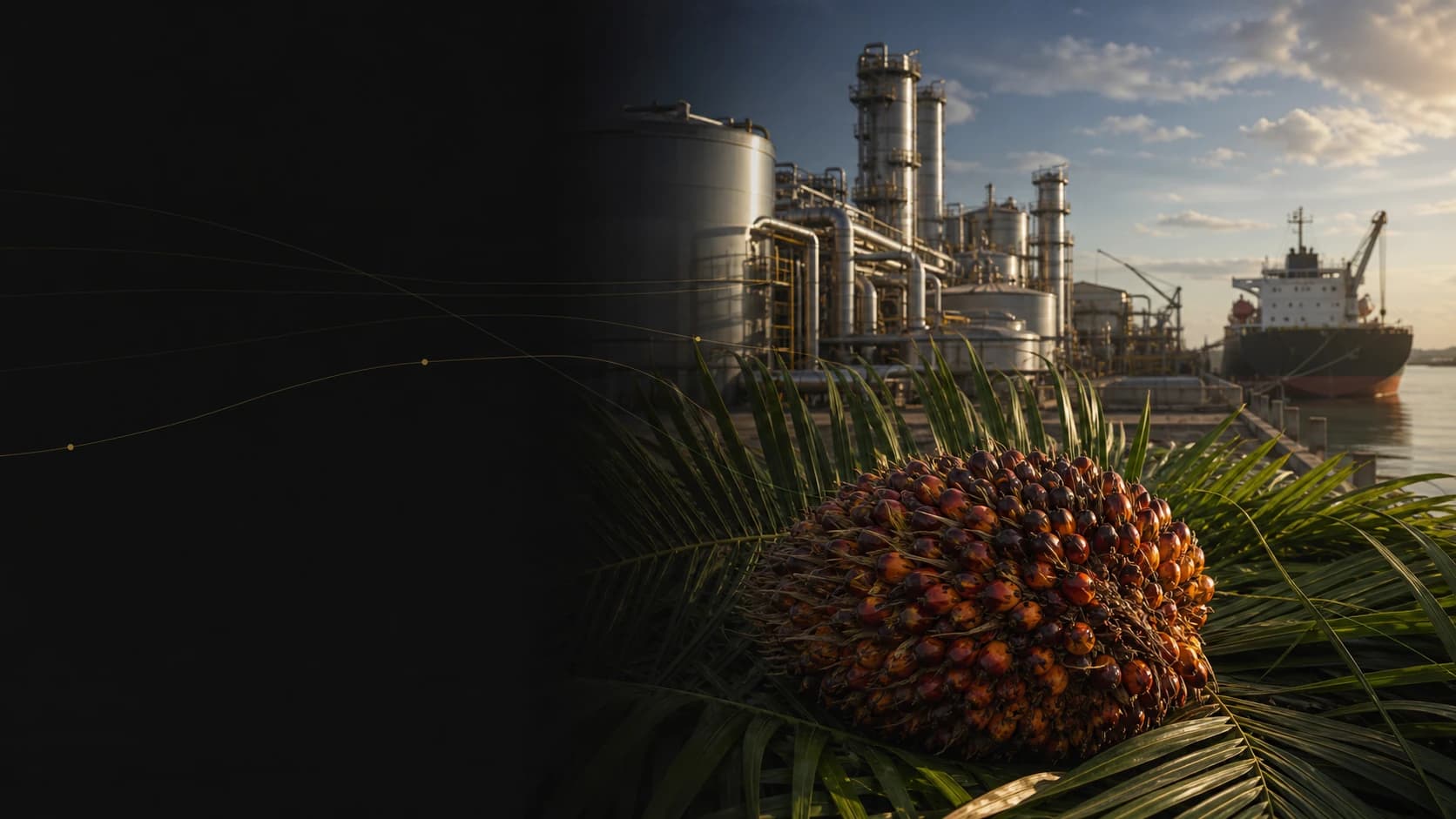
Palm fruit beside a refinery and export vessel, representing an integrated palm oil sourcing network

Sourcing, specification and market intelligence

A sourcing partner for the requirements one refinery cannot always solve.

Palm Oil Economics gives buyers one responsive desk for palm oil, palm-kernel products and downstream derivatives — from 1–2 FCL requirements to larger programmes, custom specifications, certified supply and multi-origin sourcing.

Flexible lots1–2 FCL and larger programmes
Multi-originIndonesia, Malaysia and Africa
Custom routesBlends, specifications and packing
AssuranceRSPO, organic and EUDR support
  • 7market briefs published so far todayverify
  • todaynewest price observation heldverify
  • 68consecutive days the paper has published — resets if we miss oneverify
  • 52,013price observations heldverify
  • 66 yrsof benchmark history, from 1960verify
  • 408market briefs in the archiveverify

More than a quotation

We solve the procurement problem around the product

Buying directly from a refinery can be an excellent route when the requirement is large, standard and already aligned with that plant. Many real purchases are not that simple.

A buyer may need a smaller shipment, a non-standard blend, a particular RSPO supply-chain model, different packing, an alternative origin, or help understanding how export policy changes the landed cost. A single refinery can only offer what its own production programme allows. POE can look across a wider field and build a sourcing route around the buyer's actual requirement.

Our value is not another name between buyer and plant.It is better supplier matching, faster communication, commercial comparison and one accountable line through a complex transaction.
Palm oil sourcing specialist comparing market data, origins and trade routes
Every sourcing route is considered against current market, policy and logistics evidence.

Why buyers work with POE

Seven practical advantages beyond buying from one refinery

The benefit is greatest when volume, specification, certification, origin or timing makes a direct single-plant route difficult.

01

Responsive, accountable support

A person owns the requirement from the first message onward. We acknowledge inquiries quickly, keep communication moving across time zones and provide a substantive response within one business day, including when a requirement needs clarification.

02

Flexible volumes, including 1–2 FCL

Large plants often prioritise high-volume programmes. POE can route smaller container requirements to suitable refineries, processors, packers or consolidation partners, subject to product, origin and loading feasibility.

03

A wider supplier base

One brief can be assessed across Indonesia, Malaysia and selected African supply regions. That creates alternatives when one plant, origin, shipment window or commercial structure does not fit.

04

The right plant for custom specifications

Custom blends and non-standard parameters are difficult when a refinery must interrupt a fixed production schedule. We identify facilities whose equipment, batch size and technical team are better aligned with the requested formulation.

05

Certification and traceability coordination

We help define and coordinate the required documentary route for RSPO Segregated or Mass Balance supply, organic certification, EUDR due diligence and other buyer-specific standards, always subject to the selected supplier's certified scope.

06

Origin economics, not just ex-works price

Export levies, duty structures, packing ecosystems, freight and local conversion costs can make the most competitive origin product-specific. Packed derivatives, for example, may price differently in Indonesia and Malaysia at the same moment.

07

Policy-aware execution

POE follows the export rules and policy environment affecting Indonesia, Malaysia and African supply routes, helping buyers ask the right questions before a quotation becomes a shipment problem.

Choose the route that fits

Direct refinery or POE sourcing desk?

POE does not replace a capable refinery. We make it easier to find the right one — and to build an alternative when the first route does not fit.

Buyer requirementDirect refinery routePOE sourcing route
Large, repeat volume in one standard gradeOften efficient when the plant, specification and contract size already align.Compares suitable origins and adds independent market context before terms are fixed.
A smaller requirement such as 1–2 FCLMay sit below a large refinery's preferred programme or minimum run.Routes the brief to plants, processors, packers or consolidation options able to consider it.
A custom blend or buyer-defined specificationPossible only when that individual plant can accommodate the batch and process change.Searches across capabilities to find the production route that best matches the technical brief.
Certified or traceable supplyLimited to the schemes and supply-chain models available at that site.Matches the requested RSPO, organic or EUDR documentation route to an eligible supply option.
Origin and landed-cost comparisonA quotation naturally reflects one supplier and usually one production origin.Considers product price, export structure, packing, freight, lead time and policy across routes.
Palm oil refinery infrastructure supporting regional production and export

A broader origin strategy

One requirement, several possible supply regions

The cheapest quotation is not automatically the best landed outcome. POE compares the capabilities and commercial conditions surrounding each viable route.

Indonesia

Broad refinery and downstream capacity, strong packed-product capability and commercial outcomes shaped by changing export levies and domestic policy.

Malaysia

Established refining, fractionation and certification infrastructure with mature export logistics and a wide portfolio of palm and kernel derivatives.

African supply regions

Growing production and processing options that can suit regional demand, selected export programmes and buyers seeking a broader origin strategy.

Customisation without guesswork

Find the refinery that can make the product — not merely quote its name

Customisation can require a different feedstock, fractionation route, batch size, packing line or quality-control plan. Many large refineries reasonably avoid small production changes that interrupt a high-volume schedule. POE redirects the brief toward plants and specialist processors whose capabilities are a better match.

  • Palm blends and application-specific formulations
  • Melting profile, cloud point and iodine value targets
  • FFA, moisture and fatty-acid profile requirements
  • Liquid, solid, flaked, drummed, flexitank and buyer-defined packing
  • Samples, COA alignment and independent inspection coordination
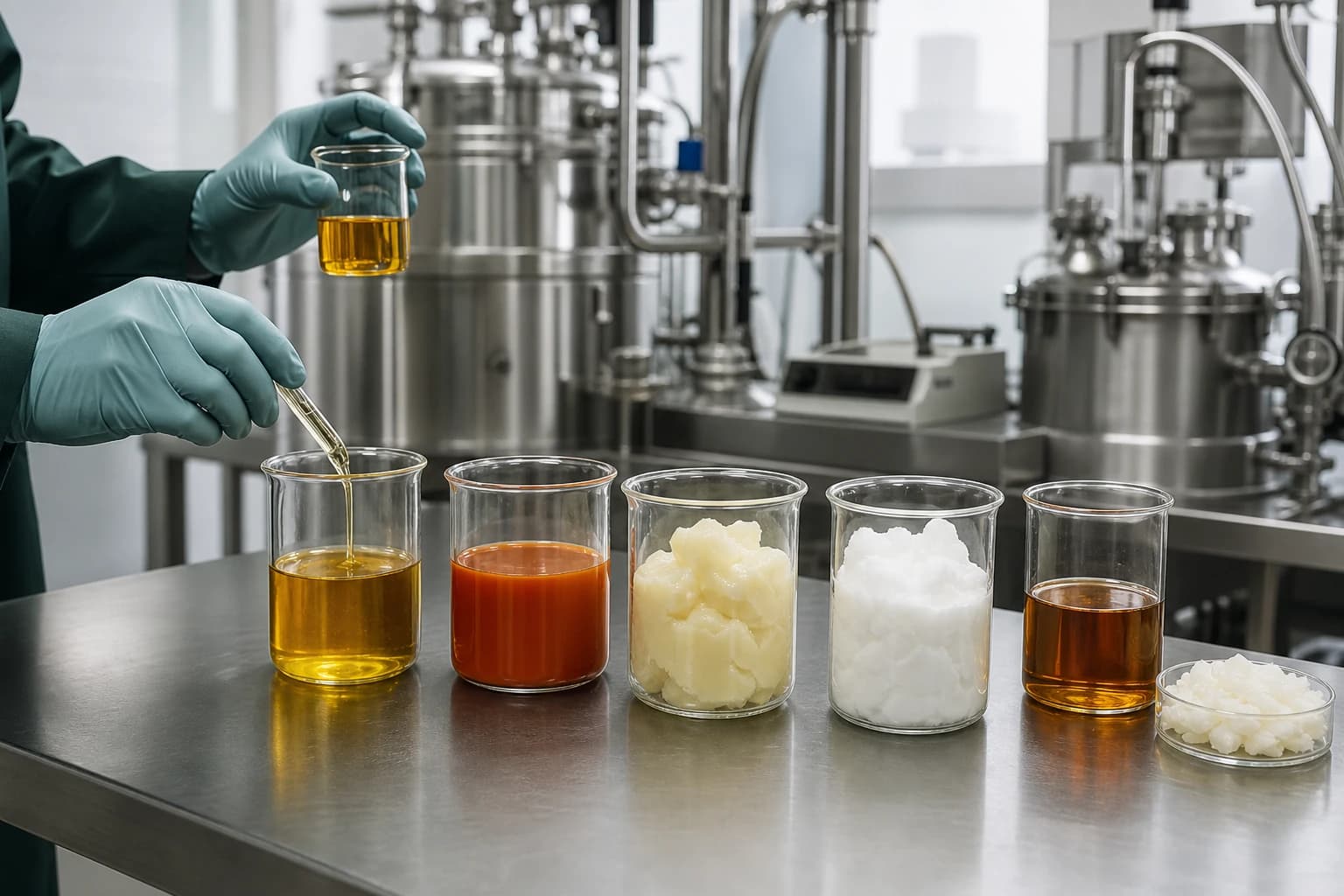
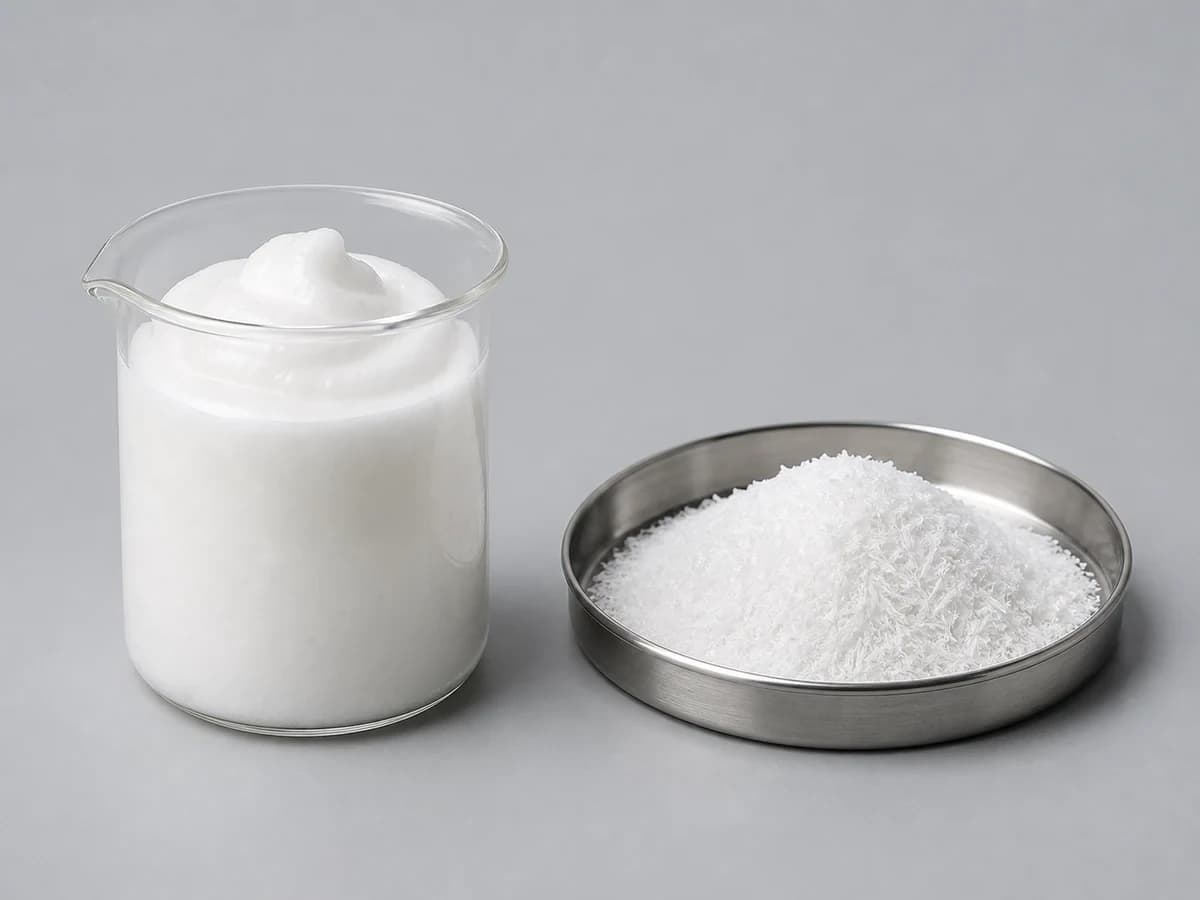
Palm-derived liquid and solid samples being evaluated for a custom formulation
A precise technical brief determines the process, plant and quality route.

A wide product brief

Primary oils, fractions, food fats and industrial derivatives

POE supports every item in the catalogue, related palm-derived products not yet listed and buyer-defined formulations.

Explore all 46 products and derivatives
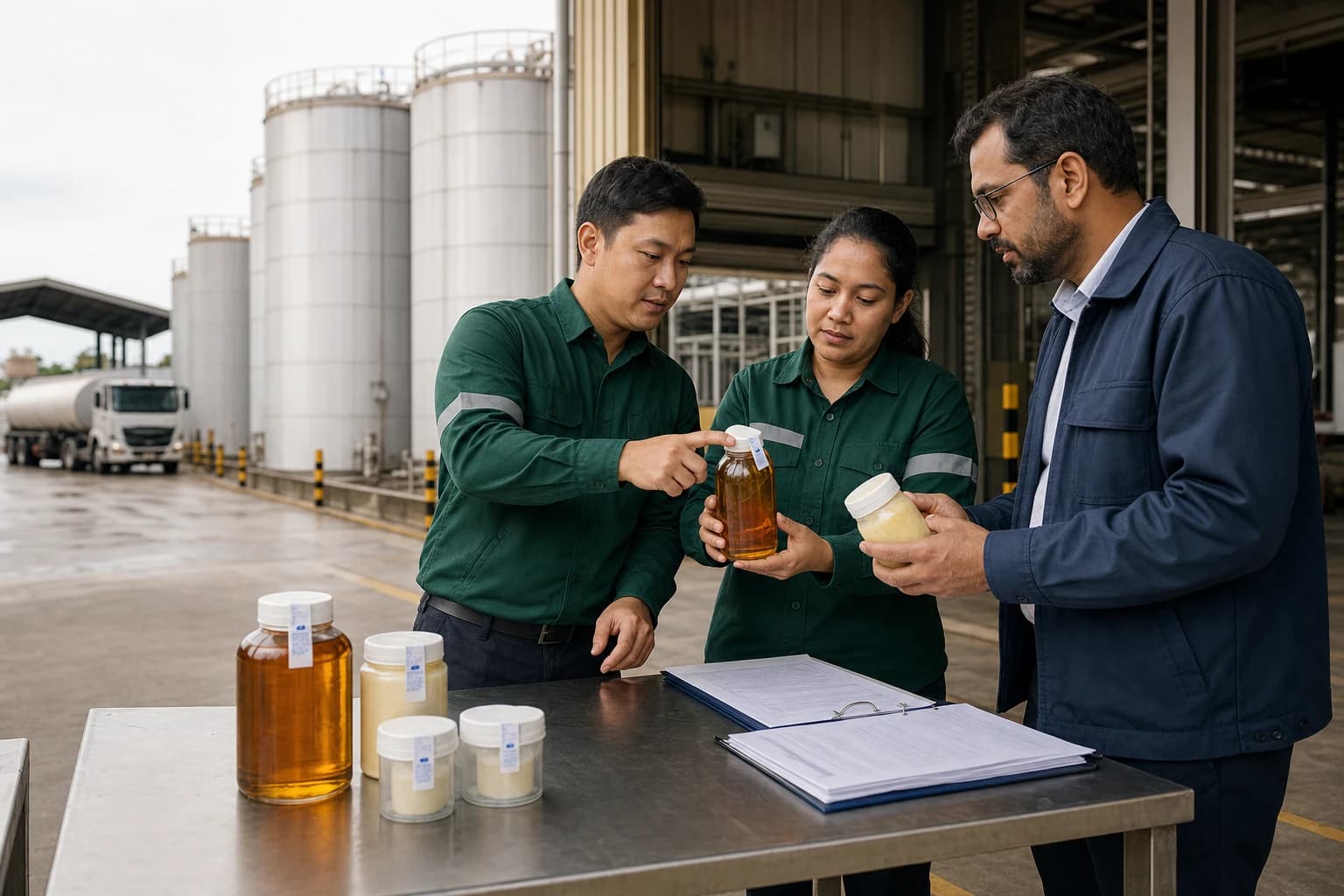
Buyer and refinery specialists reviewing palm oil samples and shipment documentation
Product evidence and documentary requirements are aligned before shipment stages.

Certification, traceability and documents

Compliance requirements shape the sourcing route from the start

Certification cannot be added after the product is selected. The refinery, supply chain, transaction model and documentary evidence must all fit the buyer's intended claim and destination requirements.

RSPO supply-chain models

Segregated (SG) and Mass Balance (MB) availability is matched to the product, site and transaction route rather than treated as a generic badge.

Organic-certified products

We identify supply whose producer, processor and chain documentation can support the organic standard required by the destination market.

EUDR readiness

For applicable EU movements, we coordinate available origin, traceability and due-diligence information. EUDR is a legal compliance process, not a certificate, and each regulated party retains its own obligations.

Shipment documentation

Specifications, COA, SDS, certificate of origin, packing details, inspection requirements and other agreed documents are mapped before execution.

POE coordinates the sourcing and documentation process; accredited certification bodies issue certifications, and each contracting or regulated party remains responsible for its own legal, technical and due-diligence obligations.

From brief to shipment

One accountable process across a wider supply network

  1. 01

    Define

    Product, application, specification, volume, destination, incoterm and timing.

  2. 02

    Compare

    Suitable origins, market benchmarks, policy costs and commercially realistic routes.

  3. 03

    Match

    Refinery, manufacturer, packer or specialist processor with the required capability.

  4. 04

    Qualify

    Supplier information, product scope, documentation, samples and inspection needs.

  5. 05

    Align

    Specification, quotation, packing, payment structure and delivery milestones.

  6. 06

    Support

    A single communication line through documentation, logistics and agreed shipment stages.

Founder-led and accountable

The people behind POE are named, reachable and accountable

Palm Oil Economics was founded by Umesh Shankara Gowda, who works across software and the physical palm oil supply chain, and Hantash Najam, whose founding support helped sustain the long period of data collection behind the platform.

Their identities, roles and external profiles are public. Umesh's ownership of Bio Green Wax is disclosed because commercial sourcing is fulfilled through that company and suitable supply partners. Buyers should be able to understand both who operates the platform and how a sourcing relationship is structured before making contact.

Named leadershipReal people stand behind the information and sourcing desk.
Relevant operating contextSoftware, market data and physical palm oil sourcing are connected.
Declared commercial relationshipThe role of Bio Green Wax is stated openly, not left in the fine print.

Founder profiles

Umesh Shankara Gowda

Founder · Owner, Bio Green Wax

An entrepreneur working across software and the physical palm oil supply chain. He conceived Palm Oil Economics and owns Bio Green Wax, the sourcing and trading company through which suitable commercial requirements are fulfilled.

Contribution to POEConnects market-data systems and buyer requirements with the practical realities of palm oil sourcing.

Hantash Najam

Founder · Founding backer

A founder and the project's founding backer. He supported POE through the long data-building period before a public price record could create immediate commercial value.

Contribution to POEProvided the patient backing required to collect and publish the historical market evidence on which the platform depends.

Transparent by design

Market intelligence strengthens the sourcing conversation

POE publishes the benchmark data, daily market context and experimental forecast record that inform our view of the market. Buyers can inspect the evidence before they send a specification or consider an offer.

Palm Oil Economics does not represent itself as a refinery or certification body; its role is to provide intelligence, identify capable routes and coordinate a better-informed transaction.

The operating relationship, on one card

Sourcing and execution through
Bio Green Wax
What we provide
Market intelligence, supplier matching and sourcing execution
How we earn
Fulfilled sourcing — never from the market data, which remains free
What we are not
Not a refinery or certification body; no proprietary market positions

Bring us the difficult brief

Tell us what you need, not which refinery you think must make it

Share the product, target specification, volume, destination, incoterm and timing. We will assess the most suitable route and tell you candidly when a requirement needs adjustment or falls outside our current network.

Fastest — 30 seconds

WhatsApp the desk

A concise first message is enough: product, approximate volume and destination. The template is already prepared for you.

Open WhatsApp

Three answers

The 30-second brief

Full specification

The complete sourcing brief

Product, grade, specifications, volume, target price, incoterm, destination and timeframe — for the buyer who already has the spec sheet open. Or email it directly to [email protected].

Open the full brief

Whichever door you pick: a person replies within one business day — including when the answer is that we are not the right route. Every inquiry gets a reference code and a confirmation email the moment it arrives.