
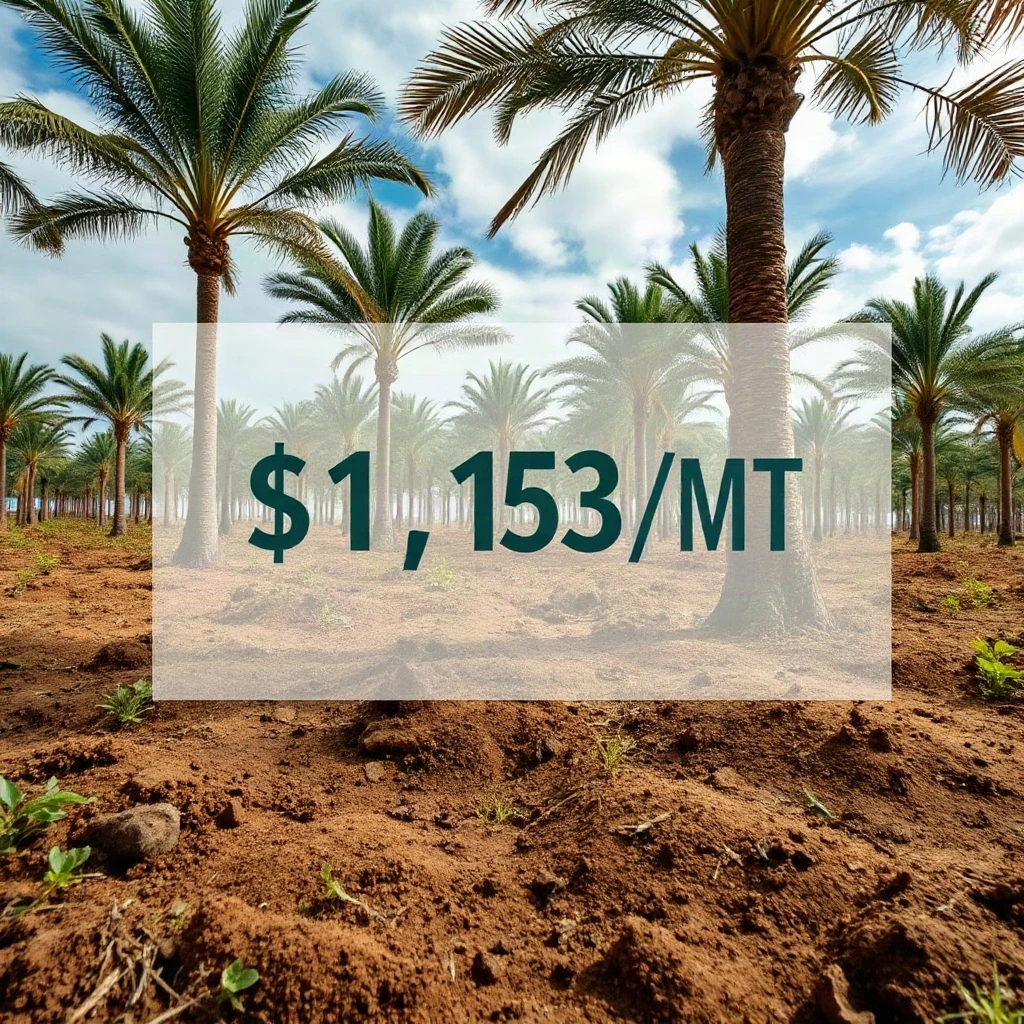
Where the price sits Malaysian CPO benchmark is trading around $1,153/MT, up 0.1% from the previous session (RM 4,663/MT at USD/MYR 4.04). The World Bank benchmark is about $1,117/MT and Indonesia's Kemendag reference is about $1,008/MT. Brent crude is around $96/bbl, near flat on the day but up 7.3% over seven days. The market is holding near the $1,153 level while positioning ahead of the next Malaysian Palm Oil Board report.
The bullish case The most immediate demand support is the BOPO spread: soybean oil at $1,527/MT versus CPO at $1,153/MT puts the spread at $374/MT, near recent highs. That makes palm oil unusually cheap relative to soybean oil, encouraging food and biodiesel buyers to switch into palm and pull on Malaysian and Indonesian supplies.
On supply, the strong El Niño is the dominant medium-term story. The ONI is +1.8°C for JJA 2026, well into strong El Niño territory, and Sarawak and Kalimantan are already dry. Palm yields react with a six-to-twelve-month lag, so the market is pricing the risk of lower 2027 production now rather than waiting for the damage to appear in the data.
Indonesia's B50 mandate adds another supply-side pull. Full B50 implementation is targeted for 1 October 2026, with distribution already at 80% and covering 90% of Pertamina stations. Each additional tonne consumed in domestic biodiesel is a tonne less available for export, tightening regional supply and supporting Malaysian CPO.
Brent at $96/bbl also helps. The POGO spread is -$328/MT, meaning palm oil is cheaper than gasoil on an energy basis; discretionary biodiesel blending is economic, which supports demand for palm as a feedstock. Technically, the chart remains in an uptrend: a golden cross is in place, MACD is positive, RSI is 66, and price is above the 5-, 20- and 50-day simple moving averages.
The bearish case The clearest near-term pressure is the upcoming MPOB August report. Headlines on 3–4 September pointed to August inventories hitting a seven-month high, and the July stocks-to-use ratio was already an ample 12.5%. July CPO production was 1,792,979 t (+9.4% month-on-month) and closing stocks were 1,429,316 t (+7.2% month-on-month). The release is about seven days away; if it confirms a large stock build, it would signal that Malaysian supply is running ahead of demand and weigh on spot CPO.
September seasonality adds to that pressure. Historically September averages -0.9% month-over-month, and production is in its seasonal peak from July through October; the seasonal stock path implies a further +6.7% increase next month. That is a mechanical drag on price as more oil comes to market.
Speculative positioning is another vulnerability. CFTC soybean oil managed money net longs are +109,912 contracts, in the 85th percentile. A crowded long is exposed to liquidation if soybean oil breaks lower, and that is exactly the risk highlighted by the 2026-09-03 decline in CBOT soy oil. Weakness in soy oil spills over into palm even when the BOPO spread remains wide, because the two oils trade as a complex.
The balance and what could flip it On our model's factor balance, the bullish drivers currently outnumber the bearish ones by five to four, so the upside has the upper hand. That does not guarantee an immediate rally: our model outlook is mixed-to-soft in the very near term as the market braces for the MPOB stock build, with a base case of modest negative drift before a post-report relief bounce. The bullish factors are more medium-term in nature, while the bearish factors are front-loaded into the next week or so. Our published path is +0.5% over 7 sessions, consistent with a contained drift and a subsequent bounce.
To flip the balance to bearish, the market would need the MPOB August stocks to come in well above the seven-month high, a cascade of soyoil long liquidation, or a delay or dilution of Indonesia's B50 rollout. To extend the bullish case, the market would need a smaller-than-expected stock build, fresh cargo-surveyor data showing strong exports, or further El Niño intensification. The Indonesian export policy is the swing factor: the Kemendag reference price rose 1.1% to $1,008/MT but the September export duty was held at $148/MT, and GAPKI has warned against raising export levies. A levy change in either direction could shift export supply quickly, but there is no immediate change priced in today.