
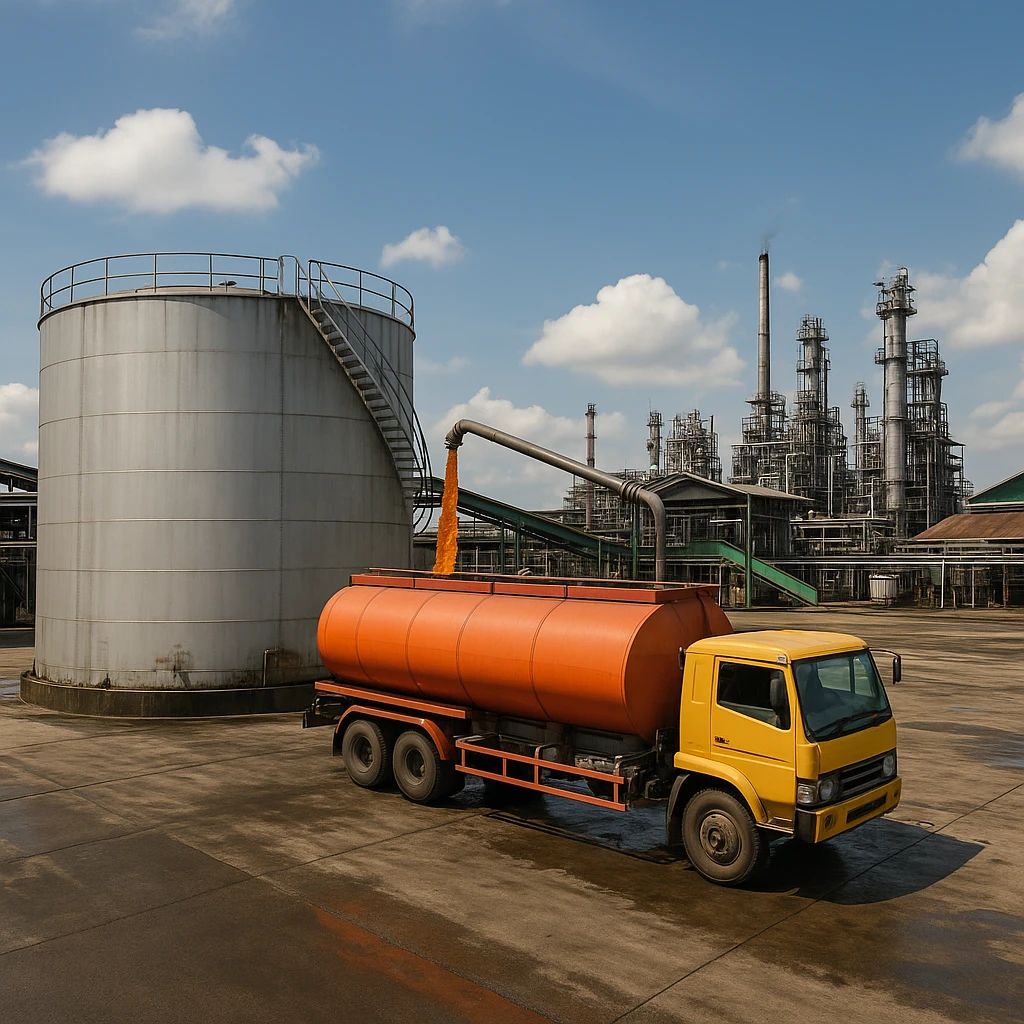
Market snapshot Malaysian CPO benchmark was little changed at about $1,153/MT, up 0.1% from the previous session and equivalent to around RM4,663/MT. The World Bank global benchmark sat lower near $1,117/MT, while Indonesia’s September reference price was roughly $1,008/MT. Brent crude held near $96/bbl, keeping biodiesel blend economics supported. The ringgit was around 4.04 per dollar.
Supply and demand The latest MPOB July data show production rose 9.4% month-on-month to 1,792,979 tonnes, while closing stocks climbed 7.2% to 1,429,316 tonnes and exports jumped 14.5% to 1,392,178 tonnes. The stocks-to-use ratio reached 12.5%, and the July FFB reference price rose 1.2% to RM49.50 per tonne. Ahead of the August report, the market is bracing for a seven-month high inventory build, with weak soybean oil adding pressure.
Weather and policy Weather remains a live supply risk. The ONI is at +1.8, indicating El Niño, and key growing areas in Sarawak and Kalimantan are dry. GAPKI has warned that Indonesia’s 2027 palm oil output could drop 2.9%, and the industry is urging faster replanting. Those dryness concerns are one reason traders are not aggressively selling despite the stock build.
Policy news is mixed. Indonesia’s full B50 biodiesel mandate is targeted for 1 October 2026, with national distribution already reaching 80% and covering 90% of Pertamina stations. The September CPO export levy remains at US$148/MT. GAPKI is also cautioning against raising CPO export levies, saying it could pressure farmer FFB prices. New export governance rules under PP 24/2026 and calls from Indonesia’s DPR for a single-door export system add to the regulatory watchlist.