Palm Oil Holds Near Highs as El Niño and B50 Offset Rising Malaysian Stocks
Malaysian benchmark CPO trades around RM4,613/MT, up 0.4%, while July MPOB stocks climb 7.2% MoM; El Niño supply risks and Indonesia's B50 mandate keep two-sided pressure.

Five bullish factors outweigh four bearish in our model, yet July MPOB stocks and peak production keep the upside choppy and capped.

Malaysian CPO is trading near $1,143/MT (RM4,613/MT), up 0.4% from the previous session. Brent is also firmer at about $91/bbl (+0.8%). Malaysia's benchmark remains above the World Bank marker near $1,101/MT and Indonesia's reference near $997/MT. Our model's anchor is four days stale at $1,145/MT, and post-anchor headlines have emphasized El Niño, so the model's base path starts with mild gains. Missing cargo-surveyor and Bursa FCPO data means the daily range is less certain; our model expects choppy moves within about ±0.8%.
The strongest near-term bid is El Niño supply concern. With ONI at +1.4 and producer-group warnings on Aug 28 that Indonesian output will be crimped, buyers are discounting future tightness even though the full oil-palm production impact has a 6–12 month lag. Dry conditions in Sarawak, Sumatra/Riau and Kalimantan reinforce the concern, so headlines are moving daily prices even before actual output damage shows up.
The soy-to-palm spread is the clearest demand mechanism. Soybean oil at $1,564/MT against CPO at $1,143/MT gives palm a $419/MT discount, the widest in recent weeks. That rewards buyers who can substitute palm for bean oil and supports demand switching at the margin.
Technical positioning is also constructive: price is above the 5-, 20- and 50-day moving averages, with a golden cross and a positive MACD histogram, while RSI near 62 is neutral-to-supportive. Biodiesel economics add demand support: the POGO spread is about -$176/MT, in the 6th percentile, meaning palm is cheaper than gasoil and discretionary blending is attractive, especially with Brent near $91/bbl and Indonesia's B40/B50 program in the background. Festival demand is not immediate but building: Diwali is 69 days away and the Indian buying window opens in roughly 20 days, with cooking-oil imports already reported higher for the festive season.
Ample Malaysian supply is the main brake. MPOB July closing stocks rose 7.2% to 1,429,316 tonnes, about 61% above the five-year average, and stocks-to-use sits at 12.5%. That is a comfortable nearby buffer and makes the next MPOB release a bearish risk rather than a bullish one.
Production seasonality compounds the stock build. Malaysia is in its Jul–Oct peak period; July output rose 9.4% month-on-month to 1,792,979 tonnes and the seasonal path implies a further +7.0% one month ahead, so August and September are likely to keep supply pressure on prices.
The weak rupiah adds supply. At USD/IDR 17,735, Indonesian exports are cheaper in dollar terms, which encourages selling and brings more regional palm into the global market. Speculative positioning is another vulnerability: CFTC soyoil managed-money net length remains elevated at +0.8σ, 79th percentile, and fell 9,795 contracts week-on-week; crowded longs are exposed to liquidation risk that can drag the whole vegetable-oil complex lower.
Our model counts five bullish drivers against four bearish ones, so the upside has the upper hand today. It is not an open-ended rally: the market is near its 52-week high and upper Bollinger band, and the ample MPOB stock cover caps the near-term extension. The published path is +1.2% over seven sessions, but the missing cargo-surveyor and FCPO inputs mean the path could be noisier than normal.
For the balance to flip bearish, we would need to see the stock buffer become overwhelming—for example, August production exceeding the +7% seasonal path and stocks building further—and/or a sharp liquidation of the crowded soyoil long position. A rapid narrowing of the palm discount to soybean oil would also remove a key demand pillar. Indonesia's export policy remains a wild card: the August reference price near $997 implies a $125 levy plus $148 export duty, and a higher September reference would lift the levy proportionally and could slow exports, but the weak rupiah is currently offsetting that drag.
Malaysian benchmark CPO trades around RM4,613/MT, up 0.4%, while July MPOB stocks climb 7.2% MoM; El Niño supply risks and Indonesia's B50 mandate keep two-sided pressure.

Malaysia’s benchmark crude palm oil ended the latest session at RM4,613/MT, equivalent to about $1,143/MT and up 0.4% from the previous close. The World Bank global palm benchmark was $1,101/MT, while Indonesia’s Kemendag reference price stood at $997/MT. With USD/MYR around 4.03 and Brent crude near $90/bbl (+0.6%), the vegetable oil complex retains an energy-linked floor.
The July MPOB release showed Malaysia’s CPO production rose 9.4% month on month to 1,792,979 tonnes, with closing stocks up 7.2% to 1,429,316 tonnes. Exports grew 14.5% to 1,392,178 tonnes, but imports dropped 51.9% to 49,566 tonnes. The stocks-to-use ratio reached 12.5%, and the FFB reference price was RM49.50, up 1.2% month on month. The stock build is consistent with seasonal peak output and keeps near-term supply comfortable.
Weather remains the largest wildcard. El Niño conditions continue with an ONI of +1.4, and dry areas are reported in Sarawak, Sumatra/Riau, and Kalimantan. Indonesian producer groups have flagged that El Niño could reduce output, while one projection puts Indonesia’s 2026 production at 50.31 million tonnes. June Indonesian production was 5.28 million tonnes, an 8.59% month-on-month rise, and June exports surged 64% according to GAPKI.
Demand-side support comes from Indonesia’s B50 biodiesel mandate, which is framed by officials as part of energy independence, and from a wide palm–soy discount of $414/MT on BOPO. MPOC reportedly expects Malaysian CPO to hold above MYR4,600 in September on tighter supply and geopolitical disruptions. However, the Indonesian rupiah has weakened despite high rates and a softer US dollar, which may dent some importers’ purchasing power.
Our model outlook sees two-sided risk. The base case is modest upward drift with consolidation around $1,140–$1,180. El Niño supply fears, B50, and the wide discount support CPO near 52-week highs. But July Malaysian stocks sit 61% above the five-year average, seasonal production is peaking, speculative soyoil longs are crowded, and the weak rupiah adds pressure. Confidence is low because the anchor is four days stale and key inputs—Bursa futures, cargo-surveyor export pace, palm-specific positioning—are unavailable. The published path is +1.7% over seven sessions.
For buyers, the near-term signal is mixed: rising Malaysian inventories and peak output point to ample supply, while El Niño damage and Indonesia’s domestic biodiesel demand could tighten availability later. Watch the next export pace, Bursa positioning, and rainfall developments in the dry zones before adjusting coverage.
Sources: Kantor Berita Sawit; InfoSAWIT; HaiSawit; bernama; The Edge Singapore; Oils & Fats International
New reference price supports export levy outlook, while B50 mandate and dry weather tighten supply narrative.

Malaysian crude palm oil futures closed higher on Monday, rebounding on renewed El Niño supply fears, with the benchmark contract trading around $1,143/MT (RM 4,613), up 0.4% from the previous session. Global benchmarks and Indonesia's reference price lag at $1,101/MT and $997/MT respectively, reflecting regional differentials and export taxes. Brent crude eased 1.1% to about $89/bbl, trimming biodiesel blending economics, while the ringgit held near 4.03 per dollar and the rupiah weakened past 17,735 per dollar.
The market remains caught between opposing forces. On the supply side, El Niño conditions (ONI +1.4) have brought dry weather to key growing regions — Sarawak, Sumatra/Riau and Kalimantan — raising concerns about output in the coming months. Indonesia's palm oil producer group GAPKI now predicts domestic CPO production will decline due to El Niño, reinforcing the supply-tightening narrative. The group is urging faster implementation of the smallholder replanting program (PSR, or peremajaan sawit rakyat) to address structural supply challenges and mitigate the impact of adverse weather.
Official data from MPOB for July 2026 shows Malaysian CPO production rose 9.4% month-on-month to 1,792,979 tonnes, while closing stocks climbed 7.2% to 1,429,316 tonnes — a level well above the five-year average. Exports jumped 14.5% to 1,392,178 tonnes, but imports fell sharply by 51.9% to 49,566 tonnes. The stock buildup suggests near-term supply is ample, even as forward-looking weather risks loom.
Demand-side support comes from Indonesia's B50 biodiesel mandate, which is expected to absorb more palm oil domestically, tightening export availability. This policy, combined with El Niño-driven output concerns, strengthens the case for sustained price firmness. Tight supply and robust biodiesel demand are keeping prices elevated, according to market participants. Additionally, the palm–soybean oil discount remains wide, making palm attractive for price-sensitive buyers, particularly in Asia and Africa. However, soybean oil futures fell last week after the U.S. EPA extended the RFS compliance deadline, which could soften competitive pressure on palm.
Indonesia has set its September CPO reference price at $1,007.51 per ton, a key benchmark for export levy calculations. This level, while below the Malaysian benchmark, supports the firm price outlook above MYR 4,600 and may influence levy rates, potentially affecting export competitiveness. The reference price reflects current market dynamics, including tight supply expectations.
Global palm oil prices are expected to surge on a narrow production surplus, with analysts warning of potential food inflation implications for buyers. Wheat, sugar and palm oil prices have all been rising, adding to food inflation concerns. Geopolitical disruptions to vegetable oil supply chains are adding a risk premium, though rising vegetable oil stocks in China and a weak rupiah are bearish counterweights.
The Malaysian Palm Oil Council (MPOC) forecasts CPO prices will stay above MYR 4,600 in September amid tightening supply and geopolitical disruptions. GAPKI's production decline forecast reinforces this outlook. Our model outlook sees modest upward drift with consolidation in the $1,140–$1,180 range, but confidence is low. The anchor is four days stale, and key data such as Bursa futures positioning, cargo-surveyor export pace, and palm-specific speculative flows are unavailable. The market is balancing El Niño supply fears and biodiesel demand against a seasonal production peak and a stock overhang. The published path suggests a +2.1% gain over seven sessions, but the risk is two-sided.
Buyers should monitor upcoming cargo-surveyor export data for August, any further El Niño updates from meteorological agencies, and the pace of Indonesia's B50 implementation and PSR progress. A break above $1,180 could signal a renewed rally, while a failure to hold $1,140 might trigger profit-taking. Also watch the rupiah — further weakness could pressure Indonesian sellers to discount.
Sources: Kantor Berita Sawit; RIAU1.COM; HaiSawit; Astro Awani; BernamaBiz; RiauAktual.com
Sarawak, Sumatra/Riau and Kalimantan stay dry as ONI sits at +1.4; near-term harvest access may hold, but 6–12 month drought stress looms.
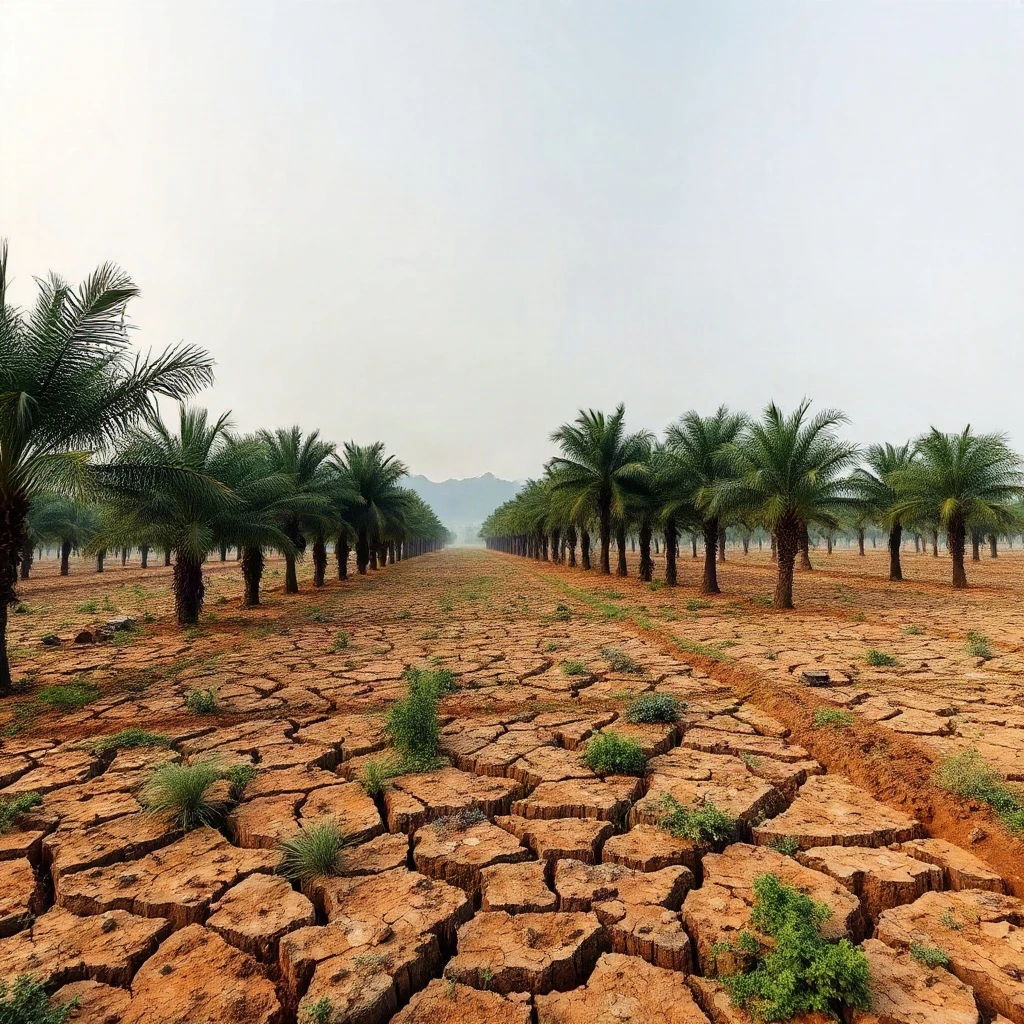
Current ENSO conditions point to El Niño, with the Oceanic Niño Index at +1.4. The notable weather signal is dry: Sarawak, Sumatra/Riau, and Kalimantan are all reported dry. These are core oil palm zones, so the balance between short-term field access and longer-term tree stress matters for the production outlook.
July MPOB data showed CPO production of 1,792,979 tonnes, up 9.4% month-on-month, and palm oil exports of 1,392,178 tonnes, up 14.5% month-on-month, with a stocks-to-use ratio of 12.5%. The published path implies a 1.7% gain over 7 sessions, and our base case sees modest upward drift with consolidation roughly in the $1140–$1180 range, though confidence is low because the anchor is four days stale and key data are unavailable.
Dry conditions persist in Sarawak, Sumatra, Riau and Kalimantan, with El Niño's yield impact still unfolding even as seasonal production peaks.

As of late August 2026, the ENSO state remains a firm El Niño, with the Oceanic Niño Index at +1.4. That places the region firmly in a warm-phase pattern that historically brings drier-than-normal conditions to much of maritime Southeast Asia during the current season.
Seven-day rainfall outlooks point to continued dryness across key producing zones. Sarawak on Malaysian Borneo is dry, as are Sumatra's and Riau's growing areas in Indonesia and much of Kalimantan. For estates, the immediate effect is less about moisture stress on trees and more about the absence of rain-related disruption to harvesting and logistics. Dry weather supports field access, fruit collection and mill throughput in the near term.
The more consequential impact is the lagged response to drought. El Niño-driven water stress typically reduces palm fruit bunch weight and overall yield with a six-to-twelve month delay. That means the dry signal embedded in the current ONI reading is not yet fully reflected in fresh fruit bunch output; the pain is likely to show up in late 2026 and into early 2027, depending on how long the current warm phase persists.
For Malaysia, the July 2026 MPOB data show CPO production at 1,792,979 tonnes, up 9.4% month-on-month, and closing stocks at 1,429,316 tonnes, up 7.2%. That suggests the immediate supply picture is still one of seasonal expansion, with output climbing toward its typical peak. The dryness in Sarawak, however, raises the risk that the current upswing is not fully sustained into the final quarter of the year.
In Indonesia, the dry belt across Sumatra, Riau and Kalimantan is a concern for the same lagged reason. These are core producing regions, and prolonged moisture deficits now can trim bunch weights later, even if current harvests remain adequate.
Our model outlook notes that El Niño supply fears, a wide palm–soy discount and Indonesia's B50 biodiesel mandate are supporting prices near 52-week highs. But July stocks rose 7.2% month-on-month to 1.43 million tonnes, about 61% above the five-year average, and seasonal production is still climbing. That creates a two-sided risk: weather-driven supply anxiety versus a well-stocked near-term pipeline.
A transition toward La Niña, which typically brings wetter conditions to Southeast Asia, would ease drought stress but could also disrupt harvesting and logistics through heavy rain. For now, the dry signal dominates, and the market is left weighing immediate output strength against a delayed yield penalty that has yet to materialize in the data.
The current ENSO state points to a tightening supply outlook on a 6-12 month horizon, even as near-term production peaks. Dry weather in Sarawak, Sumatra, Riau and Kalimantan supports field operations now but sets up a potential yield drag later. Traders and millers will watch for any shift in rainfall patterns or ENSO forecasts as the key swing factor for the coming quarters.
How hydrogenation changes palm oil and palm stearin into hard fats and free-flowing powders, and what procurement teams should check.

Hydrogenation is a standard fat-modification process. It adds hydrogen to unsaturated double bonds in vegetable oils using a metal catalyst, heat and pressure. The result is a more saturated fat with a higher melting point and longer oxidative shelf life. Palm oil and its solid fraction, palm stearin, are common feedstocks because they already have a high proportion of saturated fatty acids and need relatively mild hydrogenation to reach hard-fat specifications.
Partial hydrogenation leaves some double bonds but can form trans isomers. Full hydrogenation converts nearly all double bonds and produces a very hard, stable fat with negligible trans content. Buyers should always ask whether a product is fully or partially hydrogenated and request a trans fatty acid value on the certificate of analysis.
Hydrogenated palm oil (HPO) is made from refined, bleached and deodorized palm oil. The process raises its slip melting point and solid fat content, turning the oil into a hard, waxy solid at room temperature. HPO is used as a hardstock in bakery shortenings, margarine blends, non-dairy creamer fats and coating fats. Key purchasing specifications include: - iodine value (low, indicating high saturation) - slip melting point and solid fat content at relevant temperatures - free fatty acids and peroxide value - trans fatty acid content if the product is partially hydrogenated - moisture and impurities
Palm stearin is the solid fraction obtained by fractionating palm oil. It already has a high melting point and high solid fat content. Hydrogenating palm stearin produces an even harder, lower-iodine-value fat with excellent heat stability and a steep melting curve. HPS is often chosen for confectionery coatings, compound chocolate, cookie fillings and hard fats for industrial bakery lines where a crisp snap and resistance to softening are needed.
Because HPS is harder than HPO, substitution is not always direct. A buyer should compare melting profiles and solid fat content curves before replacing one with the other.
Powdered fats are produced by spray chilling or spray cooling molten hydrogenated fat into small, uniform particles. The powder is free-flowing, easy to dose and blends well with dry ingredients. Common uses include cake and bakery premixes, instant soup and sauce bases, non-dairy creamer powders, and dry seasoning blends. Typical checks for powdered fats include: - particle size distribution and bulk density - flowability and resistance to caking - fat content and moisture content - melting point of the fat component - free fatty acid and peroxide values
Request a full certificate of analysis from the supplier and keep retained samples. Store hydrogenated palm products in a cool, dry area away from strong odors and direct sunlight. Powdered fats are sensitive to temperature cycling; repeated melting and resolidifying can cause clumping and uneven performance. Compare packaging options such as cartons, bags or bulk containers based on your handling equipment and usage rate.
Hydrogenated palm products remain workhorse fats where hardness and oxidative stability matter. Asking the right specification questions helps first-time buyers avoid mismatches in melting behaviour, powder flow and trans fat requirements.
Our market desk connects serious buyers with vetted origin suppliers across Southeast Asia. Indicative pricing, specifications and shipment guidance — free of charge.
Get connected →Malaysian benchmark CPO trades around RM4,613/MT, up 0.4%, while July MPOB stocks climb 7.2% MoM; El Niño supply risks and Indonesia's B50 mandate keep two-sided pressure.
New reference price supports export levy outlook, while B50 mandate and dry weather tighten supply narrative.
Sarawak, Sumatra/Riau and Kalimantan stay dry as ONI sits at +1.4; near-term harvest access may hold, but 6–12 month drought stress looms.
Dry conditions persist in Sarawak, Sumatra, Riau and Kalimantan, with El Niño's yield impact still unfolding even as seasonal production peaks.
How hydrogenation changes palm oil and palm stearin into hard fats and free-flowing powders, and what procurement teams should check.
Five bullish factors outweigh four bearish in our model, yet July MPOB stocks and peak production keep the upside choppy and capped.
Malaysian CPO is trading near $1,143/MT (RM4,613/MT), up 0.4% from the previous session. Brent is also firmer at about $91/bbl (+0.8%). Malaysia's benchmark remains above the World Bank marker near $1,101/MT and Indonesia's reference near $997/MT. Our model's anchor is four days stale at $1,145/MT, and post-anchor headlines have emphasized El Niño, so the model's base path starts with mild gains. Missing cargo-surveyor and Bursa FCPO data means the daily range is less certain; our model expects choppy moves within about ±0.8%.
The strongest near-term bid is El Niño supply concern. With ONI at +1.4 and producer-group warnings on Aug 28 that Indonesian output will be crimped, buyers are discounting future tightness even though the full oil-palm production impact has a 6–12 month lag. Dry conditions in Sarawak, Sumatra/Riau and Kalimantan reinforce the concern, so headlines are moving daily prices even before actual output damage shows up.
The soy-to-palm spread is the clearest demand mechanism. Soybean oil at $1,564/MT against CPO at $1,143/MT gives palm a $419/MT discount, the widest in recent weeks. That rewards buyers who can substitute palm for bean oil and supports demand switching at the margin.
Technical positioning is also constructive: price is above the 5-, 20- and 50-day moving averages, with a golden cross and a positive MACD histogram, while RSI near 62 is neutral-to-supportive. Biodiesel economics add demand support: the POGO spread is about -$176/MT, in the 6th percentile, meaning palm is cheaper than gasoil and discretionary blending is attractive, especially with Brent near $91/bbl and Indonesia's B40/B50 program in the background. Festival demand is not immediate but building: Diwali is 69 days away and the Indian buying window opens in roughly 20 days, with cooking-oil imports already reported higher for the festive season.
Ample Malaysian supply is the main brake. MPOB July closing stocks rose 7.2% to 1,429,316 tonnes, about 61% above the five-year average, and stocks-to-use sits at 12.5%. That is a comfortable nearby buffer and makes the next MPOB release a bearish risk rather than a bullish one.
Production seasonality compounds the stock build. Malaysia is in its Jul–Oct peak period; July output rose 9.4% month-on-month to 1,792,979 tonnes and the seasonal path implies a further +7.0% one month ahead, so August and September are likely to keep supply pressure on prices.
The weak rupiah adds supply. At USD/IDR 17,735, Indonesian exports are cheaper in dollar terms, which encourages selling and brings more regional palm into the global market. Speculative positioning is another vulnerability: CFTC soyoil managed-money net length remains elevated at +0.8σ, 79th percentile, and fell 9,795 contracts week-on-week; crowded longs are exposed to liquidation risk that can drag the whole vegetable-oil complex lower.
Our model counts five bullish drivers against four bearish ones, so the upside has the upper hand today. It is not an open-ended rally: the market is near its 52-week high and upper Bollinger band, and the ample MPOB stock cover caps the near-term extension. The published path is +1.2% over seven sessions, but the missing cargo-surveyor and FCPO inputs mean the path could be noisier than normal.
For the balance to flip bearish, we would need to see the stock buffer become overwhelming—for example, August production exceeding the +7% seasonal path and stocks building further—and/or a sharp liquidation of the crowded soyoil long position. A rapid narrowing of the palm discount to soybean oil would also remove a key demand pillar. Indonesia's export policy remains a wild card: the August reference price near $997 implies a $125 levy plus $148 export duty, and a higher September reference would lift the levy proportionally and could slow exports, but the weak rupiah is currently offsetting that drag.