
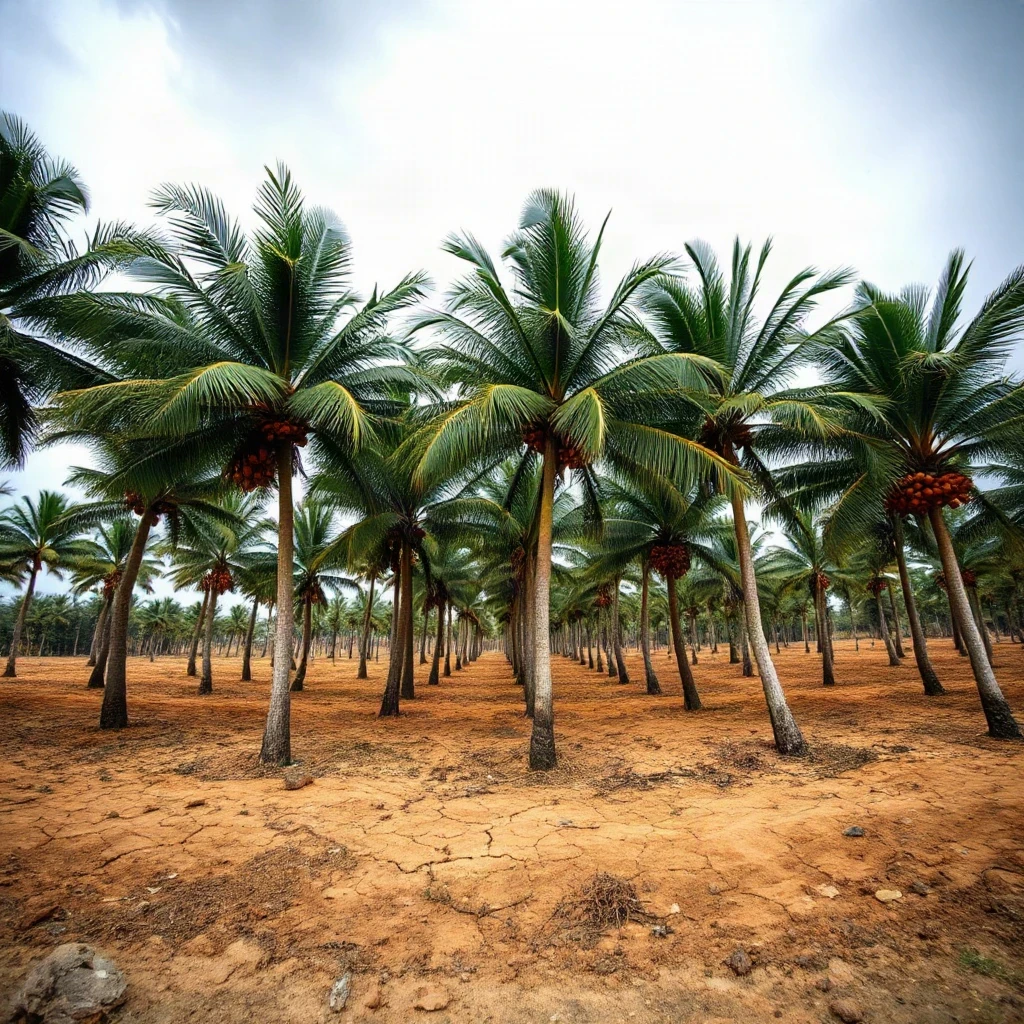
Weather and crop backdrop
As of late August 2026, the ENSO state remains a firm El Niño, with the Oceanic Niño Index at +1.4. That places the region firmly in a warm-phase pattern that historically brings drier-than-normal conditions to much of maritime Southeast Asia during the current season.
Seven-day rainfall outlooks point to continued dryness across key producing zones. Sarawak on Malaysian Borneo is dry, as are Sumatra's and Riau's growing areas in Indonesia and much of Kalimantan. For estates, the immediate effect is less about moisture stress on trees and more about the absence of rain-related disruption to harvesting and logistics. Dry weather supports field access, fruit collection and mill throughput in the near term.
The lagged yield risk
The more consequential impact is the lagged response to drought. El Niño-driven water stress typically reduces palm fruit bunch weight and overall yield with a six-to-twelve month delay. That means the dry signal embedded in the current ONI reading is not yet fully reflected in fresh fruit bunch output; the pain is likely to show up in late 2026 and into early 2027, depending on how long the current warm phase persists.
For Malaysia, the July 2026 MPOB data show CPO production at 1,792,979 tonnes, up 9.4% month-on-month, and closing stocks at 1,429,316 tonnes, up 7.2%. That suggests the immediate supply picture is still one of seasonal expansion, with output climbing toward its typical peak. The dryness in Sarawak, however, raises the risk that the current upswing is not fully sustained into the final quarter of the year.
In Indonesia, the dry belt across Sumatra, Riau and Kalimantan is a concern for the same lagged reason. These are core producing regions, and prolonged moisture deficits now can trim bunch weights later, even if current harvests remain adequate.
Two-sided market signals
Our model outlook notes that El Niño supply fears, a wide palm–soy discount and Indonesia's B50 biodiesel mandate are supporting prices near 52-week highs. But July stocks rose 7.2% month-on-month to 1.43 million tonnes, about 61% above the five-year average, and seasonal production is still climbing. That creates a two-sided risk: weather-driven supply anxiety versus a well-stocked near-term pipeline.
A transition toward La Niña, which typically brings wetter conditions to Southeast Asia, would ease drought stress but could also disrupt harvesting and logistics through heavy rain. For now, the dry signal dominates, and the market is left weighing immediate output strength against a delayed yield penalty that has yet to materialize in the data.
Bottom line
The current ENSO state points to a tightening supply outlook on a 6-12 month horizon, even as near-term production peaks. Dry weather in Sarawak, Sumatra, Riau and Kalimantan supports field operations now but sets up a potential yield drag later. Traders and millers will watch for any shift in rainfall patterns or ENSO forecasts as the key swing factor for the coming quarters.