Palm Oil Caught Between MPOB Stock Build and Indonesia B50 Demand Hopes
Malaysia’s benchmark eases to $1,137/MT as August total stocks hit 2.82m tonnes, while biodiesel targets and firm crude limit downside.

A four-to-two bullish factor balance keeps palm oil's demand and weather premium ahead of August's heavy stock build; our model sees a +0.3% seven-day path.

Malaysian CPO benchmark is trading about $1,137 per tonne, down 0.7% from the previous session and equivalent to RM 4,617 per tonne at USD/MYR 4.08. The World Bank global palm oil benchmark is about $1,117 per tonne, while Indonesia's reference price is about $1,008 per tonne. Brent crude is up 0.2% to about $105 per barrel. The Malaysian benchmark started from a two-day-stale anchor at $1,137, and our model's published seven-day path is +0.3% over seven sessions, implying the pull factors are modestly outweighing the push factors for now.
The widest visible support comes from the soybean oil palm oil spread. The soybean oil premium is about $402 per tonne, leaving palm heavily discounted. A wide BOPO spread makes palm the cheaper cooking and oleochemical input, encouraging buyers to switch into palm and supporting physical CPO demand.
Energy markets add a second bullish mechanism. Brent crude has risen 8.5% over the past seven days to about $104.4 per barrel. Palm's POGO spread is about -$375 per tonne, in the 0th percentile of its range. At that level palm oil is cheaper than diesel on an energy-equivalent basis, which strengthens the case for discretionary biodiesel blending and reinforces Indonesia's policy-driven demand.
Indonesia's B50 mandate is a further demand-side support. Pertamina is targeting 100% B50 distribution by the end of September. Moving from B40 to B50 absorbs an estimated 3-4 million tonnes of palm oil per year, tightening the domestic balance and reducing exportable supply even as production rises.
El Niño adds a weather risk premium. The ONI is at +1.8 degC, a strong El Niño state. Dryness in Kalimantan is notable: about 15 mm of rainfall is expected over the next seven days, while other palm belt areas show 44-66 mm. The yield impact is likely to be lagged by 6-12 months, but the current risk premium supports prices because buyers and sellers worry about future supply losses even while current output is strong.
The heaviest bearish force is the MPOB August stock build. Headline total palm stocks rose 7.48% to 2.82 million tonnes. Official CPO closing stocks rose 15.2% month-on-month to 1,645,570 tonnes, 58% above the five-year average. The stocks-to-use ratio is 14.1%, an ample level. Exports fell 7.5% month-on-month to 1,294,664 tonnes. This combination of rising stocks and weakening exports means more palm is available to the market, pressuring nearby prices.
Peak production season compounds that pressure. July through October is the seasonal peak for Malaysian output. Our model's seasonal path shows production up about 4.5% two months ahead and stocks up about 7.0% one month ahead, with the September monthly average at -0.9%. Strong seasonal supply is arriving before any El Niño yield damage can bite, keeping the physical market well supplied.
Our model's factor balance is four bullish to two bearish, so the upside has the upper hand for now. The bullish side has direct demand mechanisms: the wide BOPO spread, the deeply negative POGO, Indonesia's B50 targets, and the El Niño risk premium. The bearish side is concentrated in the current stock overhang and peak-season production, which are visible in official data but may not fully reflect the lagged weather risk. Technical signals are mixed, with a 5/20 SMA golden cross but a negative MACD histogram and RSI at 52, while CFTC soyoil net longs are crowded but fell 8.1k contracts week-on-week. These are neutral factors in our model and do not tip the balance.
To flip the balance to bearish, two things would need to change. First, the MPOB stock build would need to persist into September with exports staying weak, confirming that demand is not absorbing the seasonal surplus. Second, the B50 mandate would need to be delayed or watered down, and Brent or the BOPO spread would need to narrow, removing the energy and substitution bid. For now, the model's 7-day path of +0.3% reflects a market that is absorbing bearish supply data while retaining a bullish demand and weather layer underneath.
Malaysia’s benchmark eases to $1,137/MT as August total stocks hit 2.82m tonnes, while biodiesel targets and firm crude limit downside.
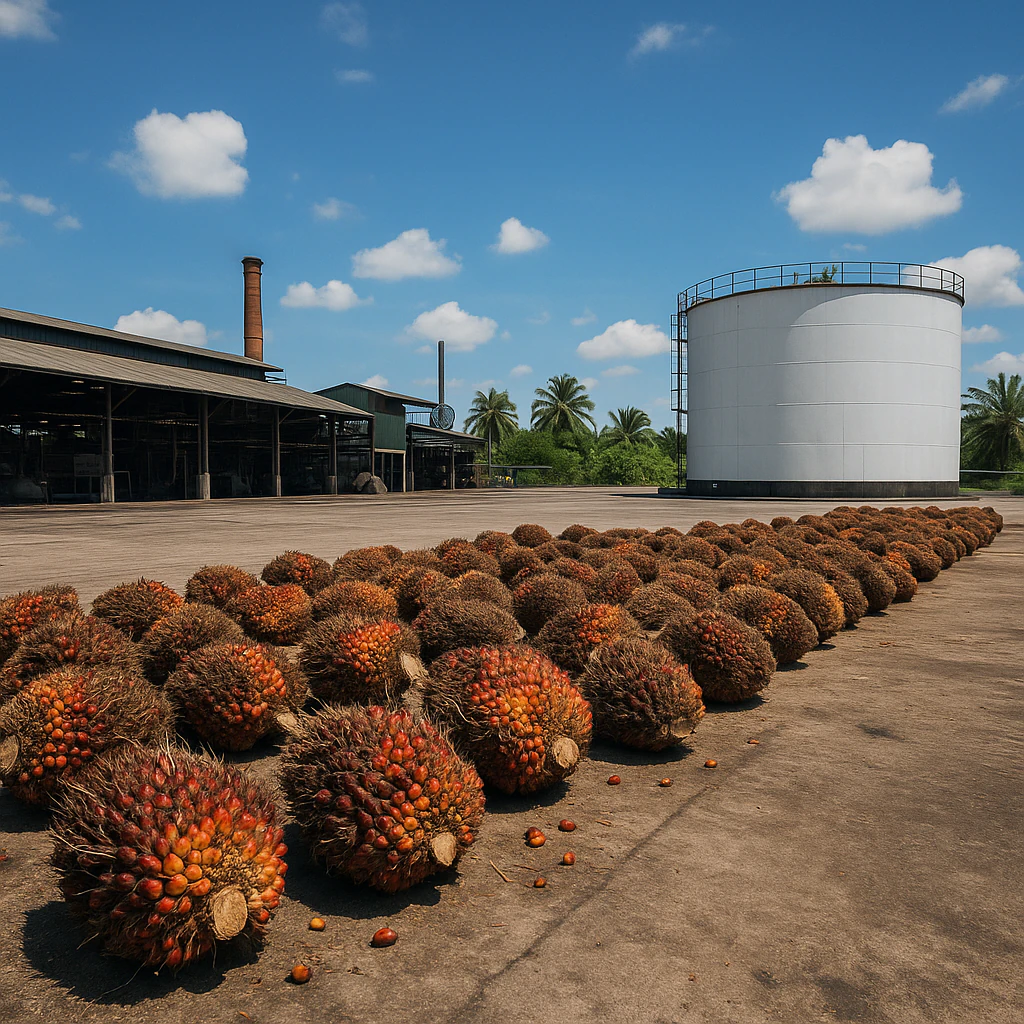
Malaysia’s CPO benchmark slipped 0.7% to about $1,137/MT (RM4,617/MT), while the World Bank global palm benchmark stood at $1,117/MT and Indonesia’s reference price at $1,008/MT. Brent crude firmed 0.2% to around $105/bbl, supporting biodiesel blend economics, and the ringgit traded near 4.08 per dollar.
The MPOB August release showed CPO production at 1,817,499 tonnes, up 1.4% month-on-month, with CPO closing stocks rising 15.2% to 1,645,570 tonnes. Malaysia’s total palm oil stocks increased 7.48% to 2.82 million tonnes, as reported across trade media, reinforcing the bearish supply narrative. Exports declined 7.5% to 1,294,664 tonnes, while imports were little changed at 49,524 tonnes. The stocks-to-use ratio reached 14.1% and the FFB reference price was RM49.76, up 0.5% from the previous month. Futures had also been pressured by weaker export estimates earlier in the week.
Indonesia’s B50 biodiesel program is in focus. Pertamina reportedly aims for 100% distribution by the end of September, and GAPKI has called for B50 to be fixed before any B60 mandate in 2027, while warning about El Niño and smallholder replanting constraints. The September CPO reference price increase pushed Indonesia’s export levy to $148 per tonne, which can affect export competitiveness. Indonesian CPO exports have grown 5.49%, but downstreaming policy remains a swing factor.
El Niño remains active with an ONI value of +1.8 and dry conditions in Kalimantan, which could tighten production later. Brent crude near $105/bbl, supported by Middle East shipping concerns around the Strait of Hormuz and the Red Sea, underpins biodiesel demand and limits losses from weaker rival vegetable oils.
Our model outlook views the next seven sessions as a tug-of-war: bearish MPOB stock build and peak production season against bullish biodiesel demand, a wide palm discount to rival oils, and El Niño risk premium. The published path is +0.3% over seven sessions, but the absence of fresh cargo-surveyor export pace and Bursa FCPO quotes widens near-term uncertainty.
Key signals are the next Malaysian export estimates, confirmation of Indonesia B50 blending rates, and any escalation in dry weather. A continued rise in stocks or slower biodiesel uptake would keep spot offers under pressure, while crude strength and El Niño supply risks could provide support.
Sources: HaiSawit; elaeis.co; Majalah Sawit Indonesia; ANTARA News Sultra; Bernama; BernamaBiz
Malaysia's August build confirmed at a year's high; Indonesia's B50 and B60 plans and firm crude offer the counterweight.
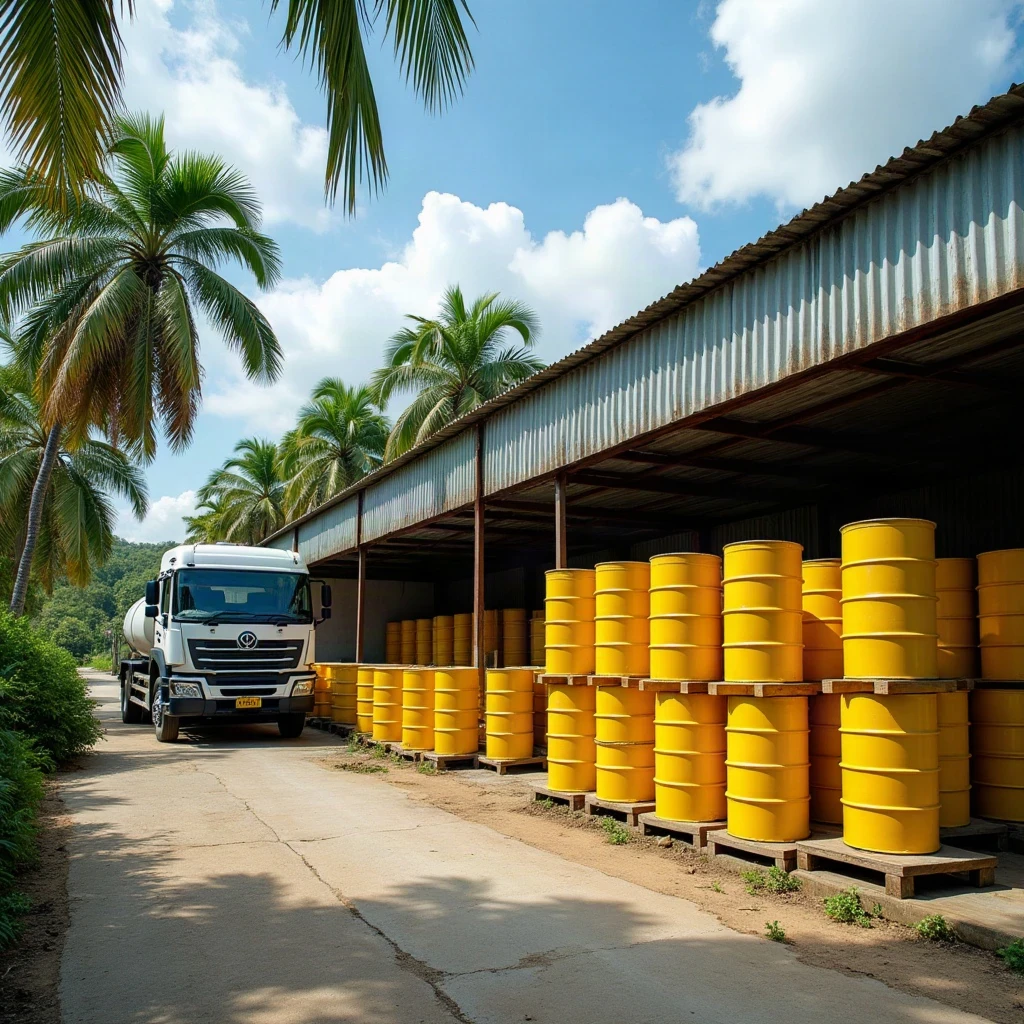
Malaysian crude palm oil futures were quoted around $1,137/MT, down 0.7% from the prior session and equivalent to roughly RM 4,617/MT at a ringgit rate near 4.08. The World Bank palm oil benchmark sat near $1,117/MT, while Indonesia's Kemendag reference price was about $1,008/MT. Brent crude held close to $105/bbl, a touch firmer, keeping biodiesel blend economics broadly intact.
The August MPOB report is now confirmed and remains the dominant fundamental. Total Malaysian palm oil stocks rose 7.48% month-on-month to 2.82 million tonnes, a year's high, with closing stocks reported at 1,645,570 tonnes, up 15.2%. Crude palm oil production reached 1,817,499 tonnes, a modest 1.4% gain, while palm oil exports fell 7.5% to 1,294,664 tonnes. Fresh fruit bunch reference was RM 49.76, up 0.5%. Rising inventories alongside softer offtake have weighed on sentiment, and headline flow through the week reflected that, with futures ending lower on weaker export estimates and following rival vegetable oils down.
Against the bearish stock picture, Indonesia's biodiesel programme remains a supportive theme. The government is targeting full B50 implementation in October 2026, and a B60 mandate is now being discussed that would lift crude palm oil demand to as much as 23 million tonnes. That longer-dated policy signal matters because it points to structurally firmer domestic offtake rather than a one-off blend bump. Industry body GAPKI has pushed for flexible policy while flagging El Niño risk and smallholder replanting challenges, and has argued the B50 groundwork should be tidied up before any move to B60. Regional administrations have voiced support for the rollout. Firm crude oil has also helped cap losses in palm, with sessions earlier in the week ending higher on firmer crude and Dalian palm olein gains, and crude's approach toward the $100 mark has revived an energy-led bid for vegetable oils.
The tension now runs beyond the current report. Inventories sit at a seasonal peak, yet the forward supply picture is less comfortable: production in the second half of 2026 is expected to stay firm, but the market is also watching for a supply squeeze to emerge as the peak passes. ENSO conditions remain El Niño, with the ONI at +1.8, and Kalimantan has seen notably dry rainfall, keeping a risk premium in the background. The wider vegetable oil complex is under pressure from increasing supply, though Chinese oilseed demand and a more positive palm demand outlook have provided some balance. A wide palm discount to rival oils continues to underpin price-sensitive buying interest.
The near-term picture is a tug-of-war: a confirmed Malaysian stock build at a year's high and firm second-half production on one side, biodiesel demand, a wide palm discount and El Niño risk on the other. Our model outlook, anchored two days stale at RM 4,617, projects mild downside with volatility over the next seven sessions, with missing cargo-surveyor export pace and Bursa FCPO quotes widening uncertainty. Buyers should watch Malaysian export pace for signs the stock overhang is clearing, Indonesian B50 and B60 mandate progress, Brent crude for blend economics, and El Niño rainfall patterns in Kalimantan for any production signal.
Pertamina targets full B50 distribution by end-September as GAPKI urges flexible rules and flags dryness risk.

Indonesia's biodiesel programme is moving toward a fuller blend mandate, with Pertamina targeting complete distribution of B50 biodiesel by the end of September, according to the state distributor. The timeline puts the world's largest palm oil producer on course to absorb more of its own output into domestic fuel, a shift that matters well beyond Indonesia's borders.
GAPKI, the Indonesian palm oil association, has urged a flexible approach to B50 implementation while warning about two constraints: the possible impact of El Niño conditions and the slow progress of smallholder replanting. That combination frames the central tension in the market.
Indonesia has also been positioned as an international reference point for B50 development, reflecting the country's ambition to lead on biodiesel policy.
The demand side of the equation is firming. Brent crude around $104/bbl keeps biodiesel blending economics generally workable, and a wide palm discount to competing oils supports both food and fuel uptake. Malaysia's August data showed crude palm oil production at 1,817,499 tonnes, up 1.4% month on month, while closing stocks rose 15.2% to 1,645,570 tonnes and exports fell 7.5% to 1,294,664 tonnes. The stock build is a bearish near-term signal, but peak production season is a familiar seasonal pattern.
Our model outlook frames the next week as a tug-of-war: bearish Malaysian stock build and peak output against bullish biodiesel demand, a wide palm discount and an El Niño risk premium. The published path is +0.3% over seven sessions, with the anchor two days stale at $1,137/MT.
For buyers with sustainability and traceability obligations, the B50 rollout adds a layer of complexity. More domestic absorption in Indonesia can tighten export availability and shift trade flows toward other origins. Buyers should track:
The policy direction is clear, but implementation details and weather will decide how much supply actually reaches the export market.
CPO holds near $1,137/MT as Malaysia's August stock build meets firm Brent and Indonesia's B50 push; our model sees a modest rise.

Palm oil ended the week with the Malaysian crude palm oil benchmark near $1,137/MT, equivalent to about RM 4,617/MT, down roughly 0.7% on the prior session. The global reference tracked close behind at about $1,117/MT, while Indonesia's Kemendag reference sat lower at about $1,008/MT, keeping a wide spread across the three quoted benchmarks.
Brent crude was steady at about $104/bbl, a level that continues to shape biodiesel blending economics and, by extension, the demand floor for vegetable oils. In currency markets, the ringgit traded near 4.08 per dollar and the rupiah near 17,623 per dollar, moves that matter for the dollar-denominated pricing of a crop produced and exported largely from Southeast Asia.
Malaysia's August data showed the sector's near-term pressure point clearly. Crude palm oil production reached 1,817,499 tonnes, up 1.4% month on month, while closing stocks climbed to 1,645,570 tonnes, a 15.2% monthly increase. Exports slipped to 1,294,664 tonnes, down 7.5%, and imports were little changed at 49,524 tonnes, off 0.1%. The fresh fruit bunch reference price edged up 0.5% to RM 49.76. Headlines after our anchor point put total Malaysian palm stocks up 7.48% at 2.82 million tonnes, reinforcing the bearish stock-build narrative.
ENSO conditions remain El Niño, with the ONI at +1.8. Notable rainfall deficits have been observed in Kalimantan, a pattern that keeps a weather risk premium in the market even as near-term supply looks comfortable.
Our model outlook anchors on a price two days stale at $1,137/MT. The seven-session view is a tug-of-war: bearish Malaysian stock build and peak production on one side, against Indonesia's B50 biodiesel push, firm Brent, a wide palm discount to competing oils, and El Niño risk premium on the other. The published path points to a rise of about 0.3% over seven sessions. Missing cargo-surveyor export pace and Bursa FCPO quotes widen the uncertainty around that projection.
Attention turns to the usual monthly cycle of Malaysian Palm Oil Board and export-surveyor releases, which will test whether the August stock build extends into September. Indonesian biodiesel policy milestones around the B50 programme remain a key demand-side watch item, alongside any shift in Brent or the ringgit. Seasonally, production typically peaks in the third quarter before tapering, so the pace of the current stock build will be closely read against that pattern. This is neutral market information, not a recommendation.
A step-by-step look at the chemistry, feedstock economics and sourcing checks behind palm methyl ester production.
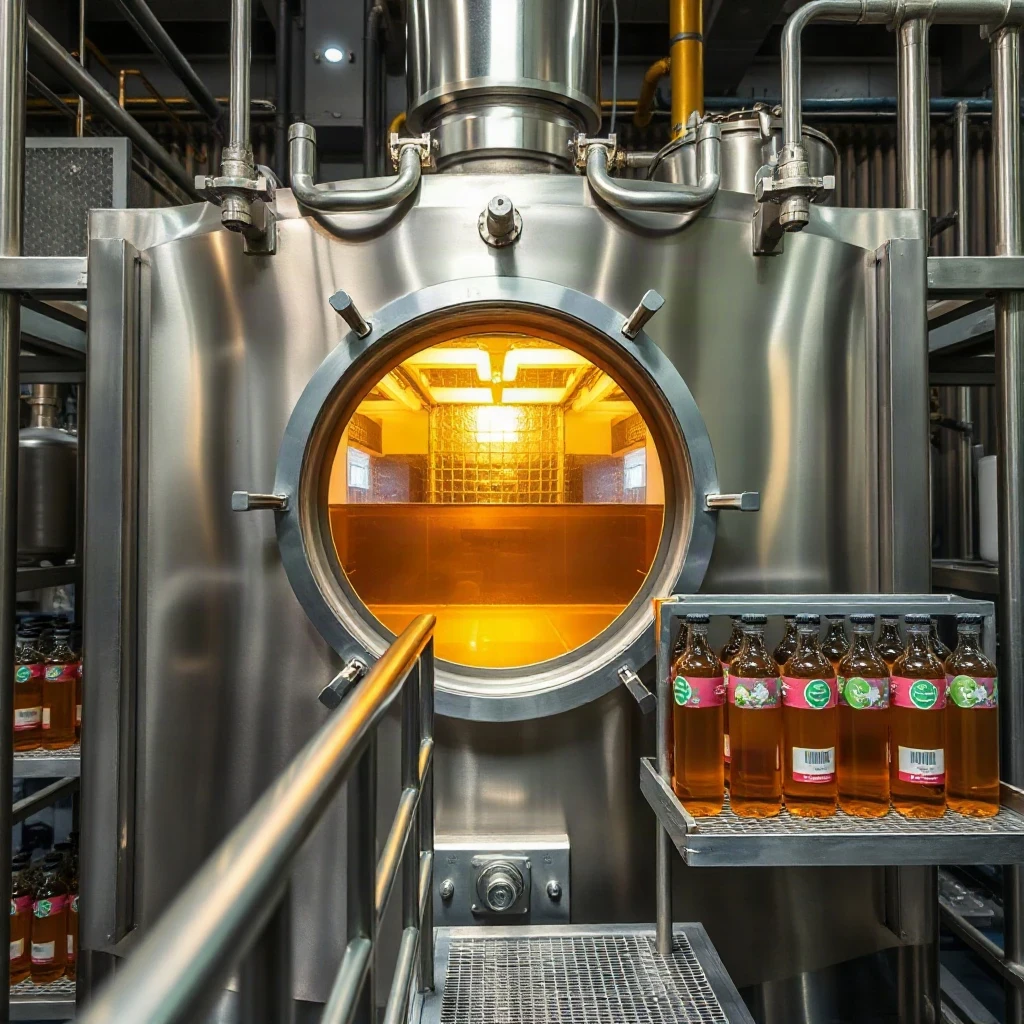
Palm oil does not burn well in a modern diesel engine. Its molecules are too large and too viscous, and its behaviour in cold weather is poor. The fix is a chemical reaction called transesterification, which converts the oil into fatty acid methyl esters - the material sold as palm biodiesel, or palm methyl ester (PME).
A triglyceride is a glycerol backbone carrying three fatty acid chains. In transesterification, methanol reacts with the oil in the presence of a catalyst - typically sodium hydroxide or sodium methoxide - and the glycerol is displaced. Each fatty acid chain is converted into a methyl ester, and glycerol emerges as a dense co-product. The overall reaction is reversible, so industrial plants run with excess methanol to push conversion towards the esters.
Transesterification links two markets. The biodiesel maker competes with food and oleochemical buyers for the same palm oil, so the price of the feedstock usually sets the floor for PME. Glycerol output adds a second revenue stream, and methanol and catalyst costs sit on the other side of the margin. Policy - blending mandates and sustainability rules in importing countries - often drives demand more than engine technology does.
Understanding the reaction helps buyers see why quality, price and policy are so tightly connected in the palm biodiesel chain.
Our market desk connects serious buyers with vetted origin suppliers across Southeast Asia. Indicative pricing, specifications and shipment guidance — free of charge.
Get connected →Malaysia’s benchmark eases to $1,137/MT as August total stocks hit 2.82m tonnes, while biodiesel targets and firm crude limit downside.
Malaysia's August build confirmed at a year's high; Indonesia's B50 and B60 plans and firm crude offer the counterweight.
Pertamina targets full B50 distribution by end-September as GAPKI urges flexible rules and flags dryness risk.
CPO holds near $1,137/MT as Malaysia's August stock build meets firm Brent and Indonesia's B50 push; our model sees a modest rise.
A step-by-step look at the chemistry, feedstock economics and sourcing checks behind palm methyl ester production.
A four-to-two bullish factor balance keeps palm oil's demand and weather premium ahead of August's heavy stock build; our model sees a +0.3% seven-day path.
Malaysian CPO benchmark is trading about $1,137 per tonne, down 0.7% from the previous session and equivalent to RM 4,617 per tonne at USD/MYR 4.08. The World Bank global palm oil benchmark is about $1,117 per tonne, while Indonesia's reference price is about $1,008 per tonne. Brent crude is up 0.2% to about $105 per barrel. The Malaysian benchmark started from a two-day-stale anchor at $1,137, and our model's published seven-day path is +0.3% over seven sessions, implying the pull factors are modestly outweighing the push factors for now.
The widest visible support comes from the soybean oil palm oil spread. The soybean oil premium is about $402 per tonne, leaving palm heavily discounted. A wide BOPO spread makes palm the cheaper cooking and oleochemical input, encouraging buyers to switch into palm and supporting physical CPO demand.
Energy markets add a second bullish mechanism. Brent crude has risen 8.5% over the past seven days to about $104.4 per barrel. Palm's POGO spread is about -$375 per tonne, in the 0th percentile of its range. At that level palm oil is cheaper than diesel on an energy-equivalent basis, which strengthens the case for discretionary biodiesel blending and reinforces Indonesia's policy-driven demand.
Indonesia's B50 mandate is a further demand-side support. Pertamina is targeting 100% B50 distribution by the end of September. Moving from B40 to B50 absorbs an estimated 3-4 million tonnes of palm oil per year, tightening the domestic balance and reducing exportable supply even as production rises.
El Niño adds a weather risk premium. The ONI is at +1.8 degC, a strong El Niño state. Dryness in Kalimantan is notable: about 15 mm of rainfall is expected over the next seven days, while other palm belt areas show 44-66 mm. The yield impact is likely to be lagged by 6-12 months, but the current risk premium supports prices because buyers and sellers worry about future supply losses even while current output is strong.
The heaviest bearish force is the MPOB August stock build. Headline total palm stocks rose 7.48% to 2.82 million tonnes. Official CPO closing stocks rose 15.2% month-on-month to 1,645,570 tonnes, 58% above the five-year average. The stocks-to-use ratio is 14.1%, an ample level. Exports fell 7.5% month-on-month to 1,294,664 tonnes. This combination of rising stocks and weakening exports means more palm is available to the market, pressuring nearby prices.
Peak production season compounds that pressure. July through October is the seasonal peak for Malaysian output. Our model's seasonal path shows production up about 4.5% two months ahead and stocks up about 7.0% one month ahead, with the September monthly average at -0.9%. Strong seasonal supply is arriving before any El Niño yield damage can bite, keeping the physical market well supplied.
Our model's factor balance is four bullish to two bearish, so the upside has the upper hand for now. The bullish side has direct demand mechanisms: the wide BOPO spread, the deeply negative POGO, Indonesia's B50 targets, and the El Niño risk premium. The bearish side is concentrated in the current stock overhang and peak-season production, which are visible in official data but may not fully reflect the lagged weather risk. Technical signals are mixed, with a 5/20 SMA golden cross but a negative MACD histogram and RSI at 52, while CFTC soyoil net longs are crowded but fell 8.1k contracts week-on-week. These are neutral factors in our model and do not tip the balance.
To flip the balance to bearish, two things would need to change. First, the MPOB stock build would need to persist into September with exports staying weak, confirming that demand is not absorbing the seasonal surplus. Second, the B50 mandate would need to be delayed or watered down, and Brent or the BOPO spread would need to narrow, removing the energy and substitution bid. For now, the model's 7-day path of +0.3% reflects a market that is absorbing bearish supply data while retaining a bullish demand and weather layer underneath.