Indonesia B50 Biodiesel Mandate: Export Revenue Risk vs Domestic Demand Lift
Policy trade-off emerges as Indonesia's 50% biodiesel mandate boosts local palm oil use but threatens $2.7 billion in export earnings.

Export revenue risk and domestic demand surge drive prices to two-week highs
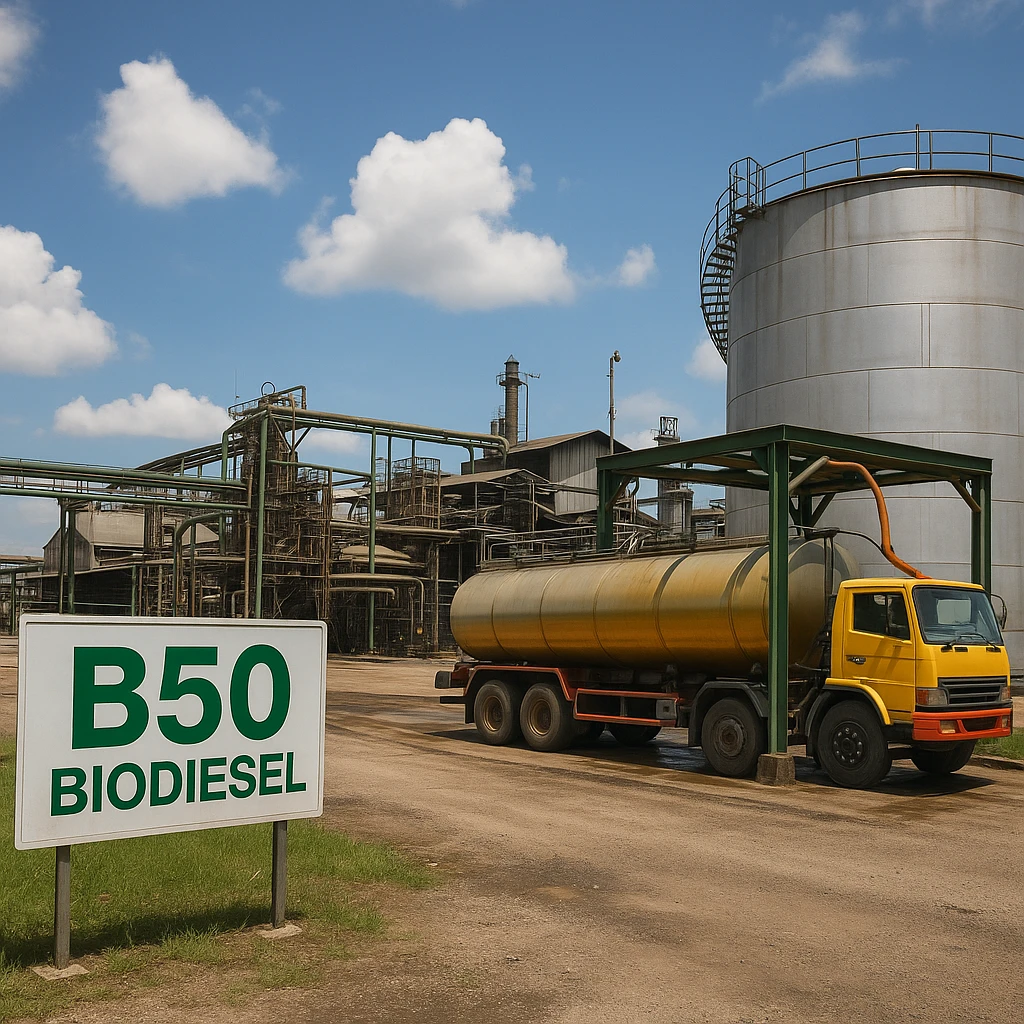
Indonesia’s rollout of the B50 biodiesel mandate is reshaping the palm oil market, with analysts estimating a potential $2.7 billion loss in export revenue as domestic consumption rises. The policy, launched this week, requires a 50% palm oil blend in biodiesel, boosting local demand and tightening global supplies.
Palm oil futures climbed to a two-week high, supported by strength in rival vegetable oils and crude oil. Soybean oil also rose to a three-week high amid geopolitical tensions in the Middle East, which have lifted biofuel demand expectations. The rally reflects broader market anticipation of reduced export availability from Indonesia, the world’s largest palm oil producer.
The B50 mandate is expected to divert significant volumes of palm oil from export markets to domestic biodiesel production. This shift could reduce Indonesia’s export revenue by $2.7 billion, according to industry estimates. Meanwhile, Thailand has tightened its palm oil export controls, further reshaping regional supply flows. European Union imports of Malaysian palm oil have increased year-on-year, indicating sustained demand from key buyers.
El Niño concerns add to supply uncertainty, with analysts raising price forecasts for 2026-27. The combination of weather risks and biodiesel-driven demand is tightening global stocks, supporting a bullish outlook.
India and China have signed an edible oil trade pact to boost soybean oil imports, potentially easing pressure on palm oil demand from the two largest vegetable oil importers. However, the immediate impact of Indonesia’s biodiesel policy is expected to keep palm oil prices elevated relative to other oils.
Monitor Indonesia’s B50 implementation pace and export allocation data closely. Any delays or adjustments in the mandate could shift price direction, while El Niño developments will remain a key supply risk through the second half of 2026.
Sources: energynews.pro; The Jakarta Post; Reuters; Nikkei Asia; Bloomberg.com; UkrAgroConsult
Policy trade-off emerges as Indonesia's 50% biodiesel mandate boosts local palm oil use but threatens $2.7 billion in export earnings.

Indonesia has officially rolled out its B50 biodiesel mandate, requiring a 50% palm oil-based biodiesel blend in diesel fuel. The policy, announced in early July 2026, is designed to cut fuel imports and strengthen energy security. Industry sources estimate the mandate could divert up to $2.7 billion worth of palm oil from export markets to domestic biodiesel production.
The B50 program represents a structural shift in palm oil demand. Domestic biodiesel consumption will absorb a significantly larger share of Indonesia's crude palm oil output, tightening availability for traditional buyers in India, China, the EU and other importing regions. The mandate comes at a time when global supply is already under pressure from El Niño-related weather concerns, which have raised production uncertainty across Southeast Asia.
Analysts have revised palm oil price forecasts upward for 2026-27, citing both the biodiesel demand boost and potential output shortfalls. Higher domestic absorption means less palm oil flows into export channels, potentially supporting benchmark prices in the near to medium term.
For compliance-minded buyers, the B50 mandate introduces new layers of risk and complexity. Export volumes from Indonesia are likely to shrink, forcing importers to seek alternative origins such as Malaysia or Thailand, or to adjust their vegetable oil procurement strategies. Buyers with sustainability commitments should monitor how the increased domestic biodiesel demand affects land-use and deforestation pressures, as well as the availability of certified sustainable palm oil.
The policy underscores a classic trade-off: Indonesia gains energy independence and supports its domestic palm oil industry, but risks losing export revenue and market share. The $2.7 billion export revenue estimate highlights the scale of potential displacement. Market participants will watch how the government balances these competing priorities, and whether any adjustments to export levies or domestic supply obligations follow.
Palm oil economics now hinges on the interplay between biodiesel blending mandates, weather-driven production risks, and shifting global trade flows. Buyers and traders should factor in tighter supply fundamentals and elevated price volatility as the B50 mandate takes effect.
Sources: energynews.pro; The Jakarta Post; Reuters; Nikkei Asia; Bloomberg.com
Crude palm oil and palm kernel oil come from the same fruit but differ in composition, uses and market dynamics.

The oil palm fruit is a drupe that naturally produces two distinct oils. Understanding the difference between crude palm oil (CPO) and palm kernel oil (PKO) is essential for procurement managers and first-time buyers navigating the palm oil market.
The oil palm bunch contains hundreds of individual fruits. Each fruit has three layers: the outer skin (exocarp), the fleshy mesocarp, and a hard endocarp (shell) that protects a single kernel. The mesocarp yields CPO; the kernel yields PKO. Both are extracted in separate processes.
CPO is pressed from the fleshy mesocarp. It is semi-solid at room temperature, rich in palmitic acid (about 44%) and oleic acid (about 39%). Its balanced fatty-acid profile makes it versatile for cooking oils, margarine, shortening and frying fats. CPO also contains carotenoids (giving it a reddish colour) and vitamin E tocotrienols. Refining removes colour and odour for edible uses.
PKO is extracted from the kernel after the shell is cracked. It is highly saturated (about 80% lauric acid), similar to coconut oil. PKO is solid at cooler temperatures and used primarily in confectionery, ice cream, non-dairy creamers, cocoa butter substitutes and personal-care products such as soap and cosmetics. Its lauric content gives it quick melting properties and good lathering ability.
At the mill, fresh fruit bunches are sterilised, stripped and digested. The mesocarp is pressed to release CPO. The nuts are separated, dried and cracked to recover kernels, which are then pressed or solvent-extracted to yield PKO. CPO yields per bunch are roughly 20–25% of fruit weight; PKO yields are about 2–5%.
CPO and PKO trade on separate price curves. CPO is the larger-volume commodity, influenced by edible-oil demand and biodiesel mandates. PKO prices are more volatile, driven by lauric-oil supply from coconut and palm kernel sources. Buyers should specify which oil they need, as substitution is limited by different melting points and fatty-acid profiles.
Both oils originate from the same fruit but serve distinct industrial roles. Knowing their differences helps buyers avoid costly specification errors.
This space reaches palm oil buyers, traders and industry readers every day. Sponsorship and advertising enquiries are welcome — get in touch:
[email protected]Policy trade-off emerges as Indonesia's 50% biodiesel mandate boosts local palm oil use but threatens $2.7 billion in export earnings.
Crude palm oil and palm kernel oil come from the same fruit but differ in composition, uses and market dynamics.
Export revenue risk and domestic demand surge drive prices to two-week highs
Indonesia’s rollout of the B50 biodiesel mandate is reshaping the palm oil market, with analysts estimating a potential $2.7 billion loss in export revenue as domestic consumption rises. The policy, launched this week, requires a 50% palm oil blend in biodiesel, boosting local demand and tightening global supplies.
Palm oil futures climbed to a two-week high, supported by strength in rival vegetable oils and crude oil. Soybean oil also rose to a three-week high amid geopolitical tensions in the Middle East, which have lifted biofuel demand expectations. The rally reflects broader market anticipation of reduced export availability from Indonesia, the world’s largest palm oil producer.
The B50 mandate is expected to divert significant volumes of palm oil from export markets to domestic biodiesel production. This shift could reduce Indonesia’s export revenue by $2.7 billion, according to industry estimates. Meanwhile, Thailand has tightened its palm oil export controls, further reshaping regional supply flows. European Union imports of Malaysian palm oil have increased year-on-year, indicating sustained demand from key buyers.
El Niño concerns add to supply uncertainty, with analysts raising price forecasts for 2026-27. The combination of weather risks and biodiesel-driven demand is tightening global stocks, supporting a bullish outlook.
India and China have signed an edible oil trade pact to boost soybean oil imports, potentially easing pressure on palm oil demand from the two largest vegetable oil importers. However, the immediate impact of Indonesia’s biodiesel policy is expected to keep palm oil prices elevated relative to other oils.
Monitor Indonesia’s B50 implementation pace and export allocation data closely. Any delays or adjustments in the mandate could shift price direction, while El Niño developments will remain a key supply risk through the second half of 2026.