Palm Oil Edges Lower as Bearish Headwinds Outweigh Bullish Demand Signals
Malaysian CPO benchmark slips to $1,101/MT, with peak production, rupiah weakness and softer crude capping gains despite BOPO-driven demand and Indian festival buying.

State energy firm Pertamina begins nationwide B50 biodiesel distribution, confirming Indonesia's mandate is now operational and underpinning palm oil demand.

Indonesia's B50 biodiesel programme has moved from policy announcement to operational reality, with state energy firm Pertamina launching nationwide distribution of the 50% palm oil blend. The development confirms the mandate is now live across the archipelago, a step that directly expands domestic palm oil consumption and reshapes demand dynamics for global buyers.
The rollout comes as palm oil markets show mixed signals. Malaysian CPO futures traded around $1,101 per metric ton, down 0.3% from the previous session, while the global benchmark stood near $1,105. Indonesia's reference price was about $1,030 per ton. The modest dip reflects ongoing concerns about production increases and inventory build-ups, but the operational B50 programme provides a structural demand boost that could offset some bearish pressures.
Pertamina's nationwide distribution means B50 blending is now active at retail and industrial levels, not merely announced. This is expected to absorb a significant portion of domestic palm oil supply, reducing export availability and potentially tightening global markets. The policy aligns with Indonesia's goal to cut fuel imports and support farmer incomes, but it also means less palm oil for international buyers.
Market participants note that the programme's success depends on feedstock supply and blending infrastructure. However, the nationwide launch signals strong government commitment, which could support prices over the medium term. The wide BOPO (biodiesel vs. gasoil) spread, currently favorable, makes the blend economically viable, especially with Brent crude holding near $83 per barrel, down 7.9% on the session.
Today's price action reflects a complex landscape. Malaysian production rose 8.1% month-on-month in June to 1.64 million tons, while stocks increased 3.7% to 1.33 million tons. Exports grew 5.7%, but imports surged 135.3%, indicating robust domestic demand. Weather remains a wildcard, with El Niño conditions causing dry spells in key growing regions like Sabah, Sarawak, and Kalimantan, which could curb future output.
Our model outlook for the near term is slightly bearish, as peak production, weak rupiah, and crude oil declines weigh against supportive wide BOPO spread and the B50 launch. Data staleness adds uncertainty. The rupiah's depreciation (around 17,989 per dollar) makes Indonesian exports more competitive, but it also raises import costs for buyers.
For palm oil traders, the Pertamina-led B50 rollout is a key demand-side factor to monitor. It could tighten supply availability from Indonesia, the world's largest producer, and support price floors. Buyers may need to adjust procurement strategies, considering potential export reductions. The policy also reinforces palm oil's role in energy transition, linking its price more closely to crude oil movements.
As the programme rolls out, market attention will shift to implementation details, such as blending rates and feedstock availability. For now, the nationwide launch marks a pivotal moment for palm oil demand, with effects likely to ripple through global vegetable oil markets.
Sources: Oils & Fats International
Malaysian CPO benchmark slips to $1,101/MT, with peak production, rupiah weakness and softer crude capping gains despite BOPO-driven demand and Indian festival buying.
India’s festival‑driven restocking is another pillar. Imports typically surge from July through October ahead of Diwali, and early trade data point to a strong seasonal pulse, tightening availability in the physical market just as sellers position for that flow.
Longer‑term, the developing El Niño (ONI +1.0°C) is injecting a risk premium. While the current state helps harvesting in the short run, historical episodes show that sustained dry conditions eventually stress trees and drag on yields. The market is already pricing in the possibility of a smaller production cycle next year, adding a floor under spot prices despite ample current supplies.
The Indonesian rupiah’s persistent weakness is magnifying the export flow. A softer IDR makes Indonesian palm more competitive in dollar terms, encouraging shipments and swelling the regional supply pool, which puts downward pressure on Malaysian benchmarks.
Weaker crude oil is also sapping upward momentum. The 1.9% weekly drop in Brent erodes the competitiveness of palm‑based biodiesel, particularly in Indonesia’s B35 mandate and Malaysia’s B20 program, cutting a source of incremental demand that often props up CPO during price dips.
Speculative positioning in related markets adds a final layer of bearishness. CBOT soybean oil net long positions tumbled by 15,493 contracts in the latest reporting week, signaling that a crowded long trade is unwinding. This liquidation spills over into palm oil futures, where managed money often holds correlated bets.
Malaysian CPO steadies around $1,101/MT; MPOB data shows higher production and stocks, while El Niño and B50 support prices.

Malaysian crude palm oil futures closed near $1,101 per tonne on August 3, down 0.3% from the previous session, tracking weakness in soybean oil and lingering concerns over rising supply. The global benchmark stood at about $1,105, while Indonesia's reference price was set at $1,030 for August, reflecting a slight premium for Malaysian product. The ringgit held near 4.09 per dollar, and the rupiah at 18,053, with the latter's softness supporting Indonesian export competitiveness.
MPOB's June data showed Malaysian CPO production at 1,638,777 tonnes, up 8.1% month-on-month, while closing stocks rose 3.7% to 1,332,697 tonnes. Exports increased 5.7% to 1,198,567 tonnes, but imports surged 135.3% to 103,113 tonnes, partly reflecting arbitrage opportunities. The FFB reference price slipped 1.3% to RM 48.90, signaling some softening in fresh fruit bunch values.
Weather remains a key swing factor. ENSO is in El Niño territory (ONI +1.0), with dry conditions reported in Sarawak and Kalimantan. This raises concerns about future production, though current output is still rising. Market participants are weighing near-term supply gains against potential drought stress later in the year.
India, the world's largest edible oil importer, saw June imports drop 30% year-on-year, with palm and soybean oil shipments falling. However, imports are expected to pick up from July through October ahead of festivals, as buyers rebuild inventories. Reports of India seeking sunflower oil alternatives amid Black Sea disruptions could redirect some demand toward palm and other oils. Meanwhile, India's biofuel push, including the RBI's flagging of biofuel-driven edible oil price pressures, adds another layer to demand dynamics.
Indonesia's B50 biodiesel programme, launched in July, continues to underpin long-term palm oil demand for fuel, although crude oil prices around $90 per barrel keep biodiesel economics in check. The wide BOPO spread (palm oil vs gasoil) offers some support, but any sustained drop in crude could weaken that cushion.
Our model outlook suggests near-term headwinds from rupiah weakness boosting export selling, a slowing Chinese economy, and elevated speculative longs. However, support comes from the wide BOPO spread, El Niño anticipation, and seasonal August firming. Prices are likely to remain rangebound around $1,100, with a slight initial dip on FX concerns before stabilizing.
Watch the rupiah and China's demand signals for near-term direction, but keep an eye on El Niño's evolution and India's festival-season buying as key supports. The market appears balanced, with supply increases offset by weather and biodiesel demand risks.
Sources: Bitcoin World; ChemAnalyst; bernama; Oils & Fats International; Jakarta Globe; Business Recorder
A weaker Indonesian rupiah and slower China manufacturing outlook pressured CPO prices, though a wide soy oil discount and impending Indian festival demand capped the decline.
Malaysian crude palm oil futures slipped 0.3% to about $1,101 per metric ton, with the global benchmark at $1,105/MT and Indonesia’s reference price at $1,030/MT. Brent crude held steady near $90/bbl, while the ringgit traded around 4.09 to the dollar, offering little directional push from the energy or currency complexes.
The wide palm-soy oil discount remains a powerful demand anchor. At $481/MT below soy oil, palm oil is attracting price-sensitive buyers switching from other vegetable oils, particularly in price-sensitive markets like India. This BOPO spread provides a cushion that limits downside even when other factors turn bearish.
Seasonal patterns are also turning supportive. Historically, August CPO prices rise by an average 0.7% as the trade begins positioning for the festival-driven restocking cycle across India and Southeast Asia. That window typically tightens stocks during peak production and lends a mild upward bias.
India’s edible oil import outlook reinforces this. After a weak June, imports are expected to surge from July through October ahead of major festivals. This latent demand, though not yet fully reflected in trade flows, underpins sentiment and ought to prevent a sharp price collapse.
A weakening Indonesian rupiah is encouraging more aggressive selling from the world’s top producer. The rupiah slipped on the back of China’s slower manufacturing PMI, making Indonesian palm oil cheaper in dollar terms and boosting export volumes. This added supply pressure is directly bearish for CPO.
The same China PMI slowdown signals reduced industrial activity and softer edible-oil demand, weighing on the entire vegetable-oil complex. With China being a major buyer, the demand-side risk is palpable.
Market positioning ahead of the next MPOB stocks report, due around August 10, is also fostering caution. June’s closing stocks rose 3.7% to over 1.33 million tons, and with production at its seasonal peak, another stock build is widely anticipated. Traders are likely to lighten long positions or add shorts in anticipation of a bearish data print.
Speculative positioning in Chicago soybean oil adds to the downside vulnerability. Managed money net longs are in the 85th percentile of their historical range, leaving the market exposed to long-liquidation cascades if sentiment sours — and that liquidation often spills into palm oil.
With four clear bearish drivers against three bullish props, the balance of risks currently points downward. Our model outlook concurs, expecting a modestly softer tone early in the period before stabilizing.
For the balance to flip bullish, the market would need to see a strengthening rupiah (perhaps on Chinese policy stimulus), a surprise draw in MPOB stocks, or a sharp retreat in Brent crude that reignites biodiesel blending economics. Without such shifts, the weight of export supply and cautious positioning keeps the near-term bias tilted to the downside.
Indonesia's B50 launch and crude weakness test biodiesel economics as buyers weigh compliance risks

Policy developments in Indonesia and India are resetting the demand and compliance landscape for palm oil, even as crude oil's slide complicates the arithmetic behind biodiesel blending.
Indonesia formally launched its B50 biodiesel programme in mid-July, lifting the mandated palm-oil content in biodiesel to 50%. The move extends Jakarta's long-running strategy of diverting domestic palm supply into fuel, tightening export availability in a market already watching El Niño-related dryness in Kalimantan.
For compliance-minded buyers, the mandate deepens uncertainty over Indonesian export volumes. Higher blending rates typically raise domestic absorption, and any shortfall in feedstock can prompt the government to tighten export levies or quotas. The rupiah's recent weakness against the dollar adds another layer, as it boosts exporters' local-currency returns and can encourage faster selling in the near term.
Brent crude holding around $90 per barrel has kept biodiesel blends broadly competitive. But a sharp repricing of oil futures below $70 in late July, flagged in trade press, threatens that equation. Cheaper crude narrows the incentive for blending, potentially slowing uptake in markets where mandates are less strictly enforced.
Our model outlook suggests the market is likely to stay rangebound near $1,100 per tonne for Malaysian crude palm oil, with a slight initial dip on currency-driven export selling before stabilizing. Elevated speculative longs and a slowing Chinese economy are headwinds, while the wide BOPO spread and seasonal August firming lend support.
On the demand side, Indian policymakers are increasingly vocal about edible oil prices. The central bank has linked broad-based price rises to biofuel use, citing Indonesia's B50 mandate as a factor. Meanwhile, industry bodies are pressing for curbs on duty-free edible oil imports from Nepal, which they argue undercut domestic producers and complicate India's tariff regime.
For buyers sourcing into India, these signals point to a more interventionist policy environment. Any move to tighten Nepal-origin imports would redirect demand toward mainline suppliers, while continued biofuel-linked inflation concerns could invite further tariff adjustments.
For now, the policy mix is broadly supportive of palm prices, but the crude-biodiesel link and Indian import politics remain the swing factors most likely to test that support.
Sources: AgroSpectrum India; livemint.com; livemint.com; Business Standard
Dry conditions persist in key Indonesian and Malaysian zones as El Niño's lagged impact on fruit bunch weights meets near-term harvest disruption risks.
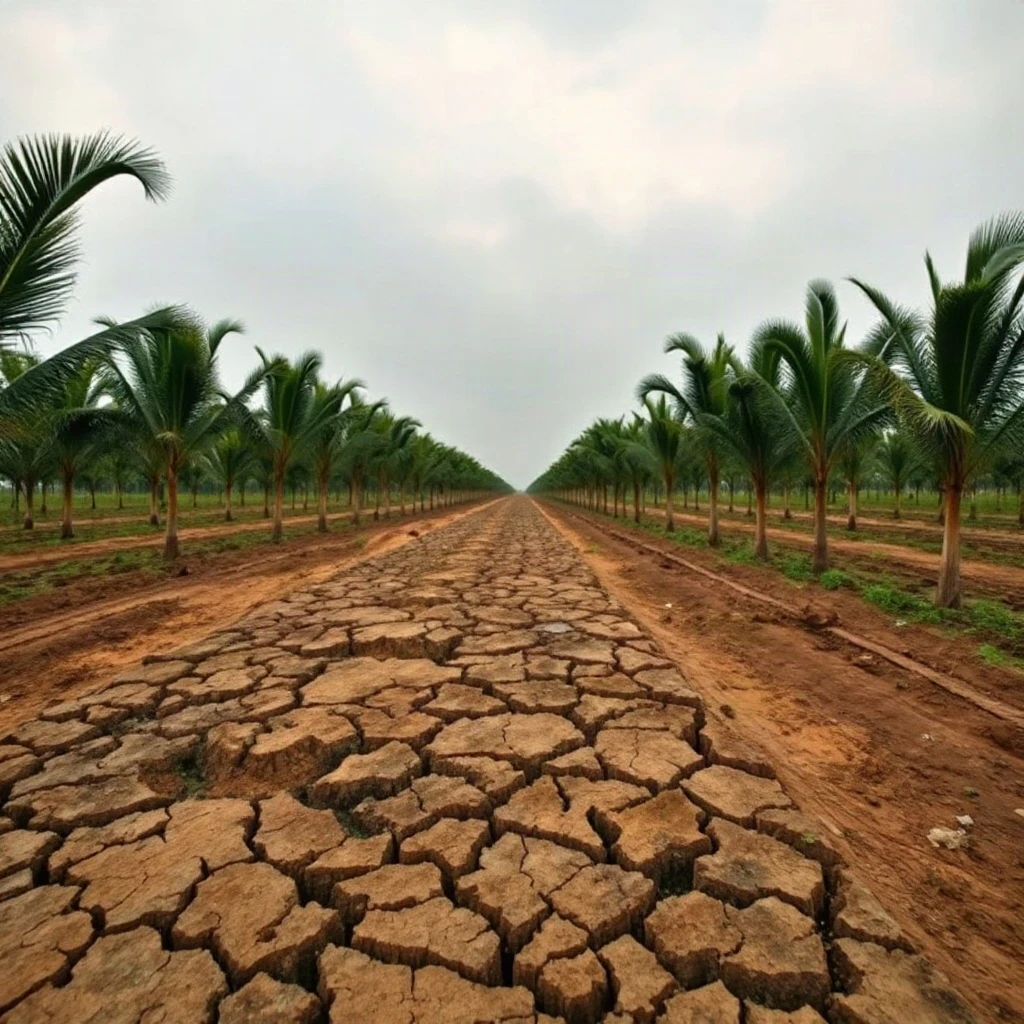
The palm oil complex enters August with the El Niño state firmly in place, an ONI reading of +1.0 confirming a moderate event. For the crop-weather desk, the immediate concern is not the current dryness alone but the delayed effect on yields. Reduced fruit bunch weights typically manifest six to twelve months after the onset of drought stress, meaning the current ENSO phase is still feeding into the output profile for late 2026 and early 2027.
Seven-day rainfall forecasts point to a stark divergence across the two main producing nations. Sarawak in Malaysian Borneo and Kalimantan in Indonesian Borneo are both flagged as notably dry. This is significant because these areas have been key contributors to regional output in recent months. Persistent dryness here accelerates soil moisture depletion, and while the immediate impact is on harvesting logistics and fruit quality, the longer-term signal is for lighter bunch weights in the coming quarters.
Conversely, the broader Southeast Asian region is not yet seeing the widespread wet anomaly that would signal a transition toward La Niña. A La Niña shift typically brings heavier rains to the palm belt, which would alleviate drought stress but introduce a different set of problems: waterlogged fields, disrupted harvesting schedules, and higher incidence of bunch rot and transport delays.
Malaysian June data from MPOB already reflects a complex picture. CPO production rose 8.1% month-on-month to 1,638,777 tonnes, while closing stocks climbed 3.7% to 1,332,697 tonnes. This suggests that current yields are still holding up, largely due to the lagged nature of El Niño's impact. However, the dry conditions in Sarawak are a cautionary signal for the July and August figures, as that state's contribution to national output is substantial.
Indonesia, meanwhile, faces a different near-term pressure. A weakening rupiah, trading around 18,053 per dollar, makes export selling more attractive for local producers, potentially increasing supply into the global market even as Kalimantan's dry spell threatens future output. This creates a paradoxical situation: ample near-term availability masking a deteriorating crop condition.
Our model outlook suggests the market is likely to remain rangebound around the $1,100 per tonne level for Malaysian CPO, with a slight initial dip possible on currency-driven export flows. The wide BOPO spread offers some price support, while the anticipation of El Niño's lagged yield hit is already partly priced in. Seasonal August firming, driven by tighter supply expectations ahead of the year-end monsoon, adds another layer of support.
The key variable to watch over the next four to six weeks is whether the dry anomaly in Sarawak and Kalimantan expands or contracts. If the current dry window persists, we would expect to see a downward revision in output forecasts for the fourth quarter, as the reduced bunch weight effect becomes more pronounced. Conversely, any unexpected return of widespread rains would shift the focus from yield concerns to harvest disruption risks.
For now, the crop-weather desk maintains a neutral-to-cautious stance, with the balance of risks tilted toward lower production in the medium term, even as immediate supply appears comfortable.
Our market desk connects serious buyers with vetted origin suppliers across Southeast Asia. Indicative pricing, specifications and shipment guidance — free of charge.
Get connected →Malaysian CPO benchmark slips to $1,101/MT, with peak production, rupiah weakness and softer crude capping gains despite BOPO-driven demand and Indian festival buying.
Malaysian CPO steadies around $1,101/MT; MPOB data shows higher production and stocks, while El Niño and B50 support prices.
A weaker Indonesian rupiah and slower China manufacturing outlook pressured CPO prices, though a wide soy oil discount and impending Indian festival demand capped the decline.
Indonesia's B50 launch and crude weakness test biodiesel economics as buyers weigh compliance risks
Dry conditions persist in key Indonesian and Malaysian zones as El Niño's lagged impact on fruit bunch weights meets near-term harvest disruption risks.
State energy firm Pertamina begins nationwide B50 biodiesel distribution, confirming Indonesia's mandate is now operational and underpinning palm oil demand.
Indonesia's B50 biodiesel programme has moved from policy announcement to operational reality, with state energy firm Pertamina launching nationwide distribution of the 50% palm oil blend. The development confirms the mandate is now live across the archipelago, a step that directly expands domestic palm oil consumption and reshapes demand dynamics for global buyers.
The rollout comes as palm oil markets show mixed signals. Malaysian CPO futures traded around $1,101 per metric ton, down 0.3% from the previous session, while the global benchmark stood near $1,105. Indonesia's reference price was about $1,030 per ton. The modest dip reflects ongoing concerns about production increases and inventory build-ups, but the operational B50 programme provides a structural demand boost that could offset some bearish pressures.
Pertamina's nationwide distribution means B50 blending is now active at retail and industrial levels, not merely announced. This is expected to absorb a significant portion of domestic palm oil supply, reducing export availability and potentially tightening global markets. The policy aligns with Indonesia's goal to cut fuel imports and support farmer incomes, but it also means less palm oil for international buyers.
Market participants note that the programme's success depends on feedstock supply and blending infrastructure. However, the nationwide launch signals strong government commitment, which could support prices over the medium term. The wide BOPO (biodiesel vs. gasoil) spread, currently favorable, makes the blend economically viable, especially with Brent crude holding near $83 per barrel, down 7.9% on the session.
Today's price action reflects a complex landscape. Malaysian production rose 8.1% month-on-month in June to 1.64 million tons, while stocks increased 3.7% to 1.33 million tons. Exports grew 5.7%, but imports surged 135.3%, indicating robust domestic demand. Weather remains a wildcard, with El Niño conditions causing dry spells in key growing regions like Sabah, Sarawak, and Kalimantan, which could curb future output.
Our model outlook for the near term is slightly bearish, as peak production, weak rupiah, and crude oil declines weigh against supportive wide BOPO spread and the B50 launch. Data staleness adds uncertainty. The rupiah's depreciation (around 17,989 per dollar) makes Indonesian exports more competitive, but it also raises import costs for buyers.
For palm oil traders, the Pertamina-led B50 rollout is a key demand-side factor to monitor. It could tighten supply availability from Indonesia, the world's largest producer, and support price floors. Buyers may need to adjust procurement strategies, considering potential export reductions. The policy also reinforces palm oil's role in energy transition, linking its price more closely to crude oil movements.
As the programme rolls out, market attention will shift to implementation details, such as blending rates and feedstock availability. For now, the nationwide launch marks a pivotal moment for palm oil demand, with effects likely to ripple through global vegetable oil markets.