
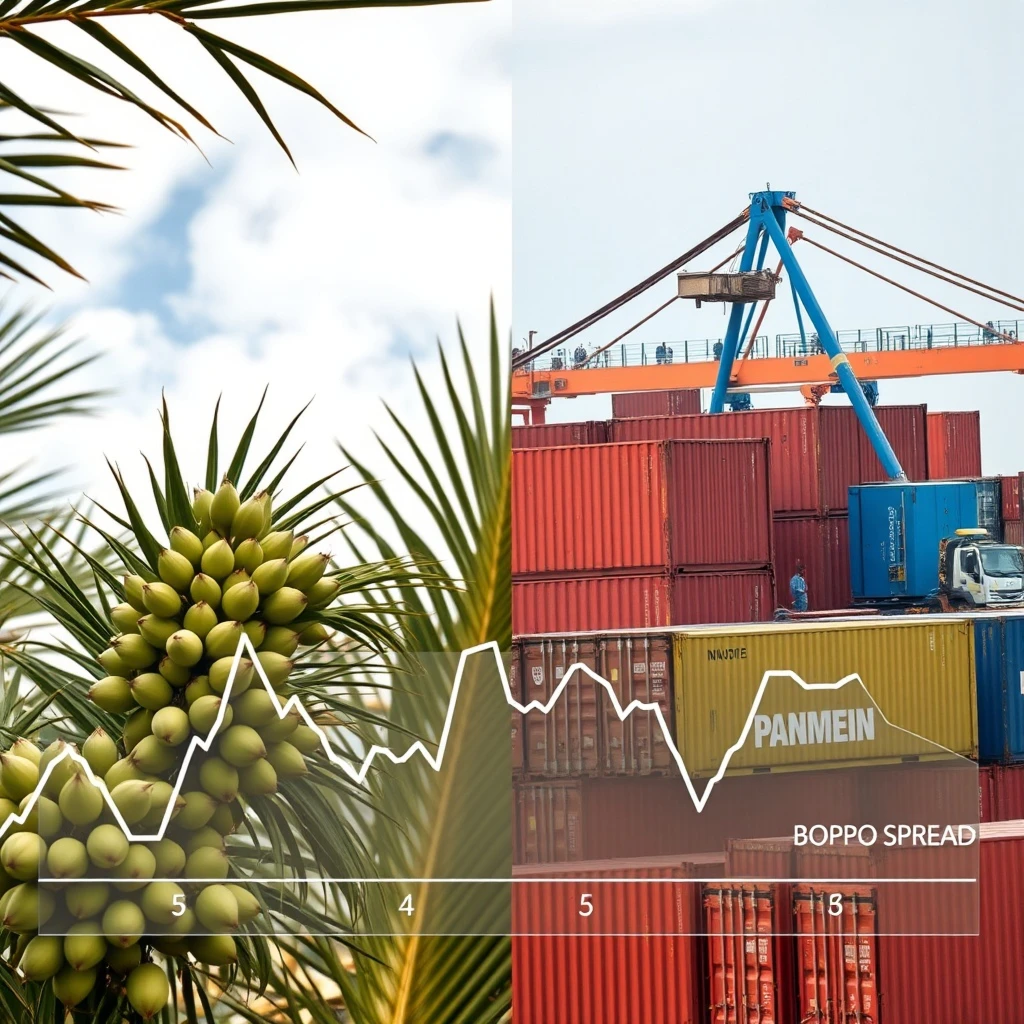
Where the Market Stands Malaysian benchmark crude palm oil (CPO) futures edged 0.3% lower to about $1,101 per metric tonne (RM4,498/MT) on Monday, extending a cautious tone as traders weighed a mixed demand–supply picture. The global palm oil benchmark tracked by the World Bank stood near $1,105/MT, while Indonesia’s Kemendag reference price remained at a discount around $1,030/MT. Brent crude oil was flat on the day at roughly $90/bbl, but remained down 1.9% over the past week—a drag on biodiesel economics. The ringgit traded at 4.09 per US dollar, offering little directional cue.
Upward Forces: Demand and Supply Risks A wide soybean oil–palm oil (BOPO) premium of $481/MT continues to steer price-sensitive buyers toward palm. This heavy discount makes CPO the cheapest among major vegetable oils, encouraging food and industrial users to switch to palm and supporting near‑term demand.
India’s festival‑driven restocking is another pillar. Imports typically surge from July through October ahead of Diwali, and early trade data point to a strong seasonal pulse, tightening availability in the physical market just as sellers position for that flow.
Longer‑term, the developing El Niño (ONI +1.0°C) is injecting a risk premium. While the current state helps harvesting in the short run, historical episodes show that sustained dry conditions eventually stress trees and drag on yields. The market is already pricing in the possibility of a smaller production cycle next year, adding a floor under spot prices despite ample current supplies.
Downward Forces: Output and Macro Headwinds The seasonal peak in Southeast Asian production remains the most immediate bearish lever. July through October is the high‑output window in both Malaysia and Indonesia, and early data confirm supplies are building. Malaysia’s June MPOB report—though now 59 days old—showed production jumping 8.1% month‑on‑month and end‑stocks rising 3.7% to 1.33 million tonnes, keeping the stocks‑to‑use ratio at a comfortable 13%.
The Indonesian rupiah’s persistent weakness is magnifying the export flow. A softer IDR makes Indonesian palm more competitive in dollar terms, encouraging shipments and swelling the regional supply pool, which puts downward pressure on Malaysian benchmarks.
Weaker crude oil is also sapping upward momentum. The 1.9% weekly drop in Brent erodes the competitiveness of palm‑based biodiesel, particularly in Indonesia’s B35 mandate and Malaysia’s B20 program, cutting a source of incremental demand that often props up CPO during price dips.
Speculative positioning in related markets adds a final layer of bearishness. CBOT soybean oil net long positions tumbled by 15,493 contracts in the latest reporting week, signaling that a crowded long trade is unwinding. This liquidation spills over into palm oil futures, where managed money often holds correlated bets.