
El Niño Still Entrenched
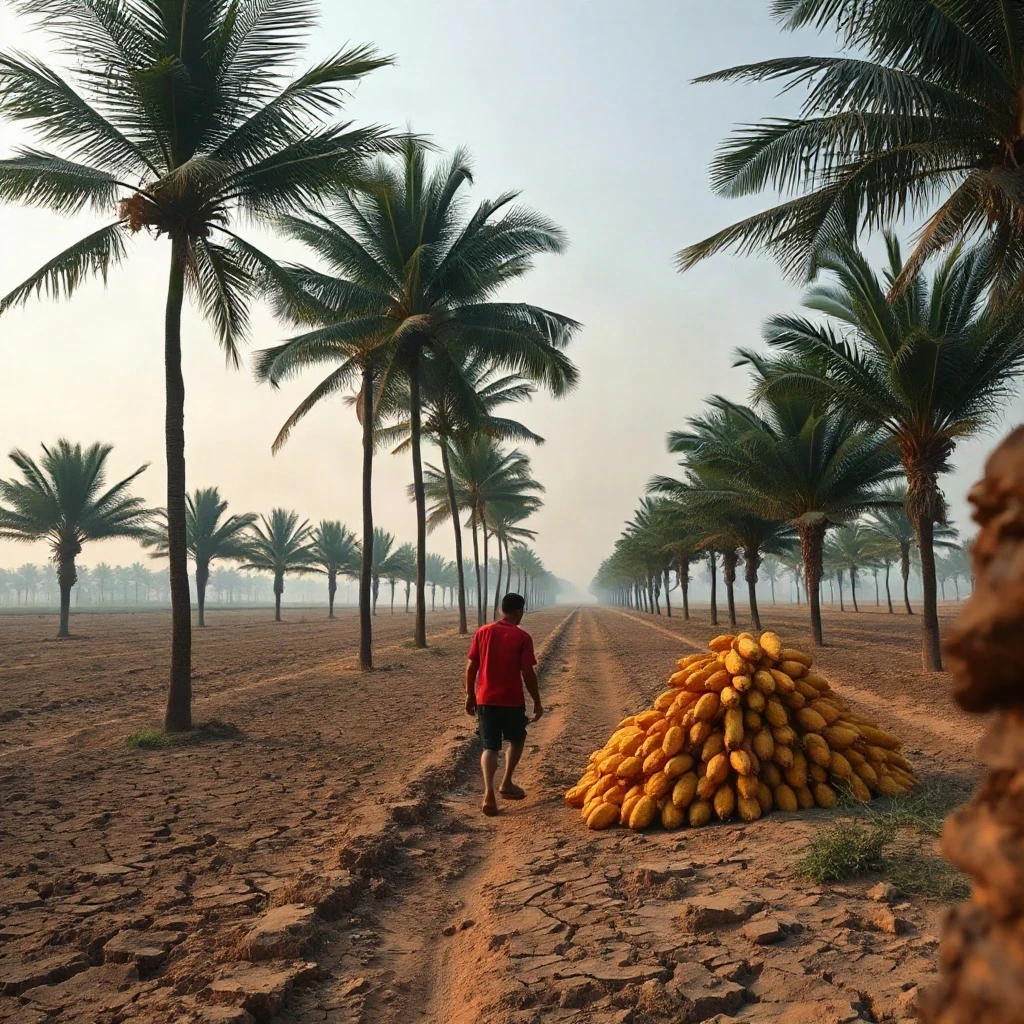
The equatorial Pacific remains in an El Niño state, with the ONI reading at +1.8. For the Southeast Asian palm belt that is the classic dry-risk signal: suppressed convection over Indonesia and, in weaker form, parts of Malaysia. The current rainfall picture already shows notable dryness across Kalimantan, the Indonesian portion of Borneo that accounts for a meaningful share of the country's crude palm oil output.
Two Clocks Running at Once
Palm oil responds to weather on two very different timescales, and the market is currently watching both.
- The immediate clock: heavy rain disrupts harvesting, fruit evacuation and mill logistics. Waterlogged estates and flooded access roads delay the movement of fresh fruit bunches, and quality can slip if fruit sits too long before processing.
- The delayed clock: drought stress shows up in yields with a lag of roughly six to twelve months. The mechanism is well established - prolonged moisture deficit reduces female flower formation and, later, individual fruit bunch weight.
That lag matters for how the current El Niño should be read. Any yield damage from this dry spell would land in the 2027 output window rather than in the next few months of production data.
What It Means for Output Now
Near-term Malaysian production remains in its seasonal peak cycle, and the August MPOB data reflect that: crude palm oil output of 1,817,499 tonnes, up 1.4% month on month. Closing stocks rose 15.2% month on month to 1,645,570 tonnes while exports fell 7.5% to 1,294,664 tonnes - a comfortable supply picture that has little to do with weather and everything to do with the calendar.
Indonesia's belt is the more exposed of the two to the current dry anomaly. Kalimantan dryness, if it persists through the coming weeks, would first be felt in evacuation logistics and later in bunch development. Our model outlook has Malaysian crude palm oil consolidating near RM4,606 after a three-session slide, with ample stocks and peak-cycle production pressing prices against a floor built on wide BOPO economics and Indonesian biodiesel demand. The published path points to modest weakness over the next seven sessions, in a range of RM4,550-4,650.
The Watch Items
- Whether Kalimantan rainfall deficits deepen or ease over the next several weeks.
- Any shift in the ONI trajectory - a move toward neutral or La Niña would typically bring wetter conditions back to Southeast Asia, flipping the risk from drought to harvest disruption.
- How quickly the market begins pricing the delayed yield channel into forward supply expectations.
For now, the weather signal is a slow-burn story: no immediate supply shock, but a dry anomaly worth tracking into next year's crop.