
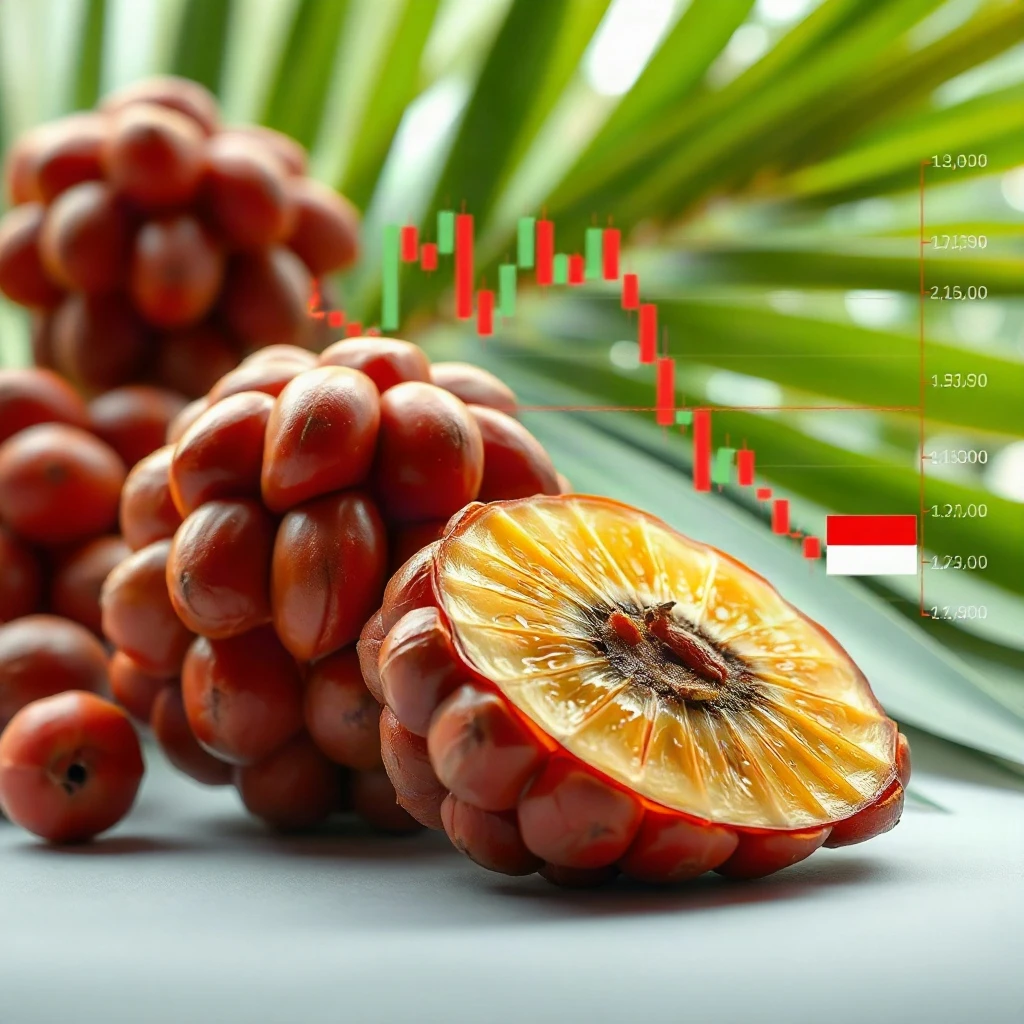
Malaysian CPO benchmark traded at about $1,128 per tonne on 2026-09-14, down 0.8% from the previous session and equivalent to RM4,596 per tonne. The World Bank palm oil benchmark was around $1,117/MT, and Indonesia's Kemendag reference price was $1,008/MT. Brent crude slipped 0.3% on the day, with Brent around $107/bbl, while USD/MYR stood near 4.07 ringgit per dollar.
What is pushing it up Wide BOPO spread: CBOT front-month soy oil at $1,543/t versus CPO at $1,128/t leaves a $414/t discount for palm. That makes palm the cheaper vegetable oil, which can shift import demand from soy oil to palm, tightening palm availability.
Indonesia B50 biodiesel ramp-up: Pertamina reports B50 distribution at 95% and is targeting 100% by end-September. This absorbs roughly 3-4 Mt/yr of palm oil into domestic biodiesel, diverting supplies away from export markets and underpinning global CPO.
Brent crude rally: Brent is around $107.7/bbl, up 3.1% over seven sessions. Higher crude raises the energy-linked value of biodiesel, improving discretionary blending economics for palm-based biodiesel and increasing demand for palm feedstock.
Indonesia export policy burden: The reference price of $1,008/t carries a $126/t levy plus a $148/t export duty. That heavy export cost slows Indonesian selling because exporters must clear high fees before cargoes leave; it pushes global buyers toward Malaysian CPO, supporting Malaysian prices.
Weaker ringgit: USD/MYR at 4.07 means the ringgit has eased against the dollar. A weaker ringgit lowers the cost of Malaysian palm in importing countries' currencies, supporting Malaysian export competitiveness and demand.
El Niño lagged supply risk: ENSO is El Niño with ONI +1.8 and notable dry conditions in Kalimantan. Historically, El Niño cuts Southeast Asian yields 6-12 months later. The market is already pricing that lagged supply risk, adding bullish anticipation even while current stocks are ample.
What is pushing it down MPOB August stocks build: Malaysia's closing stocks jumped 15.2% MoM to 1.646m tonnes, with total palm stocks at 2.82m tonnes, +7.48%. The stocks-to-use ratio rose to 14.1%, which is ample. High visible stocks make buyers less urgent and put near-term pressure on spot CPO.
Seasonal peak production: July-to-October is the peak output window. August production rose 1.4% MoM to 1,817,499 tonnes, and September historically sees only a small -0.9% MoM dip. Strong current supply reinforces the bearish seasonal flow.
Technical momentum: Short-term momentum is bearish. The MACD histogram is negative, price is below the 5-day and 20-day moving averages, and RSI is at 50. Although the 5/20 golden cross remains intact, traders may sell rallies until price reclaims those moving averages.
Which side has the upper hand Our model outlook counts six bullish factors against three bearish factors, so the upside currently has the upper hand. That does not mean prices are rising every session: the published path is -0.8% over seven sessions, and the near-term momentum remains choppy with a slight downward bias. The August MPOB stock build and seasonal peak output are strong near-term bearish forces, but the demand-side factors — the wide BOPO spread, Indonesia B50 ramp-up, high Brent, export levy burden, weaker ringgit and El Niño risk — are capping the downside and pulling the balance upward.
To flip the balance to bearish, the market would need to see repeated large stock builds, a sharp compression in the soy oil premium, a meaningful drop in Brent, a firmer ringgit, or a setback in Indonesia's B50 rollout. Without those changes, the balance of drivers supports prices.