
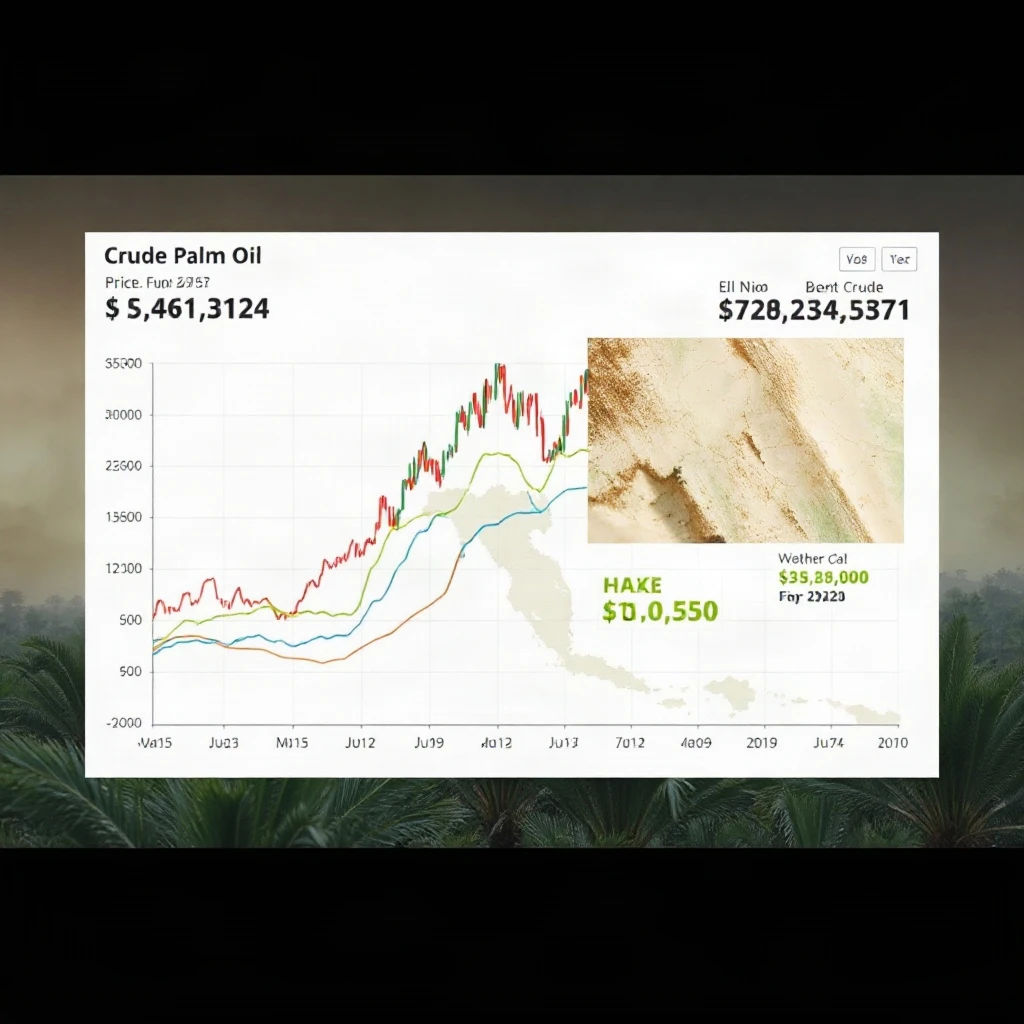
Malaysian CPO benchmark is about $1,152/MT (RM 4,664/MT), up 0.7% on the session. That leaves the contract near 52-week highs, above the World Bank benchmark at $1,117/MT and the Indonesian reference at $1,008/MT. Brent crude is about $98/bbl, up 0.5% on the day and 1.1% over the past week, while USD/MYR is about 4.05.
What is pushing CPO up
The widest demand-switching lever is the BOPO spread at $385/MT. Daily CBOT soybean oil at $1,538/MT versus CPO at $1,153/MT means palm trades at a heavy discount to soybean oil. When that gap is wide, food and industrial buyers can save money by switching formulations from soyoil to palm, pulling extra demand into the palm market and putting a cushion under prices even when spot supply is ample.
El Niño remains in play at ONI +1.8°C, and Kalimantan rainfall over the next seven days is only about 10 mm. Dry conditions and haze risk—already cited in a September 7 headline on smoke-haze fears disrupting Indonesian production—raise the chance of lower yields and difficult harvesting/transport. Buyers respond to that supply threat by bidding for current and forward cargoes, supporting the curve.
Brent near $98/bbl keeps biofuel blending unusually attractive. The POGO spread is around -$328/t, in the 1st percentile, meaning palm is cheap relative to gasoil. That makes discretionary biodiesel blending economic before any mandate forces it, creating an additional demand channel for CPO. Indonesia's B50 mandate, in force since July 1 and absorbing an estimated 3–4 million tonnes a year, adds medium-term demand even if near-term El Niño supply questions remain.
The price structure is also positive: MACD histogram positive, a 5/20 SMA golden cross, price above the 5-, 20- and 50-day SMAs, and RSI at 63—not yet overbought—leaving room toward the upper Bollinger band around $1,173/MT.
What is pushing CPO down
The heaviest near-term weight is the upcoming MPOB August data, due in about three days. Preview headlines from September 4 already flag a likely seven-month high in inventories. July closing stocks were 1,429,316 tonnes, up 7.2% month on month and 61% above the five-year average, with a stocks-to-use ratio of 12.5%. If the August print confirms that seasonal surplus, it tells buyers there is no immediate shortage; traders may lighten positions before the release rather than chase prices.
September itself is historically weak—averaging -0.9% month on month—and the production seasonal path points about +7.0% one month ahead. Malaysian output is in the July–October peak window. More supply coming to market reduces urgency, so buyers can wait for better offers, pressuring spot CPO.
The veg-oil complex is holding a crowded speculative long. CFTC soybean oil managed-money net length sits at the 85th percentile and rose 21,470 contracts week over week. That positioning is vulnerable to long liquidation if MPOB data or soybean oil disappoints; a liquidation cascade would amplify any bearish news.
Where the balance sits
The scorecard in our model is five bullish factors against three bearish. The upside currently has the upper hand. Demand-switching via the wide BOPO spread, biodiesel economics, El Niño/haze supply risk, and positive technicals are outweighing the known seasonal stock build. Our model outlook is for a choppy, slightly positive drift, with a likely data-driven dip when the August MPOB release lands; the published path is +1.2% over seven sessions.
To flip the balance, the bearish factors would need to dominate: an August stocks number well above the expected seven-month high, a rapid unwind of the crowded managed-money long in soybean oil, a narrowing BOPO spread that removes the demand-switching cushion, or a rise in the POGO spread that makes discretionary biodiesel blending less economic. If the El Niño/haze supply threat fades or Indonesian export policy materially changes levy burdens, the bull case would also lose some support.
Two neutral factors are worth noting. Indonesia's export reference price is about $1,008/MT, with a $126 levy and $148 export duty; GAPKI has warned against further increases, and if levies are capped, Indonesian exports may not slow enough to redirect demand toward Malaysia. Separately, India's Diwali stocking window opens in about 12 days, but our model finds the pre-Diwali effect historically indistinguishable from zero, so it is calendar context rather than a directional signal.