
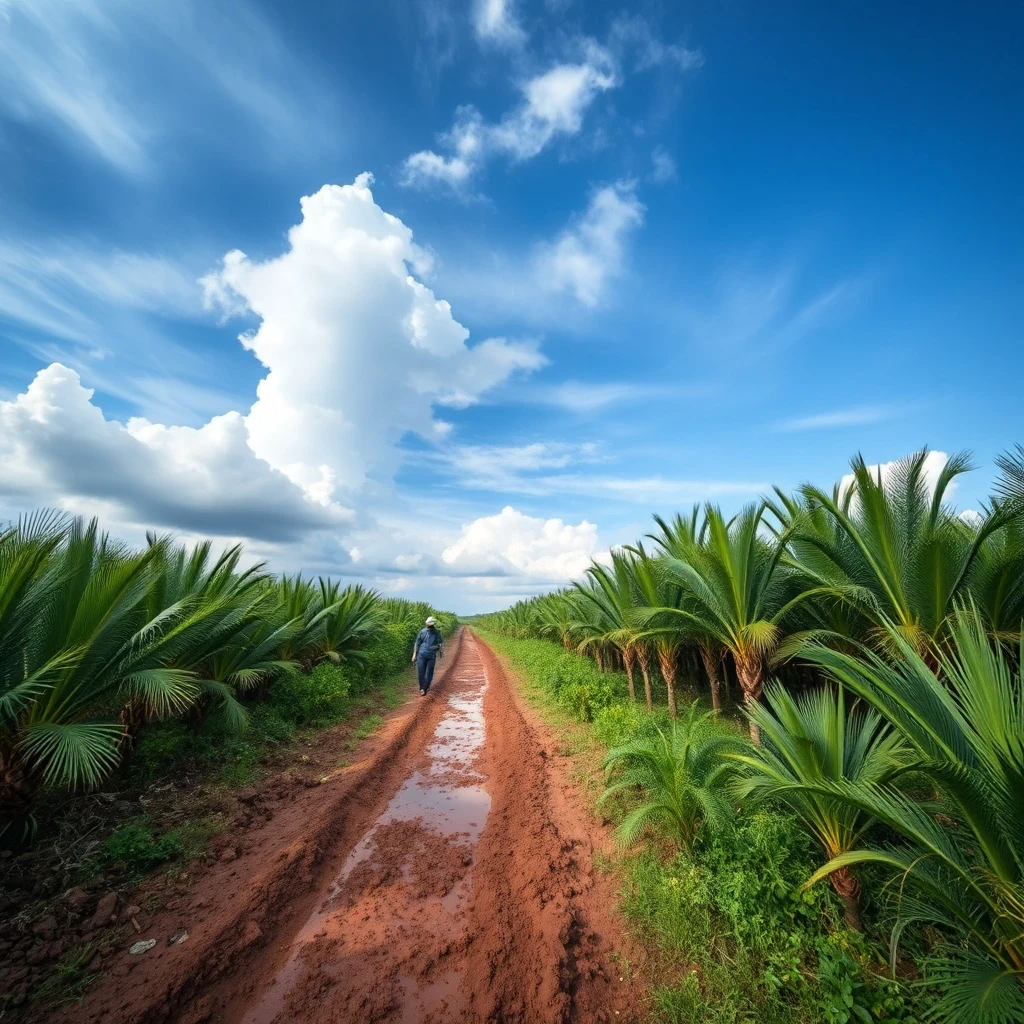
Current weather signal
The tropical Pacific is in an El Niño state, with the Oceanic Niño Index at +1.8. Across the Malaysian and Indonesian oil palm belts, the seven-day rainfall outlook remains broadly normal. That means no widespread flooding, ponding or field-access problems are currently expected in the main producing regions.
What that means for output
Normal rainfall supports near-term harvesting and transport. Fresh fruit bunches can be cut and moved from estates without the kind of wet-weather disruption that often slows field work. In the immediate sense, the weather is not tightening fresh supply.
El Niño works differently. Moisture stress affects oil palm with a lag of roughly six to twelve months. The drier conditions associated with a strong El Niño tend to reduce bunch initiation and development, and that shows up later in lower yields. With the ONI already at +1.8, the current El Niño is building a forward risk to production even though rainfall is still broadly normal right now. In past El Niño episodes, the effect on Indonesian and Malaysian production has not been immediate. Stress on palms accumulates over months: vegetative growth slows, sex ratios can shift and bunch weight declines later. Because the current rainfall is still broadly normal, the seven-day view may look benign, but the background ONI is a better guide to production risk several quarters ahead.
- Near-term: broadly normal rainfall across the belts supports steady harvesting and logistics.
- 6–12 months out: El Niño-linked moisture stress can lower bunch formation and eventual yields.
- Risk switch: if rain turns heavy, short-term harvesting and transport would be disrupted before the lagged El Niño effect appears.
Market context
Malaysian CPO is near $1,143/MT, with the World Bank benchmark near $1,117/MT and Indonesia's reference near $1,008/MT. The weather picture adds a forward supply question to an already mixed market. Our model outlook sees choppy trade around $1,140–$1,160 into the next MPOB report, with the lagged El Niño threat a key upside risk once the current inventory pressure clears. Biodiesel blend economics, supported by Brent near $96/bbl, add demand-side support that may amplify any weather-driven supply concern.