
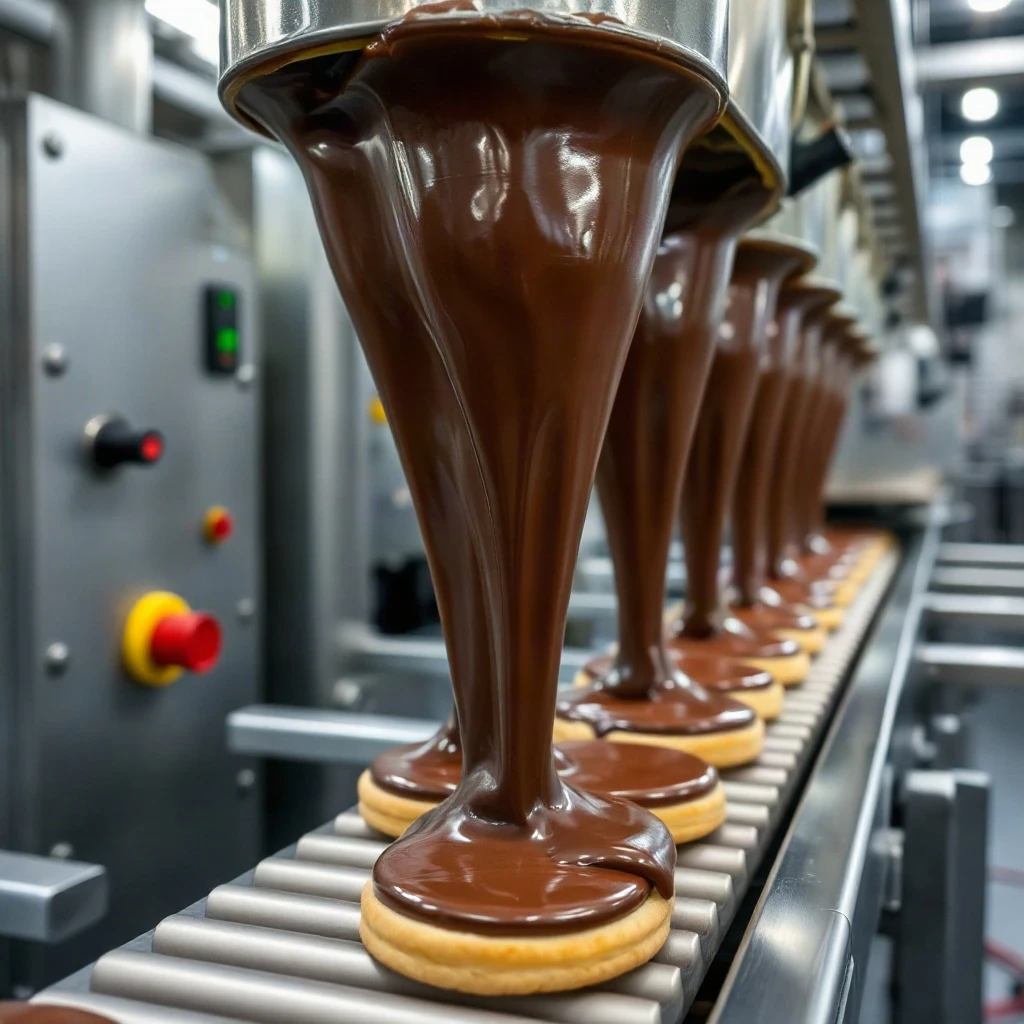
Cocoa butter substitutes (CBS) are non-lauric vegetable fats engineered to mimic the physical behavior of cocoa butter without requiring tempering. They are distinct from cocoa butter equivalents (CBE) and cocoa butter replacers (CBR) in both chemistry and application. Understanding that difference is the first step in any sourcing decision.
How CBS works
CBS fats are typically produced from palm oil or palm kernel oil through fractionation and hydrogenation. They are lauric fats, meaning they contain high levels of lauric acid (C12). Their triglyceride structure is simple and uniform, which gives them a sharp melting profile near body temperature—around 35-37°C—similar to cocoa butter.
The key technical advantage is that CBS does not require tempering. Cocoa butter has six polymorphic crystal forms, and only the beta-V form gives chocolate its snap and gloss. Achieving that form requires precise temperature cycling. CBS, by contrast, sets directly into a stable beta-prime crystal form when cooled. This eliminates the tempering step, simplifying production and reducing energy and time costs.
However, because CBS is incompatible with cocoa butter—the two fat systems do not co-crystallize—it can only be used in compound chocolate. Products must contain little or no real cocoa butter beyond what is naturally present in cocoa powder. If cocoa butter content exceeds roughly 5% of the fat phase, the finished product can develop bloom, softening, and fat migration issues.
Commercial significance
CBS is significantly cheaper than cocoa butter, which is one of the most volatile and expensive commodities in the food industry. For biscuit coatings, enrobed bars, molded novelty items, and budget chocolate-flavored confections, CBS offers a stable, cost-effective fat phase. It also provides better heat resistance in warm climates, making it attractive for export markets where real chocolate would soften or bloom.
For procurement managers, the commercial logic is straightforward: CBS decouples your coating cost from cocoa butter price swings. But that saving comes with a ceiling—CBS products cannot be labeled as "chocolate" in most jurisdictions, only as "chocolate-flavored" or "compound coating."
What to look for when sourcing
- Fat profile and melting point: Request the complete fatty acid and triglyceride analysis. A narrow melting range between 32-38°C is ideal for mouthfeel. Higher melting points suit tropical supply chains.
- Iodine value: Lower IV indicates more saturation, meaning better oxidative stability and longer shelf life. Look for IV below 5 for fully hydrogenated grades.
- Lauric acid content: Confirm the lauric profile if you need rapid set and hardness; note that lauric fats can develop a soapy off-flavor if lipase enzymes are present, so verify the supplier's enzyme inactivation steps.
- Tempering requirement: Confirm the fat is a true CBS (no tempering) versus a CBE (which requires tempering). Mislabeling is common in low-cost supply.
- Traceability and certification: Given palm oil's sustainability scrutiny, ask for RSPO certification or equivalent. Verify that the supplier's fractionation and hydrogenation processes are documented with batch-level QC data.
- Compatibility testing: Always run a pilot batch with your exact recipe. Test for bloom resistance, snap, gloss retention, and fat migration over a 3-6 month accelerated shelf-life study.
Bottom line
CBS is not a like-for-like replacement for cocoa butter—it is a different tool for a different product tier. The winning strategy is to match the fat system to the application and label claim, not to force one fat into every product. Source with full technical data, verify compatibility at pilot scale, and treat price savings as secondary to functional performance and supply-chain reliability.