
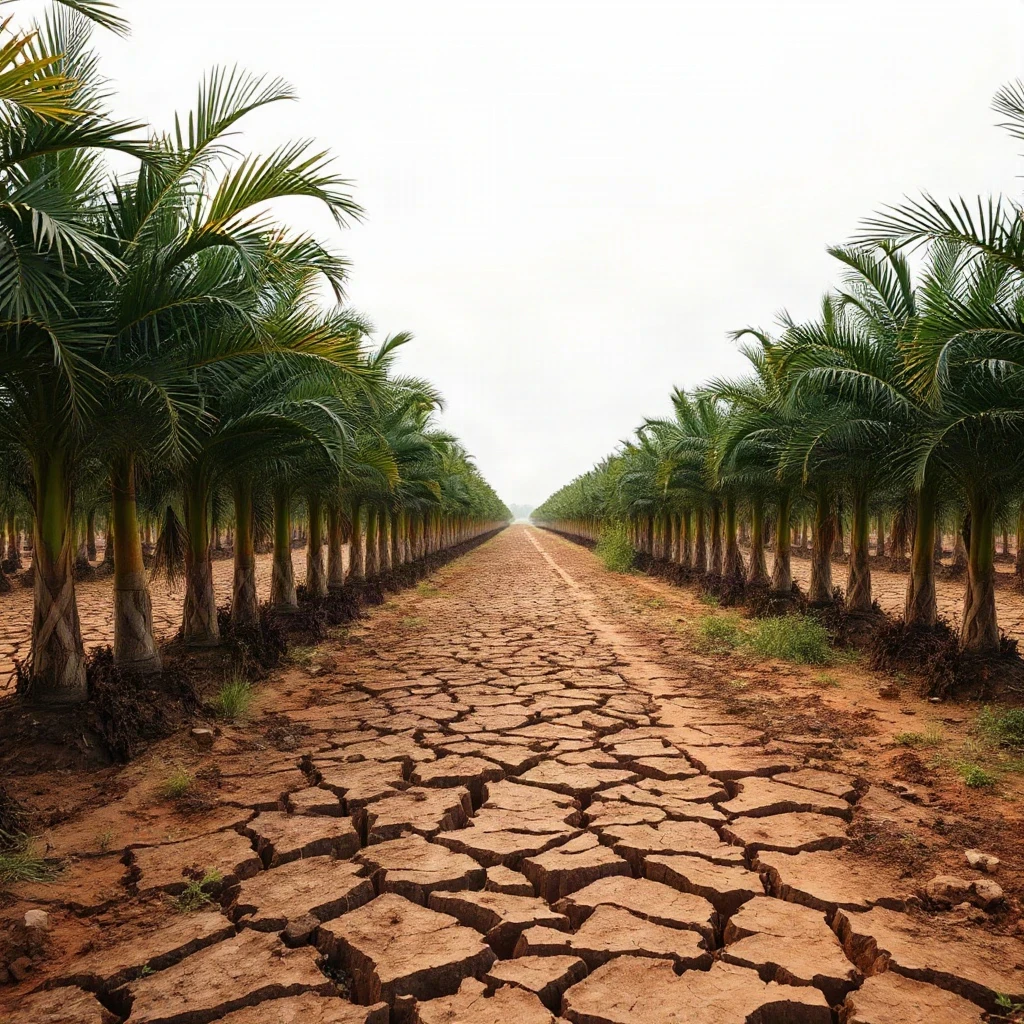
The palm oil belt across Malaysia and Indonesia is entering a critical dry phase, with the ENSO state firmly in El Niño territory at ONI +1.4. The latest 7-day rainfall outlook shows notably dry conditions across Sarawak, Sumatra, Riau and Kalimantan — the core producing regions for both countries' palm oil output.
For the near term, the dryness is a double-edged sword. Harvesting and logistics generally proceed more smoothly in dry weather, which can support short-term collection and mill throughput. However, the current El Niño pattern carries a well-documented lagged effect: drought stress typically reduces fruit bunch weight and overall yields roughly 6 to 12 months after the peak dry period. That points to a softer production profile well into 2027 if the current dryness persists through the coming months.
Malaysia: Sarawak in focus
Malaysia's July 2026 MPOB data showed CPO production at 1,792,979 tonnes, up 9.4% month-on-month, with closing stocks at 1,429,316 tonnes. The month-on-month gain reflects seasonal patterns, but the dry spell in Sarawak — the country's largest producing state — is a concern for the next crop cycle. FFB reference prices edged up 1.2% to RM 49.50, suggesting some market recognition of the weather risk.
Exports rose 14.5% month-on-month to 1,392,178 tonnes in July, while imports fell sharply to 49,566 tonnes. The export strength helped absorb some of the production increase, but stocks still built by 7.2%, leaving ample near-term supply. The question is whether the dry weather now begins to constrain output in the months ahead, tightening the balance into early 2027.
Indonesia: Sumatra and Kalimantan dry
In Indonesia, the dry signal across Sumatra and Kalimantan is the main watch point. These regions account for the bulk of Indonesian palm oil output, and the current dryness mirrors the pattern seen in previous El Niño events. The government's reference price stands at about $997/MT, below both the Malaysian benchmark and the global World Bank reference of about $1101/MT.
Biodiesel demand remains a supportive factor. Indonesia's B50 program continues to absorb domestic supply, and with Brent crude up 3.6% to about $92/bbl, the economics of palm-based biodiesel blends look more favorable. That supports overall demand for crude palm oil even as the weather story evolves.
Model outlook: mild bullish drift
Our model outlook, based on the Aug 27 close of $1143/MT, sees a base case of mild bullish drift with profit-taking, with the benchmark likely to trade in a range of roughly $1140–$1165/MT over the near term. The published path implies a gain of about 1.5% over seven sessions.
Supporting factors include the strengthening El Niño, Indonesia's B50 demand, a wide BOPO spread and an upbeat September outlook from MPOC. Against that, July MPOB stocks are ample, August data due in roughly 14 days may show a build, CFTC net long positioning is crowded, and September seasonality is historically weak.
The key variable is rainfall over the next several weeks. If the dry conditions deepen across Sarawak, Sumatra, Riau and Kalimantan, the market will begin pricing in the lagged yield impact more aggressively. For now, the weather is a slow-burn risk — one that builds into the 2027 crop rather than disrupting this season's output immediately. Heavy rain, when it does come, would disrupt harvesting and logistics in the short term, but the more persistent threat is the lingering dryness that trims fruit bunch weights months from now.