
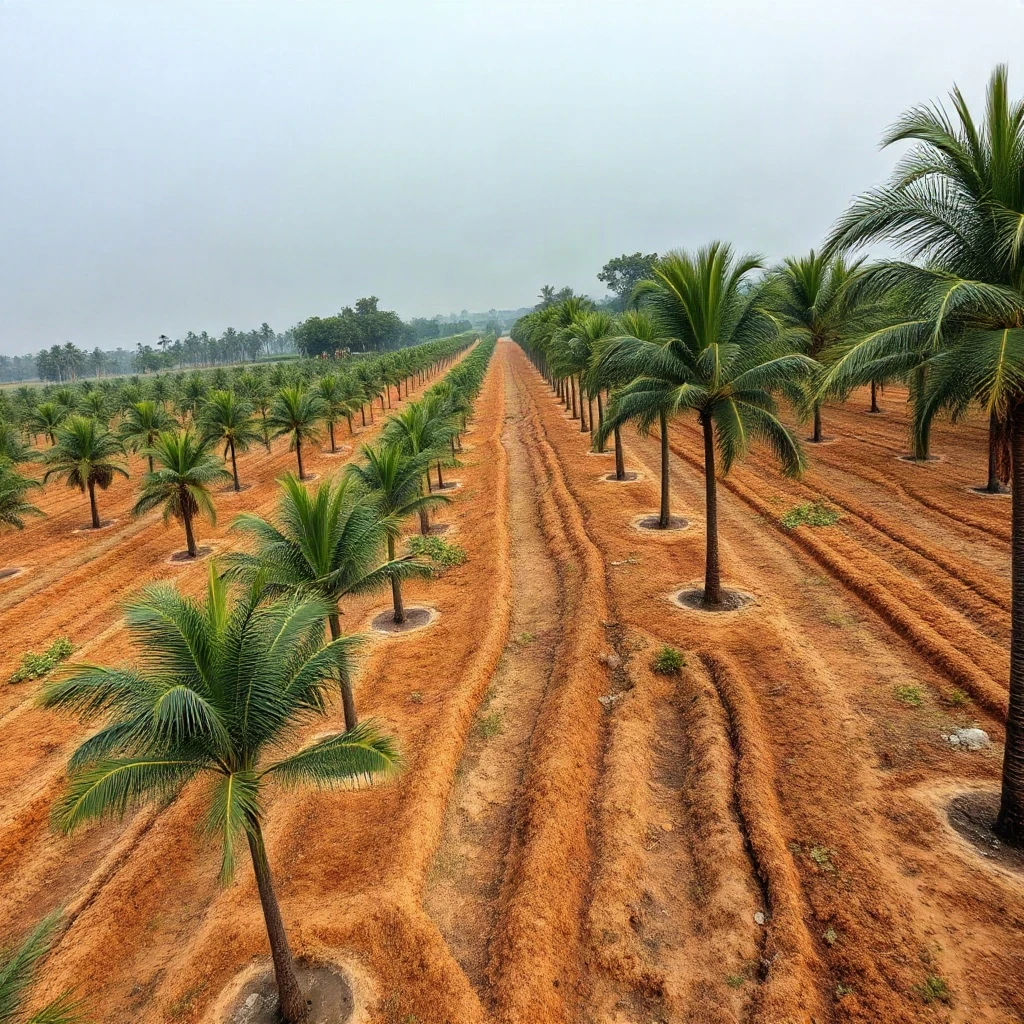
The palm oil market's daily tape is dominated by weather, policy and inventory swings, but the structural question for buyers is simpler and larger: how much new supply must the industry bring to market each year just to keep pace with demand growth from population and rising incomes?
Global population growth adds on the order of 70-80 million people per year, and per-capita edible oil consumption rises with income, particularly in developing Asia and Africa. Palm oil, as the lowest-cost major vegetable oil, captures a disproportionate share of that incremental demand. Industry trackers generally estimate world vegetable oil demand grows by roughly 3-4 million tonnes per year, with palm oil's share of that increment on the order of 40-50%.
Current Supply Signals Are Mixed
Malaysia's July 2026 data show the system can still respond when weather cooperates: CPO production rose 9.4% month-on-month to 1.79 million tonnes, and exports jumped 14.5% to 1.39 million tonnes. But closing stocks of 1.43 million tonnes, up 7.2% from June, are a reminder that near-term supply is adequate — a bearish counterweight to the forward-looking demand story.
The weather picture complicates the supply outlook. The current El Niño (ONI +1.4) has left Sarawak and Kalimantan dry, and dry conditions during the current growing window typically feed through to weaker output nine to twelve months later. That points to a tighter 2027 supply profile, even as the market digests the current stockbuild.
Price Context and the Demand Signal
At about $1,143/MT for Malaysian CPO (RM 4,613), the benchmark sits above the World Bank global reference of roughly $1,101/MT and well above Indonesia's $997/MT reference price. The wide gap between palm and other vegetable oils — the BOPO spread — keeps palm competitive in price-sensitive markets, which is exactly where income-driven demand growth is strongest.
Biodiesel policy adds another demand layer. With Brent near $88/bbl, palm-based biodiesel remains economically attractive in producer countries, and Indonesia's B50 programme represents a structural, policy-backed demand source that is largely insensitive to food-market prices.
What Would Change the Picture
For the long-run demand story to weaken, one would need to see a sustained slowdown in population growth, a shift in dietary patterns away from vegetable oils, or a structural rise in palm's price relative to competing oils that would push buyers toward rapeseed, soybean or sunflower oil. None of those are visible in current data.
For supply to keep up, the industry needs yield improvements, area expansion in suitable regions, and normal weather. A prolonged El Niño extending into 2027 would tighten the market significantly.
What a Buyer Should Watch
- Weather updates in Sarawak and Kalimantan over the next 3-6 months — dry conditions now are the single biggest swing factor for 2027 supply.
- MPOB monthly data for August and September, to see whether the July stockbuild was a one-off or the start of a seasonal build.
- B50 implementation pace in Indonesia — any delay would ease the demand-side pressure.
- The BOPO spread — if it narrows sharply, palm loses its price advantage and demand growth shifts to other oils.
Our model outlook sees the market caught between these forces: choppy with a slightly positive bias over the next seven sessions, with pullbacks limited by supply warnings and the wide spread. The long-run arithmetic, however, remains firmly on the demand side.