
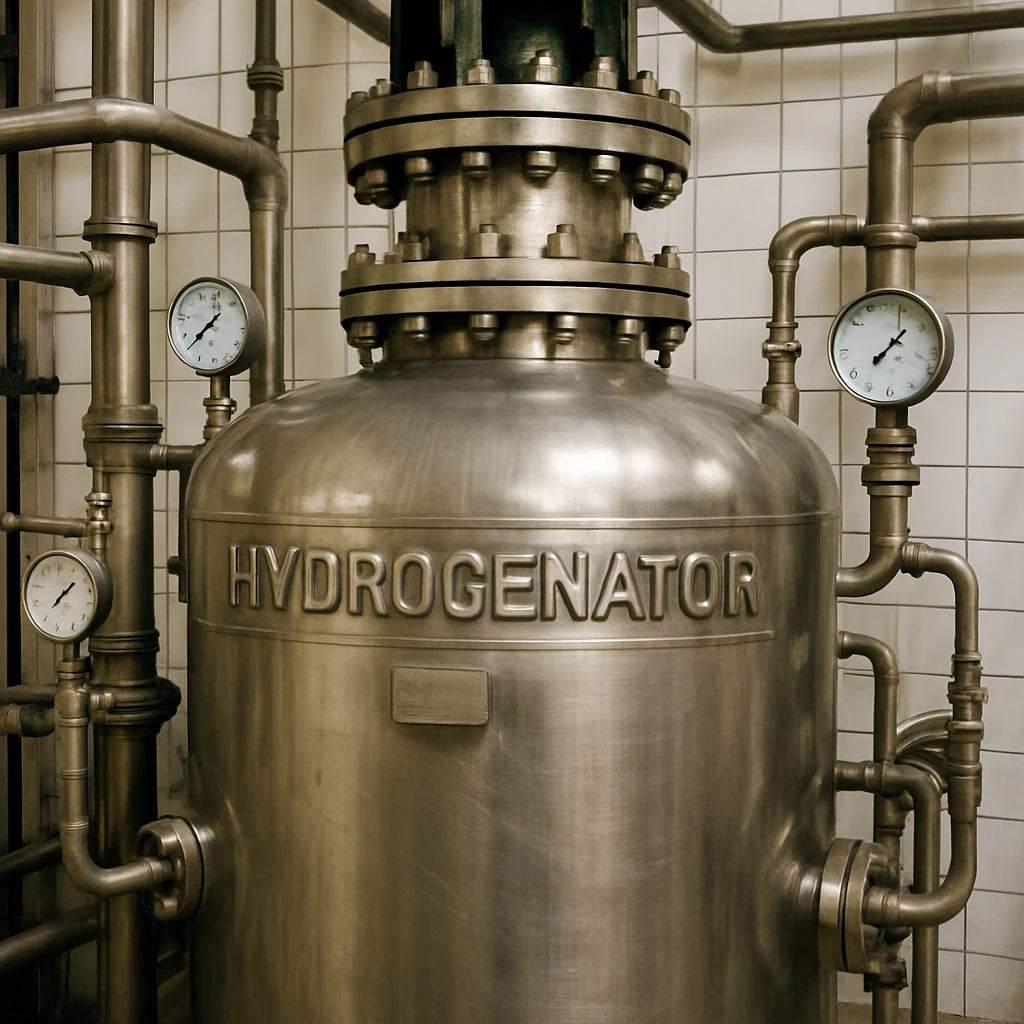
Hydrogenation is a standard modification process in palm oil refining. It adds hydrogen to unsaturated double bonds in fatty acids, reducing the oil's iodine value and raising its melting point. For procurement managers and first-time buyers, hydrogenated palm products offer harder textures, better oxidative stability, and tailored melting profiles.
What HPO, HPS and powdered fats are
- HPO (Hydrogenated Palm Oil): produced by hydrogenating refined, bleached and deodorised (RBD) palm oil. Depending on the degree of hydrogenation, its slip melting point rises from about 36°C for native palm oil to typically 40–50°C or higher. HPO is used in margarine hardstocks, shortenings, bakery fats and confectionery coatings where a firmer set is needed.
- HPS (Hydrogenated Palm Stearin): made from palm stearin, the solid fraction of palm oil. Hydrogenation further hardens it, usually giving slip melting points above 50°C and very low iodine values. HPS acts as a hard structural fat in specialty fats, fillings, and as the base for many powdered fats.
- Powdered fats: high-melting hydrogenated fats, often HPS or blends, are converted into fine free-flowing powders by spray chilling. Molten fat is atomised in a cooled chamber to form small spherical particles. Powdered fats suit dry mixes, instant soups and sauces, bakery premixes and nutritional formulations.
Why hydrogenation matters in procurement
- Melting point and hardness: specify slip melting point (SMP) to match the application. HPO generally has a lower SMP than HPS; powders need a high enough melting point to remain free-flowing in storage but melt during final use.
- Oxidative stability: hydrogenation lowers iodine value, which reduces susceptibility to oxidation and extends shelf life. Fully hydrogenated products have negligible double bonds.
- Trans fatty acids: partial hydrogenation can produce trans fats. Fully hydrogenated oils contain only trace amounts, but buyers should confirm the specification if trans fat labelling matters.
- Powder handling: for powdered fats, request particle size distribution, bulk density, flowability and moisture content. Anti-caking agents may be added.
Practical buying checks
- Ask for a certificate of analysis covering free fatty acids, moisture and impurities, iodine value, slip melting point, colour, and trans fat content where relevant.
- Confirm whether the product is fully or partially hydrogenated, as this affects the melting curve and regulatory labelling.
- For powders, check particle size (e.g., percentage passing a specified mesh), bulk density, and storage conditions—cool, dry, and below the melting point.
- Review packaging: cartons, bags, drums or bulk. Hydrogenated fats can be brittle, so packaging must protect against breakage and moisture pick-up.