
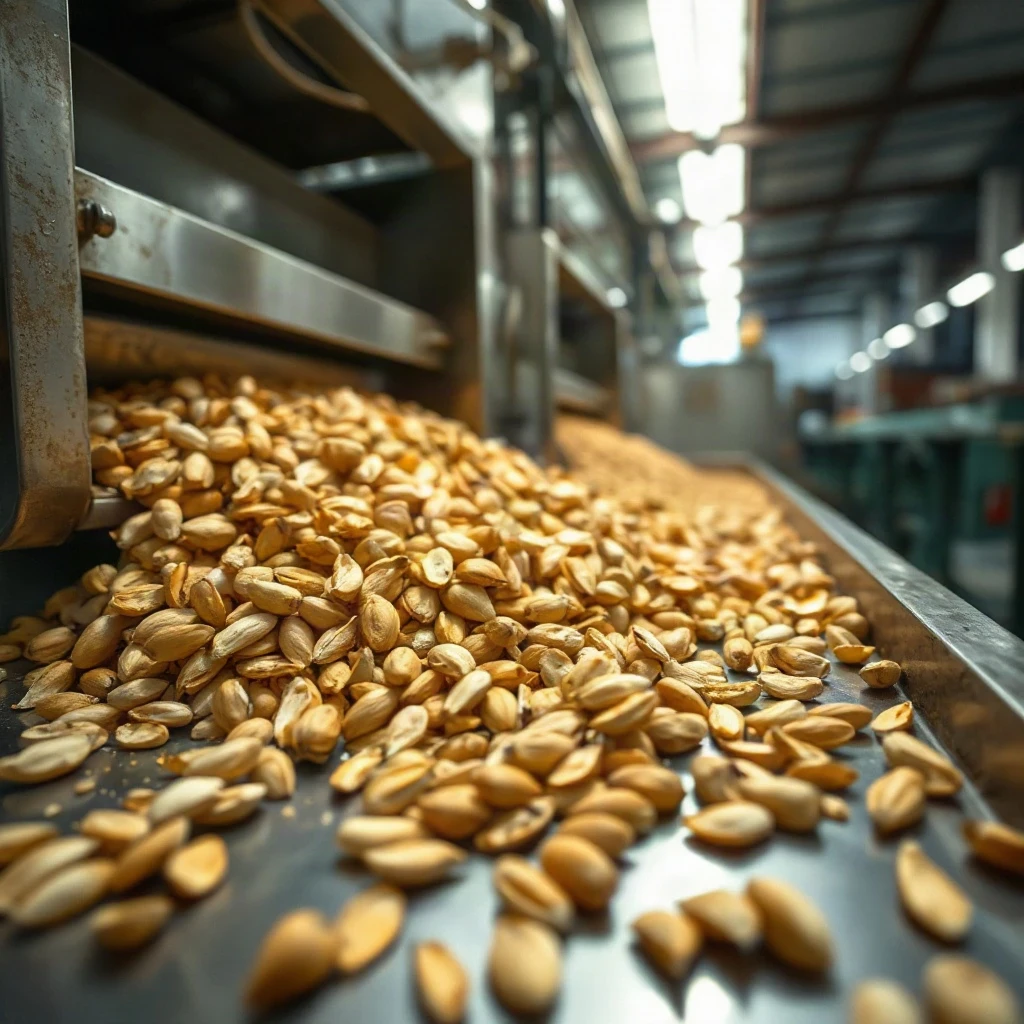
Palm kernel oil (PKO) is extracted from the kernel of the oil palm fruit, distinct from the mesocarp oil that yields crude palm oil. For procurement managers and food technologists, understanding the full processing chain is essential for assessing quality, cost, and supply risk.
From Fruit to Kernel: The Cracking Stage
After palm fruits are harvested and sterilized, they pass through a thresher to separate the fruitlets, which are then pressed to extract crude palm oil. The remaining press cake—a fibrous mass—contains the nuts. These nuts are dried and then passed through a mechanical cracker, typically a centrifugal or roller-type machine, that breaks the hard shell without damaging the kernel inside.
The cracked mixture is separated by a combination of winnowing (air classification) and hydrocyclone or clay-bath separation, which exploits density differences to isolate the lighter shells from the heavier kernels. Kernels are then dried to a moisture content of about 7-10% to prevent fungal growth and facilitate subsequent oil extraction.
Extraction: Pressing and Solvent Recovery
Dried kernels undergo mechanical pressing in a screw press, which recovers roughly 40-45% of the oil. The remaining oil in the press cake is typically recovered using solvent extraction with hexane, similar to soybean processing. The solvent is stripped from the oil and cake in a desolventiser-toaster, leaving a high-protein kernel meal (a valuable animal feed) and a crude palm kernel oil (CPKO).
Refining: From Crude to RBD Palm Kernel Oil
CPKO contains free fatty acids (FFA), phospholipids, and trace metals, which must be removed. The standard route is physical refining, preferred for PKO due to its high FFA content (typically 3-5%).
- Degumming: Addition of phosphoric acid or water to hydrate and remove phospholipids.
- Bleaching: Treatment with bleaching earth under vacuum to adsorb color bodies, oxidation products, and residual metals.
- Deodorisation: Steam distillation under high vacuum and high temperature (about 240-260°C) to strip volatile FFA and odor compounds, yielding RBD (refined, bleached, deodorised) palm kernel oil.
For specialty applications, fractionation follows refining, separating the oil into a liquid olein and a solid stearin. This is crucial for cocoa butter equivalents, confectionery fats, and ice cream coatings.
Why It Matters Commercially
PKO is prized for its high lauric acid content (about 45-50%), which gives it a sharp melting profile, excellent oxidation stability, and rapid crystallization—properties ideal for confectionery, bakery shortenings, and non-dairy creamers. Its price is often benchmarked against coconut oil, and it trades at a premium to crude palm oil due to its functional benefits and lower yield per fruit bunch.
What to Look for When Sourcing
- FFA and moisture specs: Lower FFA (below 0.1% for RBD) indicates good refining and storage.
- Iodine value: A consistent IV range signals batch-to-batch uniformity in fractionation.
- Traceability: Verify the mill's cracking efficiency and kernel quality, as poorly stored kernels develop high FFA and rancidity.
- Certifications: RSPO or ISCC certification may be required for sustainability commitments.
Understanding these process steps enables buyers to negotiate better on quality tolerances, anticipate price movements linked to kernel supply, and select the right PKO grade for their specific application.