
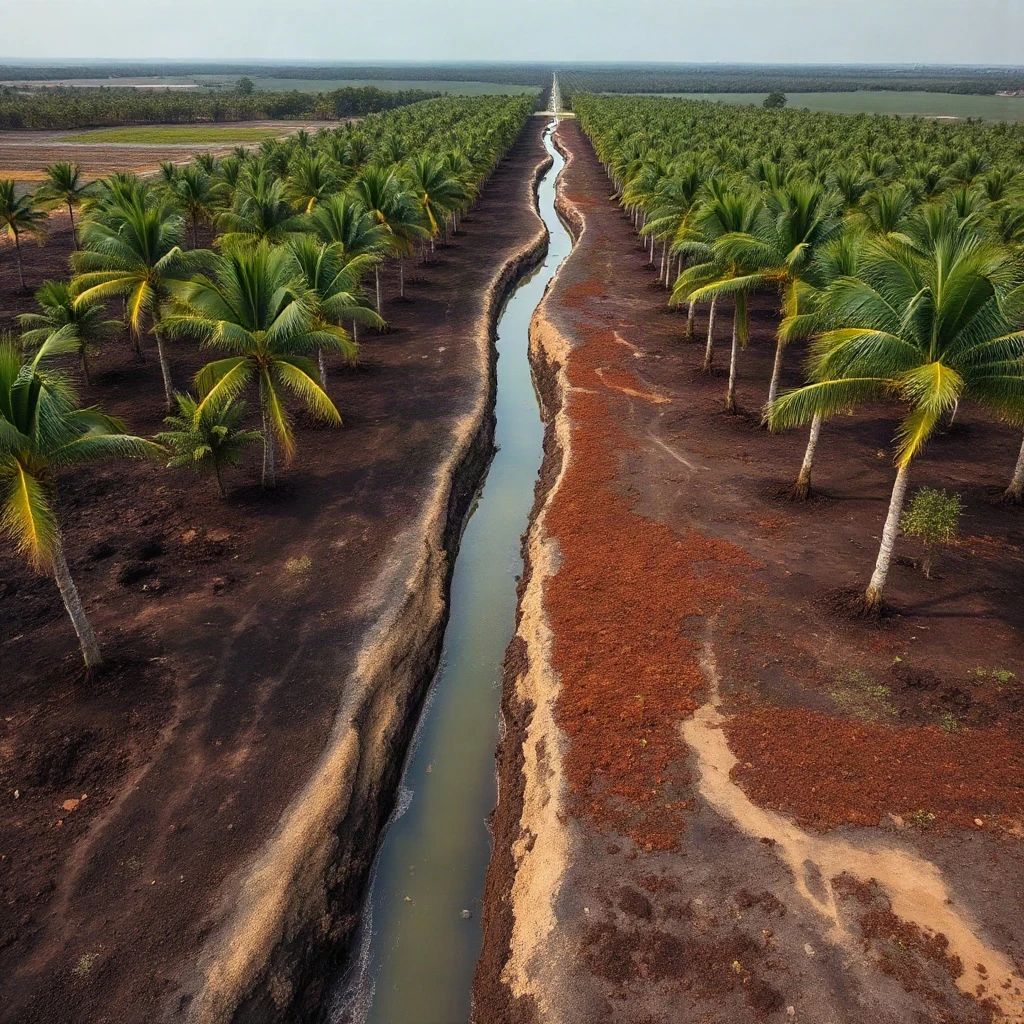
For plantation managers, refiners and buyers, the carbon question is no longer academic. It shapes land-use decisions, supply-chain policies and market access. But the science is not a single number — it splits sharply between two very different growing environments: peatland and mineral soil.
Peatland: the heavy carbon cost
Research is clearest on peat. When tropical peat forests are drained for oil palm, the peat itself begins to oxidise — a slow, steady release of carbon dioxide that continues for decades, even after the crop is established. This is not a one-off clearing debt; it is an ongoing annual emission tied to drainage depth and water management.
Beyond the carbon dioxide, drained peat is also prone to fire, which can turn a chronic emissions problem into an acute one. The evidence here is well established: peat-based oil palm carries a far heavier carbon footprint than the same crop on mineral soils. There is little scientific dispute on that direction, though the exact magnitude varies with local hydrology, drainage practices and time since conversion.
Mineral soil: a more nuanced picture
On mineral soils, the story is more contested. Early assumptions that oil palm is a net carbon sink over its life cycle have been challenged. Some studies find that the carbon lost from clearing a forest — especially a mature, high-biomass one — takes many years to be offset by the palm's growth and the carbon stored in its biomass and in the soil. Others argue that on already degraded land, oil palm can be carbon-positive within a single rotation.
What is not settled is how much carbon is lost from the soil itself under oil palm on mineral soils. Some research points to a modest decline, others to little change, and a few to gains under good management. This is where industry claims sometimes outrun the evidence — particularly the idea that oil palm is always a net carbon sink. That conclusion depends heavily on prior land use, soil type, and the time horizon chosen.
Where the evidence is still mixed
- Time horizon: short-term studies can show a sink, while longer-term accounting often flips the result.
- Prior land use: converting a degraded grassland is very different from clearing a primary forest, yet both are often lumped together in public statements.
- Management practices: fertiliser use, cover crops and mill waste treatment all shift the balance, but the data are not consistent enough to assign fixed values.
What this means practically
For producers, the immediate implication is that avoiding new peat drainage is the single most defensible carbon decision. Where peat is already in production, water-table management and fire prevention are the levers that matter most.
For refiners and buyers, the takeaway is caution. Carbon claims attached to a shipment or a certification need to specify the land-use history and the time frame. A generic 'sustainable' label does not settle the carbon question.
Finally, for anyone relying on life-cycle numbers, treat them as scenario-based, not fixed truths. The research is clear on direction — peat is bad, mineral soil is variable — but the exact numbers will keep shifting as methods improve. In the meantime, the safest carbon position is to assume that any new clearing carries a significant debt, and to weigh that against the expected yield over the full rotation. ---
*This article reflects the position as of 25 August 2026. Research moves on, and later work may revise or supersede what is described here. Please verify the current position, and any changes made after this date, before relying on it.*