
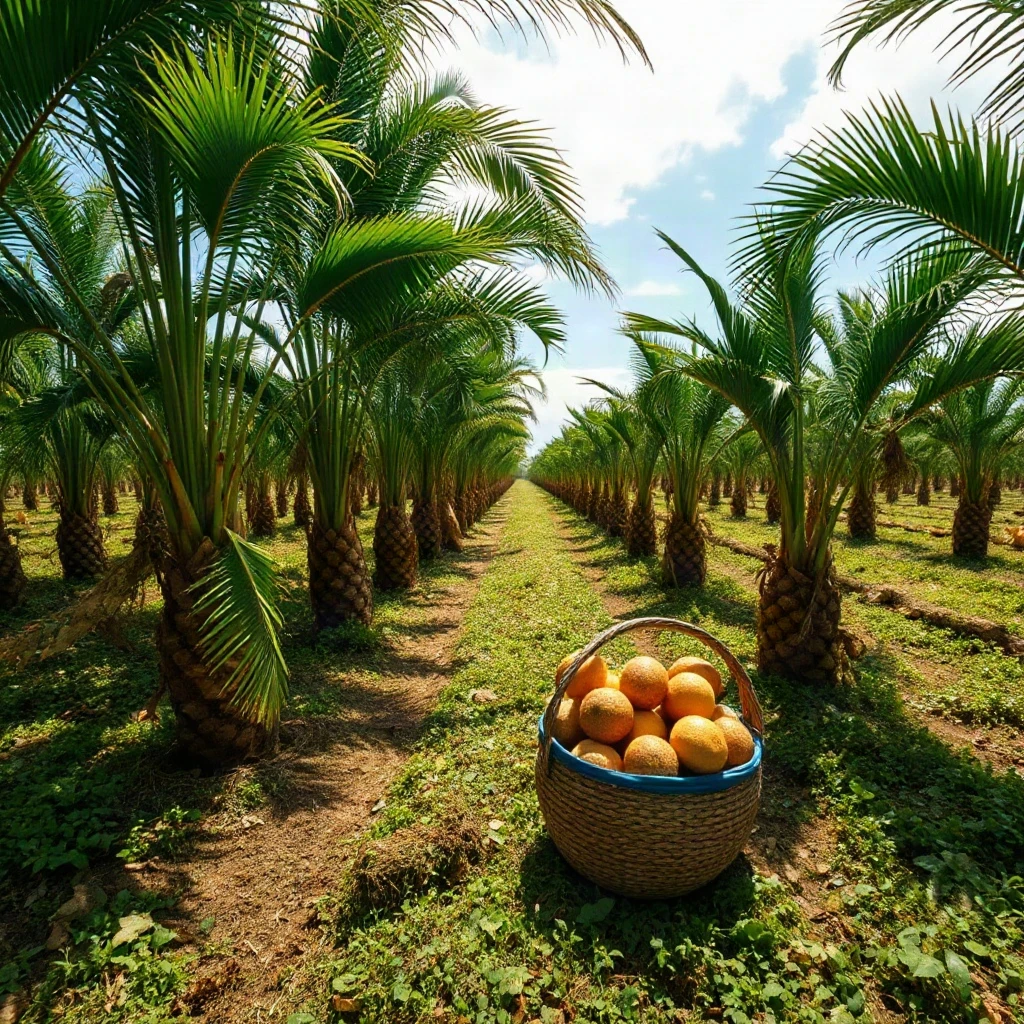
The gap between what an oil palm plot can produce under ideal trial conditions and what the average commercial field actually delivers is one of the most persistent puzzles in the industry. Growers, refiners and buyers all rely on yield forecasts, yet the gap between potential and reality is rarely explained in plain terms.
What the yield gap is
At its simplest, the yield gap is the difference between the ceiling observed in tightly managed research plantings and the average achieved across commercial estates or smallholdings. Trial plots benefit from optimal planting material, precise fertiliser timing, intensive pest control and near-perfect harvest discipline. Commercial fields operate under weather variability, labour constraints, ageing palms and uneven management.
What is well established is that the gap is real and large. Across most producing regions, average commercial yields sit well below the levels demonstrated in trials. The gap is not a single number but a range that shifts with region, palm age and management intensity.
What the evidence supports
Agronomy has a strong consensus on the main drivers of the gap. Planting material quality matters: modern selected varieties outperform unselected seed. Fertiliser and nutrient management are consistently identified as the largest controllable factor. Harvest interval and loose-fruit collection directly affect how much of the crop is actually captured. Water stress, where irrigation is absent, is a major natural constraint that no amount of management fully removes.
There is also broad agreement that part of the gap is recoverable. Closing the gap does not mean matching trial yields everywhere; it means moving the average closer to the achievable ceiling for a given environment. Most agronomists would put the recoverable portion at a meaningful share of the current shortfall, but the exact figure depends on local conditions.
Where the evidence is contested
What is less settled is how much of the gap is truly recoverable versus structural. Some industry claims imply that widespread adoption of best practice could nearly double average yields. The evidence does not fully support that. Trials are not a realistic benchmark for commercial fields; they operate under conditions that cannot be replicated at scale.
Another contested area is the role of palm age. Older plantings inevitably decline, and replanting is expensive and slow. Whether the yield gap is best closed by intensifying existing areas or by accelerating replanting remains an open debate. The evidence on the economics of each path is mixed and highly site-specific.
What it means practically
For producers, the practical takeaway is that the yield gap is not a single problem with a single fix. It is a portfolio of issues: genetics, nutrition, harvest efficiency and water. Auditing which of these is binding on a given block is more useful than chasing a generic target.
For refiners and buyers, the implication is that yield forecasts based on trial potential are optimistic. Supply models should discount for the structural gap and for the fact that recovery will be gradual. The gap also matters for sustainability claims: higher yields on existing land reduce pressure to expand into new areas, but only if the recoverable portion is actually captured.
The honest summary is that the yield gap is wide, partly recoverable, and unevenly understood. The evidence points to real gains from better agronomy, but it does not support the idea that commercial fields can routinely match trials. Treating the gap as a range, not a fixed number, is the most defensible position. ---
*This article reflects the position as of 24 August 2026. Research moves on, and later work may revise or supersede what is described here. Please verify the current position, and any changes made after this date, before relying on it.*