
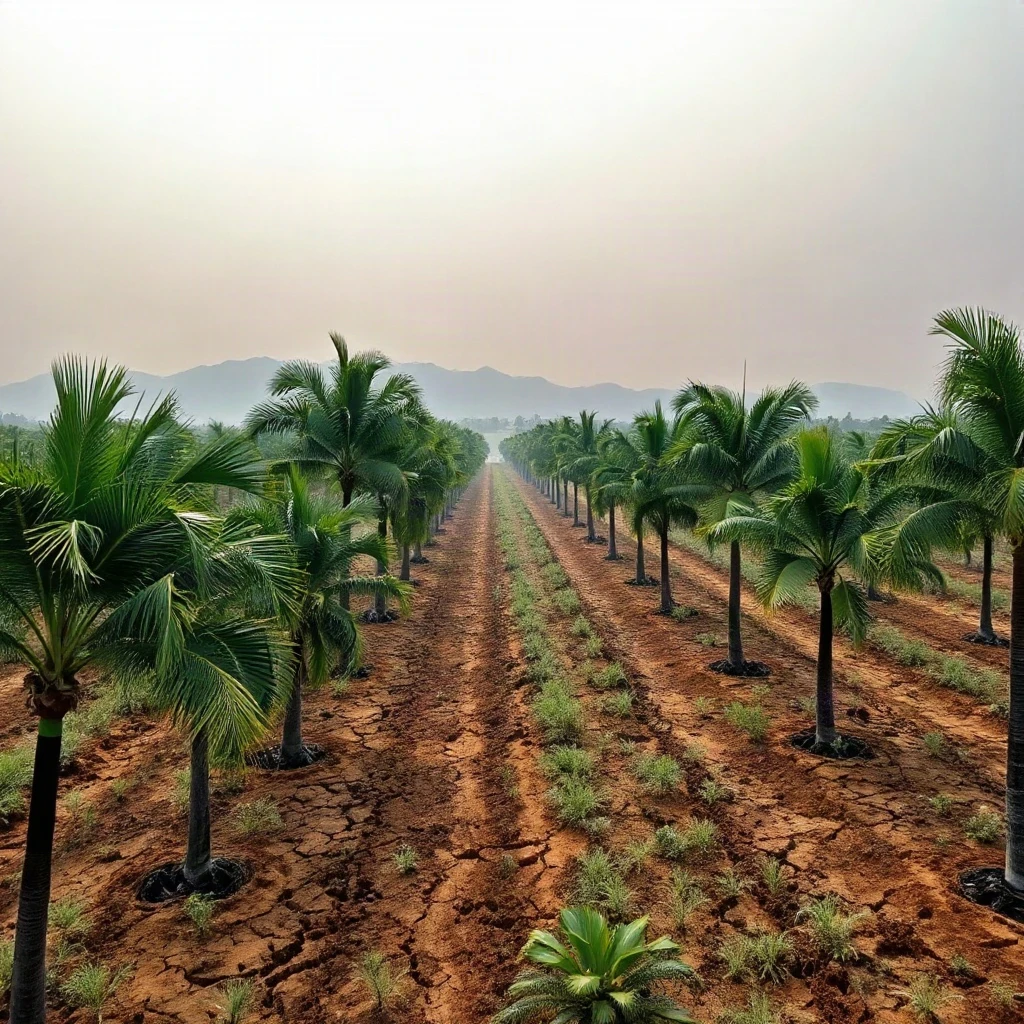
The palm oil complex is trading near the top of its 52-week range, but the weather picture across Malaysia and Indonesia remains a two-sided story. Current ENSO conditions, with an ONI of +1.4, confirm an active El Niño episode. While the strongest ocean-atmosphere coupling typically fades by late summer, the agricultural impact of El Niño is felt with a delay of six to twelve months, meaning the dry signal now is shaping output well into 2027.
Dry belts: Sarawak and Kalimantan
Seven-day rainfall forecasts show notably dry conditions across Sarawak in Malaysian Borneo and Kalimantan in Indonesian Borneo. These are core producing regions, and a lack of moisture at this stage of the fruit development cycle reduces fruit bunch weight and can lower oil extraction rates. The effect is not immediate—trees respond to water stress over several months—but the current dry spell adds to a cumulative stress footprint from the broader El Niño pattern.
Heavy rain elsewhere: a logistics risk
While Sarawak and Kalimantan are dry, other parts of the archipelago can see convective downpours typical of the season. Heavy rain does not necessarily harm the tree, but it disrupts harvesting and transport. Muddy access roads, slower collection rounds, and delays at mills all translate into temporary supply friction. That is a near-term operational issue, not a yield driver.
What the data show
Malaysia's July MPOB report points to ample supply in the near term: CPO production rose 9.4% month-on-month to 1.79 million tonnes, and closing stocks climbed 7.2% to 1.43 million tonnes. Exports were strong, up 14.5%, but imports fell sharply. Peak production season is underway, and the market is well supplied for now.
Our model outlook flags that the recent price surge—CPO up 4.6% over seven days to about $1,160/MT—has pushed technical indicators into overbought territory, with RSI at 78 and price above the upper Bollinger Band. We expect consolidation over the next seven days, with a modest pullback as profit-taking and September softness offset bullish headlines.
The bigger picture
For yields, the key variable is the lagged effect of El Niño. If dry conditions persist across Sarawak and Kalimantan into the next few months, the impact on fruit bunch weights will show up in late 2026 and early 2027. That is a longer-term supply concern. For now, the market is balancing ample current stocks and peak-season output against the prospect of a tighter post-drought period.
Traders will watch weekly rainfall data and any shift in the ENSO outlook. A transition toward neutral or La Niña conditions would typically bring wetter weather to Southeast Asia, easing drought stress but raising the risk of flooding and harvest disruptions. Either way, weather remains a pivotal swing factor for palm oil supply in the months ahead.