For procurement managers new to palm products, the oil palm is often reduced to just one output: crude palm oil. In practice, the tree is a multi-output crop where nearly every component finds a commercial use. Understanding this helps buyers identify supply opportunities and appreciate why the crop is so widely cultivated.
The Fruit: Two Oils, One Kernel
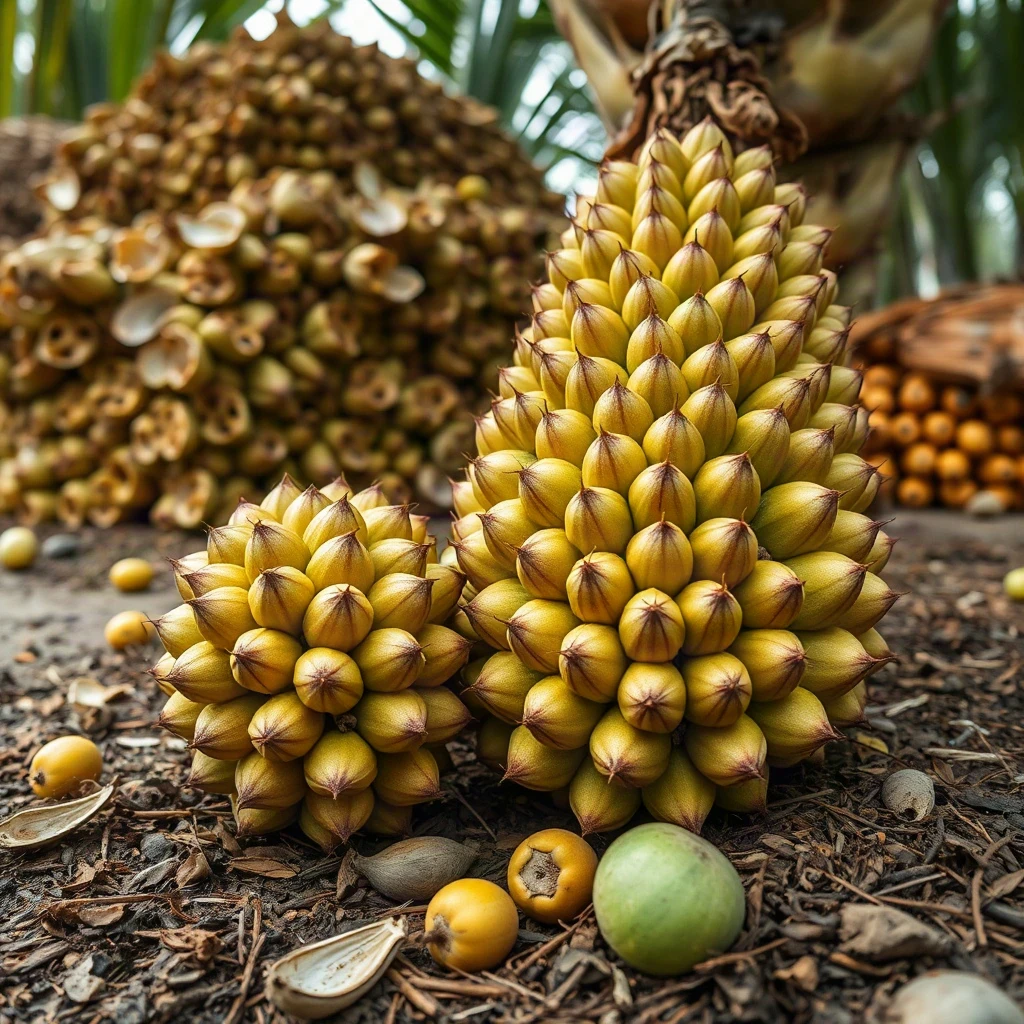
The fruit itself yields two distinct oils. The fleshy outer mesocarp produces crude palm oil (CPO), used in food, cosmetics, and biodiesel. Inside the hard kernel is palm kernel oil (PKO), with a different fatty-acid profile, prized for confectionery, margarine, and specialty fats. After pressing, the remaining kernel cake becomes a high-protein animal feed ingredient.
The Empty Fruit Bunch: Not So Empty
Once the fruit is stripped, the empty fruit bunch (EFB) remains. Rather than discarding it, many mills return EFB to plantations as mulch, returning nutrients to the soil. Some facilities also process EFB into biomass fuel, used to generate steam and electricity for the mill itself—often making mills energy self-sufficient.
The Shell and Fiber: Fuel and More
Palm kernel shells (PKS) are a hard, dry biomass with a high calorific value. They are increasingly traded as a renewable fuel for industrial boilers, particularly in Japan and South Korea. The mesocarp fiber, left after oil extraction, is also burned for energy, with the ash sometimes used as a potassium-rich fertilizer.
Trunk and Fronds: Slow-Release Value
When a palm is replanted after a 25- to 30-year cycle, the felled trunk yields a large volume of wood. Though soft and moist, it can be processed into plywood, furniture boards, or further into pulp and paper. Fronds, pruned regularly, are a source of fodder for livestock and also act as ground cover to prevent erosion.
Mill Effluent: A Resource, Not a Waste
Palm oil mill effluent (POME)—the liquid waste from processing—is rich in organic matter. Treated properly, it can be captured for biogas, reducing methane emissions, and the treated water is often reused for irrigation or land application. This closes the loop on the mill's water cycle.
What Buyers Should Note
- Specifications matter: Each by-product has its own quality parameters (moisture, oil content, fiber length) that affect its suitability.
- Logistics differ: PKS and EFB have different bulk densities and handling needs.
- Sustainability claims: Many buyers now ask for proof that by-products are managed responsibly, as this reflects on their own supply-chain footprint.
In short, the oil palm is a model of circular use. For buyers, this means a broader palette of raw materials—and a chance to align procurement with waste-reduction goals.