
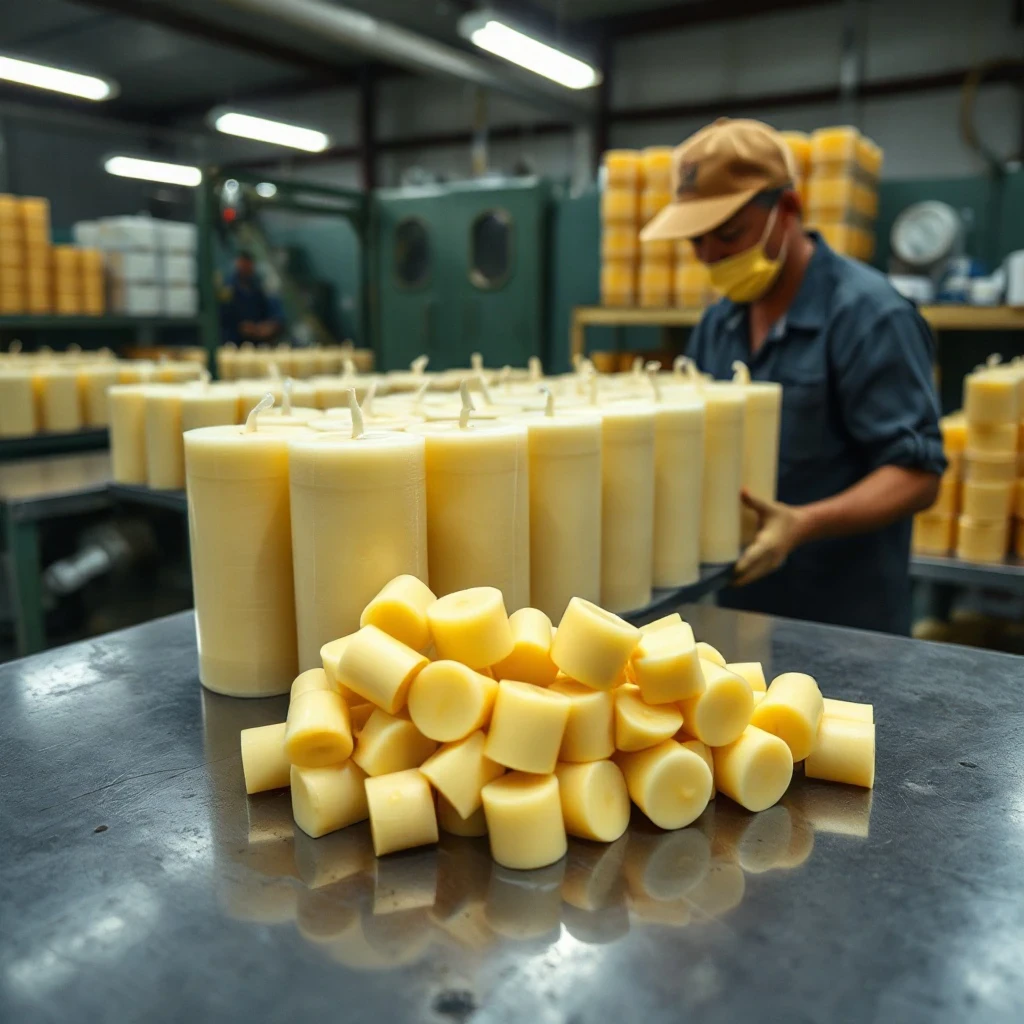
Palm wax is a fully hydrogenated palm oil product, distinct from the semi-solid palm stearin used in food. Through complete hydrogenation, the oil's unsaturated fatty acids are saturated, yielding a hard, brittle, high-melting-point fat. This base material is then fractionated or blended to achieve specific melting profiles, typically between 55°C and 62°C, which is the key to its candle-making utility.
How palm wax is processed
The production route begins with refined, bleached, and deodorized palm oil. Full hydrogenation converts the oil into a fully saturated fat with an iodine value near zero. The resulting hard fat is then processed through one of two main paths: either it is gently fractionated to isolate a higher-melting stearin fraction, or it is blended with softer oils and additives. The final wax is often formed into flakes, pastilles, or slabs for ease of handling.
For candle use, the wax is typically blended with a small percentage of additives—such as stearic acid or a polymer—to improve fragrance retention, mold release, and burn characteristics. The melting point is tuned by blending with softer fractions or with vegetable oils like coconut or soy, allowing manufacturers to produce container candles, pillar candles, or tealights from the same base material.
Why it matters commercially
Palm wax is prized for its hardness and high melting point, which give candles excellent dimensional stability in warm climates. It burns with a bright, steady flame and has a neutral scent profile, making it a strong carrier for fragrance oils. Compared to paraffin, palm wax is renewable and biodegradable, which appeals to buyers under pressure to meet sustainability targets. It is also typically less expensive than soy wax on a per-kilogram basis, though price varies with crude palm oil markets.
A key commercial advantage is its compatibility with existing candle-making equipment. Most paraffin or soy wax production lines can run palm wax with minimal adjustment, reducing switching costs for manufacturers. However, palm wax has a tendency to bloom—a white, powdery surface deposit—which some buyers may find undesirable. This can be mitigated with proper cooling rates and additives, but it remains a specification point.
What to look for when sourcing
When evaluating palm wax suppliers, focus on the melting point specification and the iodine value, as these determine performance. Ask for a certificate of analysis showing the drop point, penetration hardness, and color (typically a low Gardner number). Confirm the wax's origin and certification under the Roundtable on Sustainable Palm Oil (RSPO) or equivalent schemes, as this is increasingly a non-negotiable procurement requirement.
Check the wax's oil content—excess oil can cause smoking or poor fragrance throw. Request a small trial batch to test burn characteristics, including flame height, soot production, and fragrance release, under your specific wick and container conditions. Finally, verify the supplier's consistency across batches; palm wax can vary seasonally with crude palm oil quality, so a stable supply agreement with clear tolerances is essential for industrial buyers.