
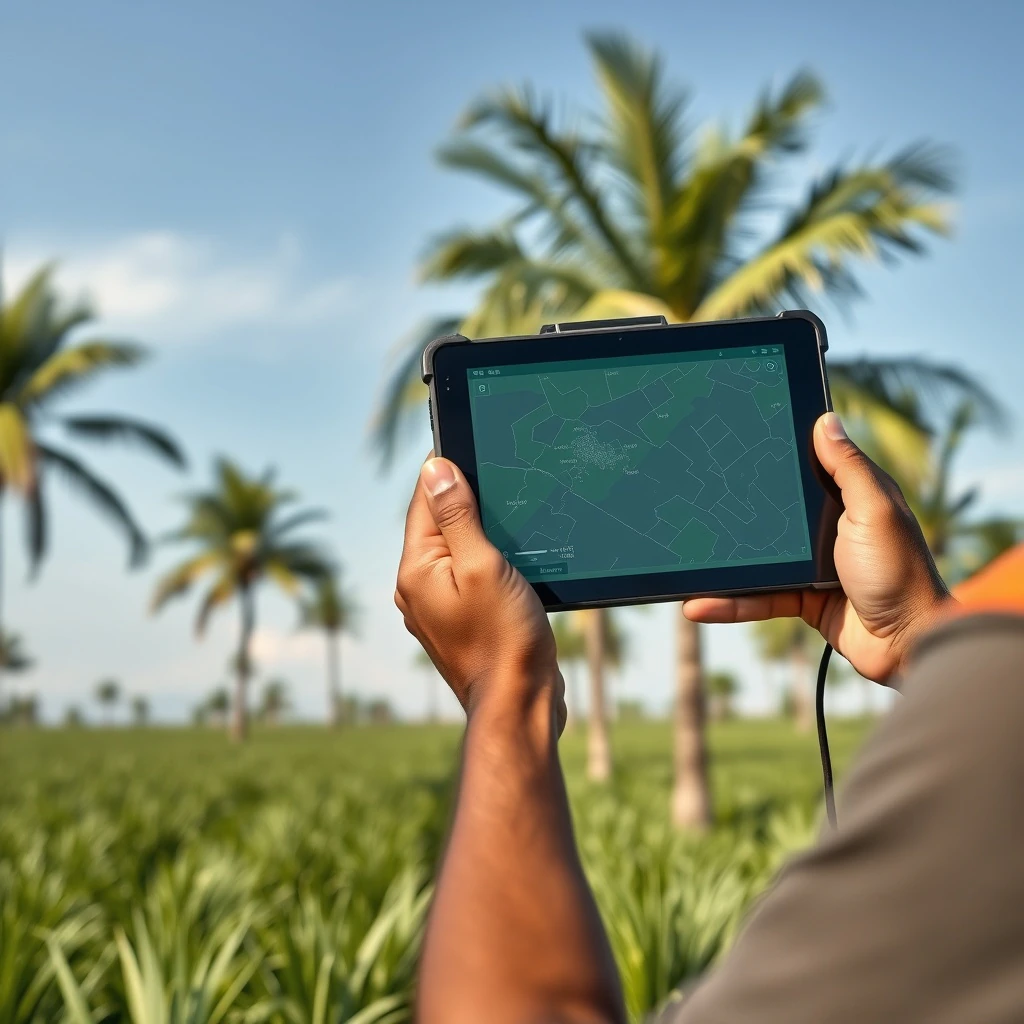
The European Union Deforestation Regulation (EUDR) requires that any palm oil, palm kernel oil, or derivative placed on the EU market be deforestation-free. To demonstrate this, suppliers must provide a specific set of geolocation and traceability data for every plot of land where the oil palm fruit was grown.
Geolocation Coordinates
For every production plot, the supplier must submit the geolocation polygon – a set of latitude/longitude coordinates that trace the boundary of the farm or plantation. If the plot is smaller than four hectares, a single point coordinate (latitude and longitude with a minimum of six decimal places) is acceptable. These coordinates must be precise enough to identify the exact land parcel.
For smallholders, who often lack GPS equipment, the regulation allows the use of public satellite imagery or government land-registry data to define the plot boundaries, provided the data is verifiable.
Supply-Chain Traceability
Beyond geolocation, the EUDR requires a chain-of-custody document that links each batch of palm product back to the specific plots where the fruit was harvested. This means suppliers must record:
- The name and contact details of the producer (whether a plantation company, smallholder cooperative, or intermediary).
- The volume of fresh fruit bunches (FFB) harvested from each plot.
- The date or harvest period for those FFB.
- The mill that processed the fruit, including its geolocation.
- All subsequent handling points – refineries, traders, storage facilities – up to the point of import into the EU.
Each link in the chain must be documented with a unique identifier (such as a lot number or barcode) so that an auditor can trace a shipment back to the origin plot.
Due Diligence Statement
The importer or operator placing the product on the EU market must submit a due diligence statement to the EU member state’s competent authority. This statement includes the geolocation data and a declaration that the product complies with the deforestation-free requirement. The statement must be supported by the underlying traceability records.
Practical Implications for Buyers
For procurement managers, this means that any palm product sourced from or destined for the EU must come with a traceability dossier. When evaluating new suppliers, buyers should request:
- A sample of the geolocation polygons for a few representative plots.
- A copy of the chain-of-custody documentation for a recent shipment.
- Confirmation that the supplier’s smallholder base has been mapped and the data stored in a verifiable format.
Suppliers who cannot provide this data may be unable to ship to the EU market after the regulation’s enforcement date. Buyers should also note that the data must be kept for at least five years and be available for inspection by EU authorities.
Data Management Systems
Most large palm-oil groups already use geographic information systems (GIS) and enterprise resource planning (ERP) software to manage this data. For smaller suppliers, third-party platforms that aggregate smallholder polygons and link them to mill receipts are becoming common. The key is that the data must be machine-readable (e.g., CSV, GeoJSON) and verifiable – not just a paper certificate.
In summary, EUDR compliance hinges on providing precise geolocation coordinates for every production plot and a complete, auditable chain-of-custody from farm to EU border. Buyers should treat this data as a standard part of their procurement documentation.