
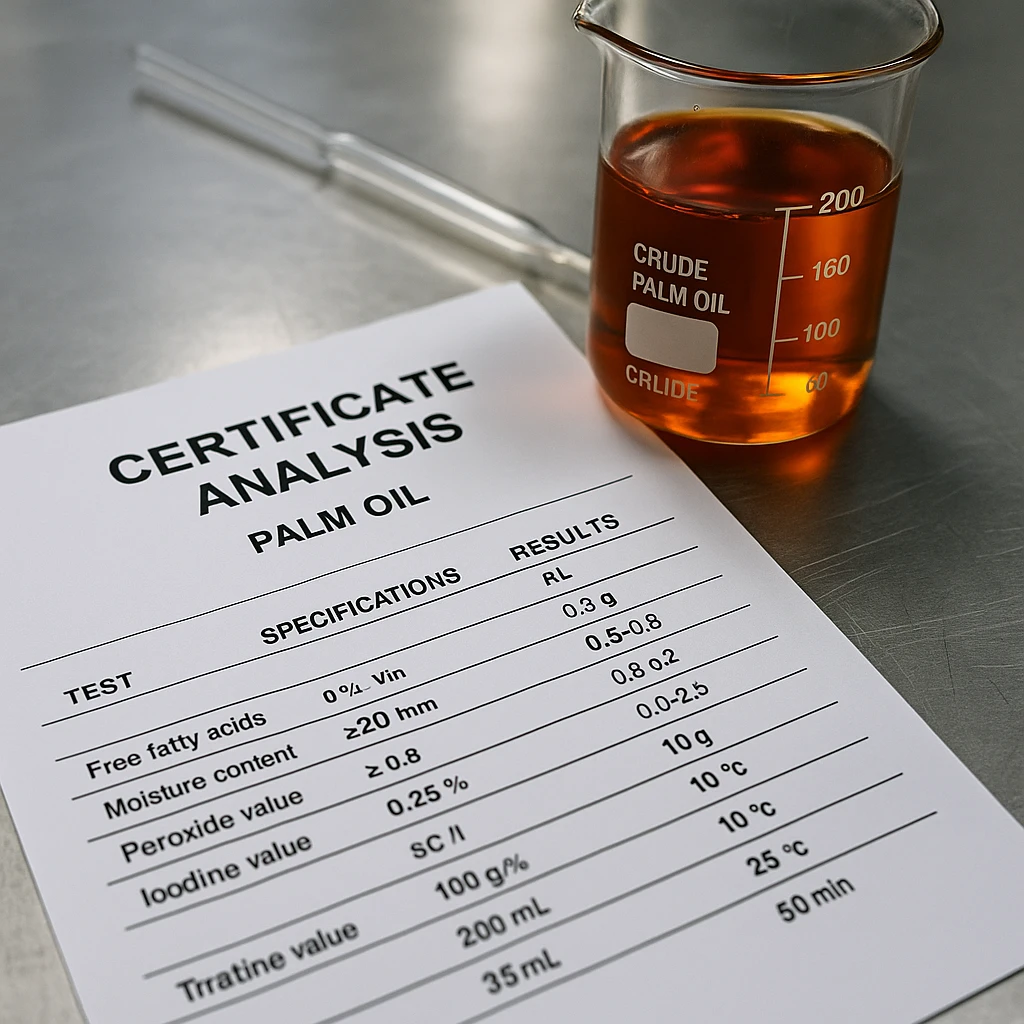
A Certificate of Analysis (CoA) is the standard document accompanying every shipment of crude palm oil (CPO) and its derivatives. For procurement managers and first-time buyers, three parameters dominate the report: free fatty acid (FFA), iodine value (IV), and moisture and impurities (M&I). Understanding what each measures—and why it matters—is essential for confirming product quality and contract compliance.
Free Fatty Acid (FFA)
FFA indicates the degree of hydrolysis in the oil. During harvesting, handling or storage, the enzyme lipase can break triglycerides into free fatty acids and glycerol. Higher FFA means more oil has degraded, reducing yield for downstream refiners.
- CPO typically ships with FFA of about 3–5% (as palmitic acid).
- Refined, bleached and deodorised palm oil (RBDPO) must have FFA below 0.1%.
- FFA is expressed as a percentage of the oil weight. A high FFA in crude oil signals poor field or mill practices.
For buyers, FFA directly affects the refining loss and final product cost. Contracts usually specify a maximum FFA; exceeding that can trigger a price discount or rejection.
Iodine Value (IV)
IV measures the degree of unsaturation in the oil—the number of carbon–carbon double bonds. It is determined by the amount of iodine absorbed by a fixed weight of oil. Higher IV means more unsaturated (softer) oil; lower IV means more saturated (harder) oil.
- CPO IV typically ranges from about 50 to 55.
- Palm olein (liquid fraction) has IV around 56–60; palm stearin (solid fraction) is roughly 30–45.
- IV is a key specification for fractionation and blending. A buyer expecting a specific IV for a food application must verify the CoA value.
IV is not a quality defect but a compositional identity. Mismatched IV can cause processing issues or product failure.
Moisture and Impurities (M&I)
M&I groups two contaminants that affect oil stability and storage life.
- Moisture: Water in the oil promotes hydrolysis and microbial growth. Maximum allowable moisture in CPO is typically 0.2%.
- Impurities: Solid particles (dirt, fibre, meal) that settle during storage. Maximum impurities in CPO is usually 0.1%.
High M&I can lead to increased refining losses, off-flavours and shorter shelf life. The combined total (moisture + impurities) is often capped at 0.5% in CPO trade contracts.
Reading the CoA
A typical CoA lists each parameter with the test method (e.g., AOCS, ISO), the result, and the specification range. Buyers should check: - FFA against contract limit. - IV against the agreed fraction or grade. - M&I against maximum tolerance.
Any deviation should be flagged immediately. The CoA is the legal record of quality at the time of shipment; it protects both buyer and seller when disputes arise.
For first-time buyers, the CoA is not a formality—it is the first line of quality assurance. Learning to read it correctly prevents costly surprises at the refinery or factory gate.