
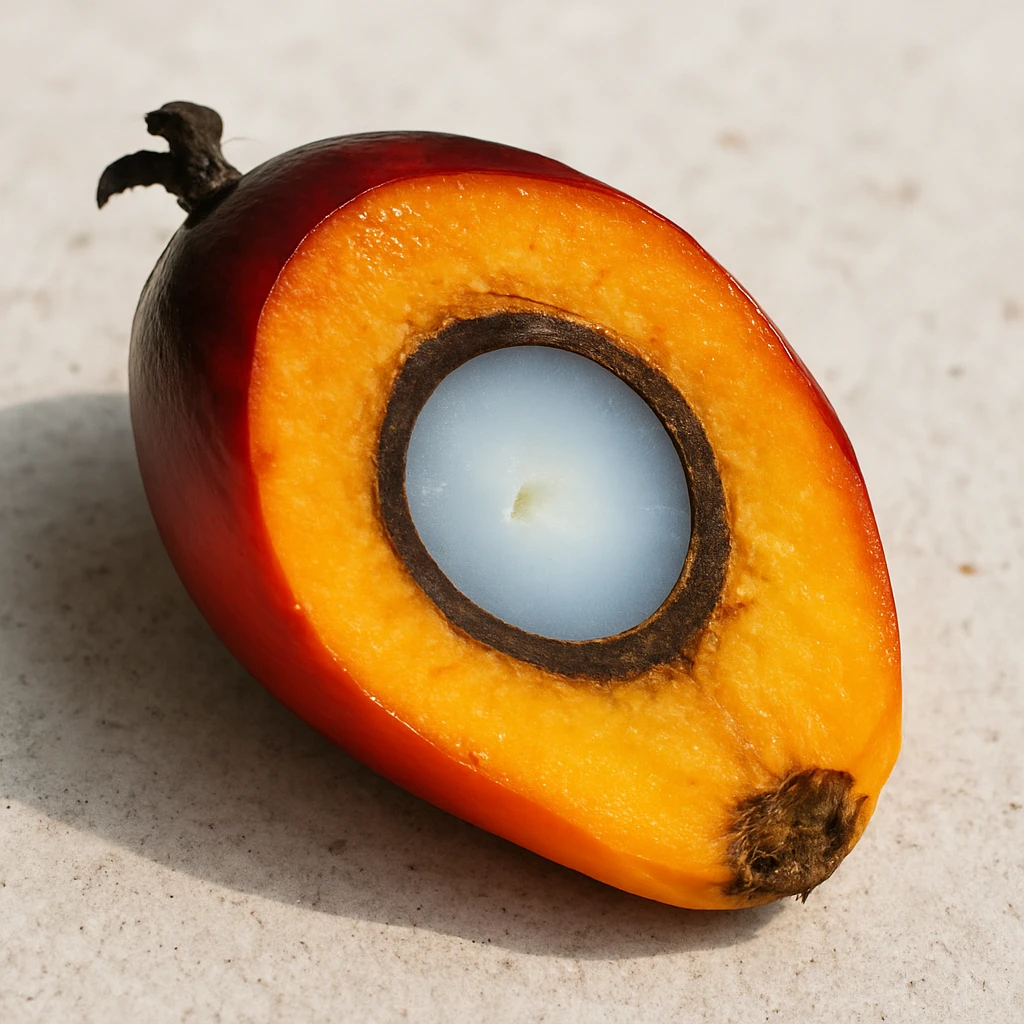
The oil palm fruit is a drupe, similar in structure to a peach or olive. Each fruit consists of an outer skin (exocarp), a fleshy middle layer (mesocarp), and a hard inner shell (endocarp) that protects a single kernel. This single fruit yields two distinct commercial oils: crude palm oil (CPO) from the mesocarp and palm kernel oil (PKO) from the kernel.
The Two Oils: Origin and Extraction
Crude palm oil is extracted from the fibrous, oily mesocarp. At the mill, fresh fruit bunches are sterilized, stripped, and digested. The mesocarp is then pressed to release CPO. This oil is semi-solid at room temperature, rich in palmitic acid, and contains high levels of carotenoids (giving it a reddish color) and vitamin E.
Palm kernel oil comes from the kernel inside the hard shell. After CPO extraction, the nuts are cracked to separate the kernel. The kernels are dried and then pressed or solvent-extracted to yield PKO. PKO is a white, lauric oil, similar in composition to coconut oil. It is high in saturated fats, particularly lauric acid, and is solid at room temperature.
Key Differences in Composition and Use
The two oils have very different fatty acid profiles. CPO is roughly balanced between saturated and unsaturated fats, with palmitic acid as the dominant saturated fatty acid. PKO is about 80% saturated, with lauric acid making up nearly half of its content. This difference drives their distinct applications.
- Crude Palm Oil (CPO): After refining, it becomes RBD palm oil. It is used widely in cooking oils, margarines, shortenings, and frying fats. Its semi-solid consistency makes it ideal for bakery products and confectionery. It is also a feedstock for biodiesel and oleochemicals.
- Palm Kernel Oil (PKO): Its high lauric acid content gives it excellent foaming and lathering properties. PKO is primarily used in the production of soaps, detergents, shampoos, and personal care items. It is also used in confectionery fats, such as cocoa butter substitutes, and in specialty fats for ice cream and non-dairy creamers.
Processing and Refining
Both oils require refining to remove impurities, free fatty acids, color, and odor. The refining process for CPO typically involves degumming, bleaching, and deodorization. PKO often undergoes fractionation to separate solid (stearin) and liquid (olein) fractions, tailoring its melting point for specific industrial uses.
Market Implications for Buyers
For procurement managers, understanding the distinction is critical. CPO and PKO are not interchangeable in most formulations. CPO is the dominant volume oil, traded on global commodity exchanges. PKO is a specialty oil with a higher price typically, driven by its use in the personal care and specialty fats sectors. Buyers should specify which oil they require, as the two products serve entirely different markets despite coming from the same fruit.