
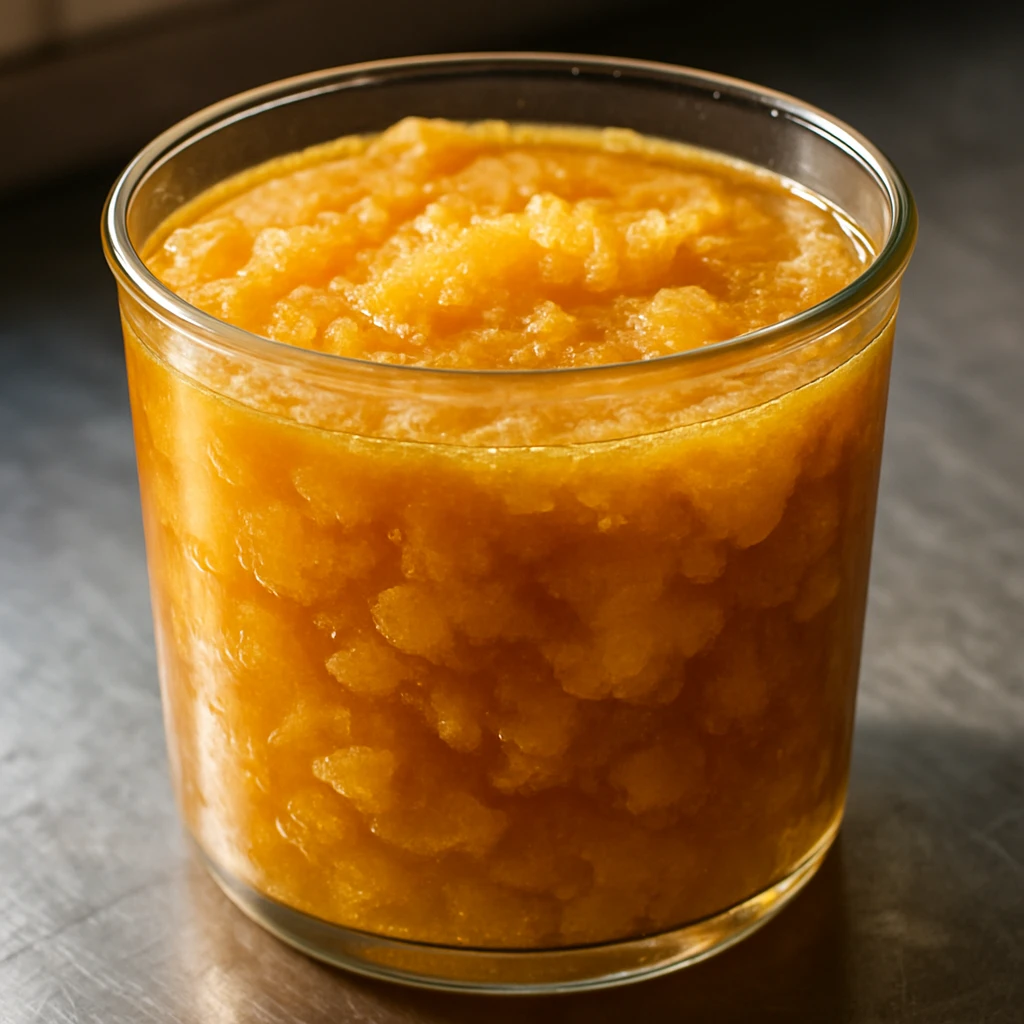
The Chemical Basis of Consistency
Palm oil’s semi-solid state at room temperature (typically 20–25°C) is a direct consequence of its fatty-acid composition. Unlike liquid vegetable oils such as soybean or sunflower, palm oil contains roughly equal proportions of saturated and unsaturated fatty acids.
About 50% of the fatty acids in palm oil are saturated—predominantly palmitic acid (C16:0) and smaller amounts of stearic acid (C18:0). The remaining 50% are unsaturated: oleic acid (a monounsaturated fat) and linoleic acid (a polyunsaturated fat).
Saturated fatty acids have straight molecular chains that pack tightly together, raising the melting point. Unsaturated fatty acids, with their double bonds, create kinks that prevent tight packing and lower the melting point. The balance between these two groups determines whether an oil remains liquid, semi-solid, or fully solid at room temperature.
The Role of Triglycerides
Palm oil is composed of triglycerides—three fatty acids attached to a glycerol backbone. The specific arrangement of saturated and unsaturated fatty acids on the glycerol molecule influences the oil’s melting behaviour.
In palm oil, the dominant triglyceride is POP (palmitic-oleic-palmitic), which has a melting point around 30–35°C. This means that at typical ambient temperatures in tropical regions (28–32°C), palm oil appears liquid or very soft, while in cooler climates it solidifies into a semi-solid fat.
Crude palm oil (CPO) has a melting range of roughly 33–39°C. Refined, bleached, and deodorised palm oil (RBDPO) has a slightly narrower range, typically 33–37°C, depending on the degree of fractionation.
Practical Implications for Buyers
For procurement managers and first-time buyers, the semi-solid nature of palm oil affects handling, storage, and application.
- Storage temperature: Palm oil must be stored above its melting point (typically 35–40°C) to remain pumpable. Below this, it solidifies and can clog pipes and tanks.
- Fractionation: The oil can be separated into liquid olein (used for cooking oils) and solid stearin (used for margarine and shortenings) through controlled cooling and crystallisation. This is a standard industrial process, not a defect.
- Transport: Bulk shipments are usually kept heated to maintain liquidity. Buyers should verify that their receiving facilities have adequate heating and agitation systems.
- Appearance variation: A semi-solid oil may appear cloudy or grainy at certain temperatures. This is a physical property, not a sign of spoilage or contamination.
Comparison with Other Oils
Palm oil’s semi-solidity is similar to that of butter or coconut oil, both of which are high in saturated fats. In contrast, oils like rapeseed or sunflower remain liquid at room temperature due to their higher unsaturated fat content. This distinction is important for buyers selecting oils for specific food or industrial applications where solid fat content (SFC) matters.
Conclusion
Palm oil’s semi-solid state is a predictable, well-understood property rooted in its fatty-acid chemistry and triglyceride structure. For buyers, recognising this characteristic helps in planning storage logistics, selecting the right fraction for end-use, and avoiding confusion over physical appearance. It is not a quality issue but a defining feature of the commodity.