
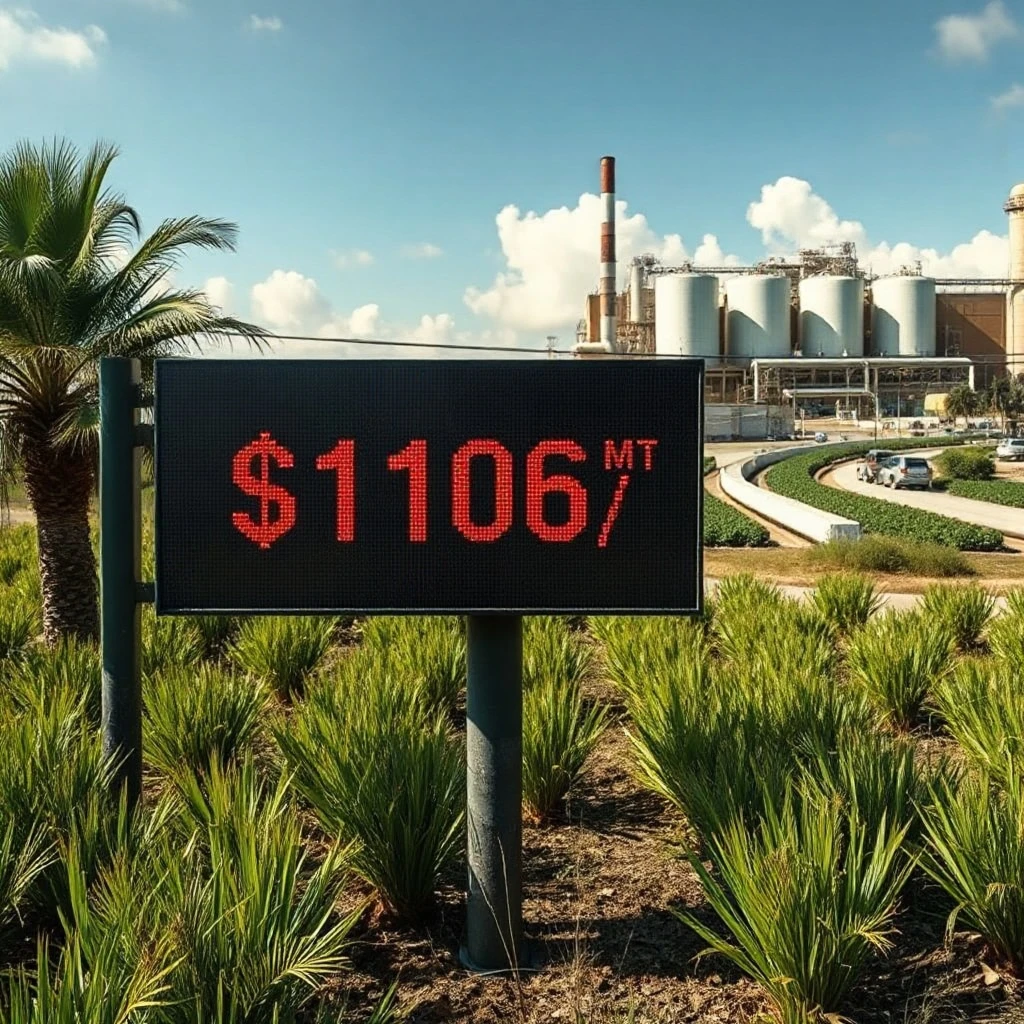
Malaysian CPO benchmark is trading at about $1,106/MT, up 0.1% from the previous session, or RM4,520/MT. The World Bank palm oil benchmark is about $1,101/MT and Indonesia's Kemendag reference is about $1,030/MT. Brent crude is about $89/bbl, down 0.1% on the day, and USD/MYR is about 4.09. CPO has been consolidating after the recent crude-driven push above RM4,750/MT. Our model outlook sees CPO consolidating near $1,106/MT with a mild upward bias; it expects choppy rangebound trade and a modest net gain of about 0.1% over the next seven sessions, with low confidence because of a stale anchor and missing key export data.
What is pushing palm oil up
Brent crude rally: Brent has gained about 6% over the past seven days to around $88.6/bbl, and CPO futures already rallied above RM4,750/MT on the stronger crude move. Higher Brent raises diesel and biodiesel margins, which improves the economics of blending palm-based biodiesel and increases feedstock demand for palm oil. The wide BOPO spread does similar work on the demand side: soybean oil at $1,581/MT versus CPO at $1,106/MT leaves palm at a $475/MT discount, a large enough gap to encourage substitution toward palm in price-sensitive food and industrial uses. El Niño is strengthening, with ONI at +1.4°C MJJ, and dry conditions are showing up in Sumatra/Riau and Kalimantan. Because El Niño affects yields with a 6-12 month lag, the anticipation is bullish and MPOB preview headlines flag a surging probability of a strong event. Indonesia's B50 biodiesel mandate has been in force since 1 July 2026, raising the blend from B40 to B50. The move is estimated to absorb 3-4 million tonnes per year of new demand, making it the largest single demand variable for palm feedstock. Black Sea supply risk adds another bullish layer: Russia is targeting Ukraine land export routes, and elevated edible-oil prices support the broader veg-oil complex because disruption to sunflower and rapeseed flows pushes buyers toward palm.
What is pushing palm oil down
MPOB July stock build: Malaysia's closing stocks rose 7.2% month-on-month to 1,429,316 tonnes, a five-month high. Production increased 9.4% MoM to 1,792,979 tonnes, and the resulting stocks-to-use ratio of 12.5% is above the 12% bearish threshold. Even though July exports rose 14.5% MoM to 1,392,178 tonnes, the market is taking the stock build as evidence that supply is currently ample. Seasonality reinforces that pressure: Malaysia's production seasonal path is +7.0% one month ahead, and August-October is normally the peak output window. July output is already about 4% above the five-year average, so further seasonal gains are likely to keep a lid on rallies.
Which side has the upper hand
The balance of our model's factors is five bullish against two bearish, so the upside currently has the upper hand. But that does not translate into a strong breakout: ample July stocks and peak-production seasonality are capping the move, leaving the market choppy and rangebound. Among the neutral factors, technicals are mixed: MACD is positive and the 5/20 SMA golden cross is supportive, but RSI is 51 and CFTC soyoil managed money is net long 80,922 contracts at the 80th percentile, which is vulnerable to long-liquidation. India's edible-oil import signals are mixed: July imports fell 7-8% year-on-year but hit a 10-month high in one report, and the Diwali buying window is still about 36 days away. Indonesia's export policy remains a swing risk: the Kemendag reference price of $1,030/MT is 73 days old, and the current policy burden is high at $129 levy plus $148 export duty, with near-term changes unconfirmed. A change there could alter export competitiveness quickly.
For the balance to shift bearish, the bearish factors would need to strengthen materially: a faster-than-expected August-October production build that pushes stocks-to-use further above 12%, or a break in Brent that narrows the BOPO spread and weakens biodiesel demand. A policy change that increases Indonesian export supply, such as lower levies or duties, could also flip the balance. Conversely, confirmation of a strong El Niño yield hit or further Black Sea supply disruption would extend the upside. Our model outlook's published path is +0.1% over seven sessions.