
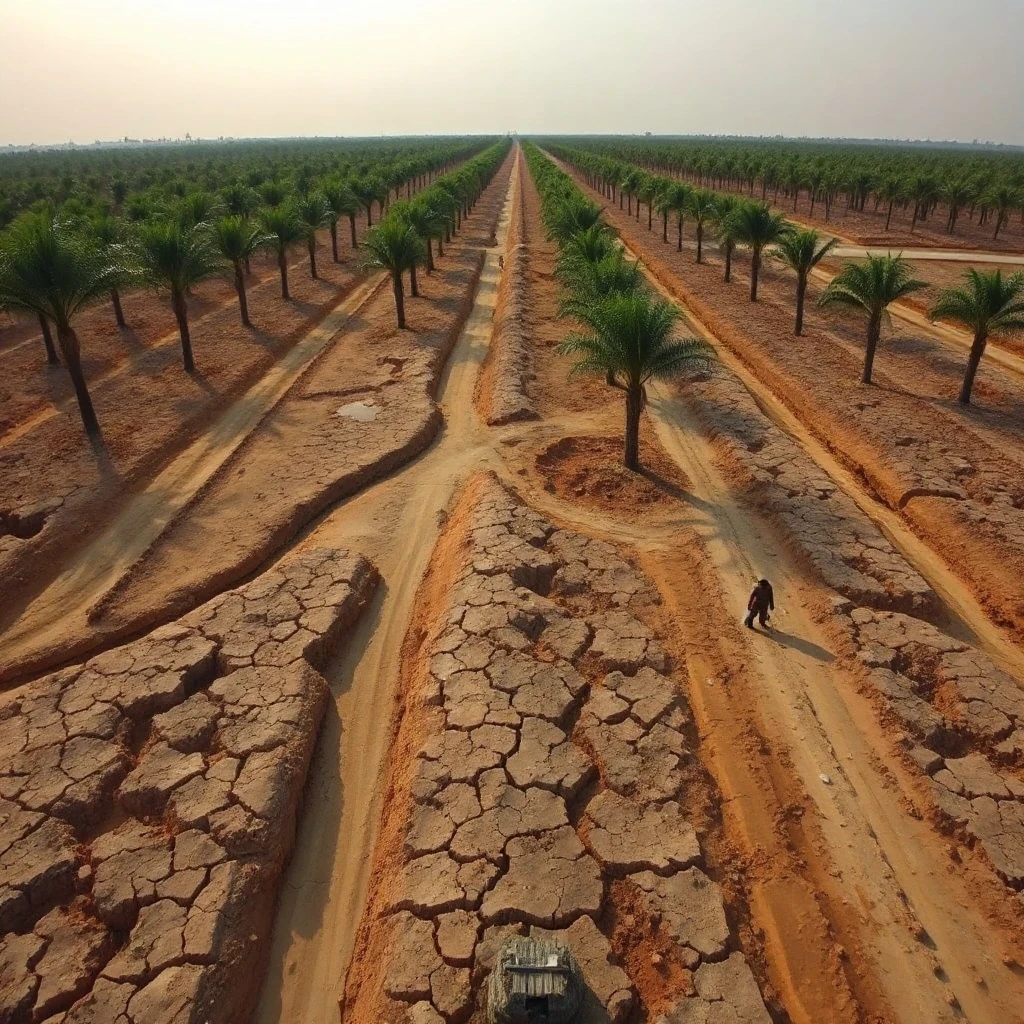
The palm oil market enters the week with the ENSO state firmly in El Niño territory, the Oceanic Niño Index at +1.4. That signal matters less for today's harvest than for what it implies about fruit development over the coming months, but the immediate weather picture is already complicated by a split across the two main producing countries.
Dry belts, wet logistics
In Malaysia, Sarawak stands out as notably dry, a condition that typically trims fruit bunch weight with a lag of six to twelve months. Growers there may be dealing with smaller bunches well into the next crop cycle even if rains return soon. The same applies to Kalimantan in Indonesia, where dry soils during the current El Niño phase can suppress flowering and fruit set for the mid-2027 crop.
At the same time, heavy recent rainfall across parts of the region is not a straightforward positive. Wet weather disrupts harvesting and transport now, slowing the flow of fresh fruit bunches to mills and adding to logistical friction at a time when peak production season is already testing infrastructure. The net effect is a market that must weigh the prospect of weaker future yields against immediate supply chain delays.
Production data still firm
Malaysian official data for June showed CPO production at 1,638,777 tonnes, up 8.1% month-on-month, with closing stocks at 1,332,697 tonnes, a 3.7% rise. Exports climbed 7.2% to 1,215,850 tonnes, while imports surged 135.3% to 103,113 tonnes, a sign that local supply is being supplemented from abroad. The FFB reference price eased 1.3% to RM 48.90.
Those figures reflect conditions before the latest weather stress fully materialized. The July report, due soon, is expected by many participants to be bullish, which has helped underpin prices at the benchmark level of about $1102 per tonne, down just 0.2% on the session.
What the next seven days look like
Our model outlook, anchored on that $1102 price, is now three days stale. Given the strengthening El Niño, recent heavy rains, anticipation of a supportive July MPOB report, and a favorable biodiesel blend spread, CPO likely edged up slightly since the anchor and may continue modest gains over the next week. We see a gradual uptrend of about 1% from the anchor as the base case.
That optimism is tempered by real constraints. Peak production season means supply is still rising, a sharp decline in Brent crude to around $84 per barrel weakens biodiesel demand economics, and the market remains vulnerable to long liquidation. Confidence in the near-term path is low, largely due to missing data and the stale price anchor.
For the broader crop outlook, the key variable is whether El Niño fades quickly or persists. A transition toward La Niña would typically bring wetter conditions to Southeast Asia, easing drought stress in Sarawak and Kalimantan but raising the risk of excessive rain and flooding in the months ahead. For now, the region is caught between dry soils that will curb future yields and wet weather that is slowing today's harvest.